Xiongan a product of necessity, not whim
 |
|
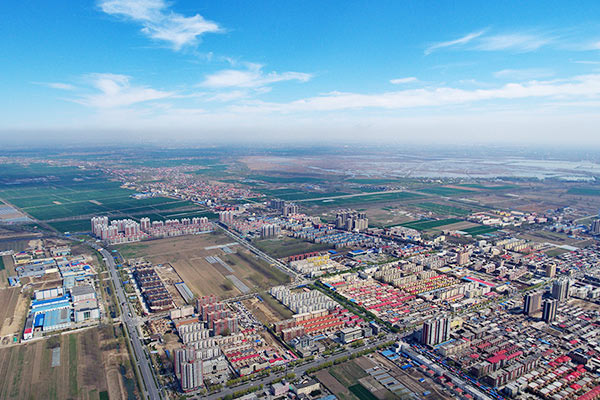
Aerial photo taken on April 1, 2017 shows Anxin county, North China's Hebei province.[Photo/Xinhua] |
Perhaps because China is a large country, or its imbalanced economic development could give rise to unexpected contradictions, the country's leadership has decided to build a cluster of modern cities in northern China. One such cluster is Xiongan New Area, which will cover 100 square kilometers initially, and expand to 200 sq km in the mid term and 2,000 sq km in the long term.
The question such a major policy decision invites is: Why a development program that entails mammoth input of resources from across the country and will take many years to accomplish has been proposed now and why has an area in North China's Hebei province been chosen as the location? Some media outlets, with little knowledge of the issue, have assumed the decision was made on a whim.
The idea of Xiongan is in keeping with the shared belief of the Communist Party of China's leaders in "concentrating resources and achieving big undertakings". But the most important reason for Xiongan is the grand trend of China's socio-economic development.
Beijing, as the national capital, is no longer able to bear its burdens, with local residents complaining about disorder, crowding and pollution. There also have been discussions on whether China should move its capital elsewhere. Setting up a new cluster of cities near Beijing (Xiongan is about 100 km southwest of Beijing) is the way the pressure on the capital can be reduced, as it can help relieve it of some of its non-capital functions, rid it of the increasingly serious urban maladies, and preserve its character.
Another important reason for Xiongan is to remedy the imbalance in social development and historical confusion in the establishment of administrative regions. Those with even a rudimentary knowledge about China know there is not only an evident development gap between the country's inland regions and coastal areas (or east and west), but also a widening gulf between the northern and southern parts.
Dividing the mainland along the Yangtze River into southern and northern regions, we can see that an economically strong south and weak north have developed. The northern region's weakness is not only in terms of GDP, but also in the structure and quality of its economy. And there are many reasons for that.
To begin with, the convoluted administrative relations have fettered the development endeavors of Beijing, Tianjin and Hebei province and created systematic barriers for future development programs. As China's capital during the imperial era, Beijing functioned as a unified administrative unit with thriving clusters on its periphery. For centuries, such an administrative region, called zhili (under the direct jurisdiction of the central government), played a pivotal role as China's economic and political hub.
By developing Xiongan New Area, the government aims to give back to Beijing some of its old characteristics, in order to resolve the south-north development gap in an efficient manner.
This way, Beijing, Tianjin and Hebei will rid themselves of the longstanding fetters of red tape and be integrated into an organic whole. Cooperation and harmony will thus become the main theme of development. From the perspective of facilitating the rise of northern China, Xiongan is likely to become a new pinnacle of reform, and could even become a new model for urban development.
The author is a research scholar with the China Foundation for International and Strategic Studies.
Source: chinausfocus.com