Peacekeeping is cost effective, but must adapt to new reality
 |
|
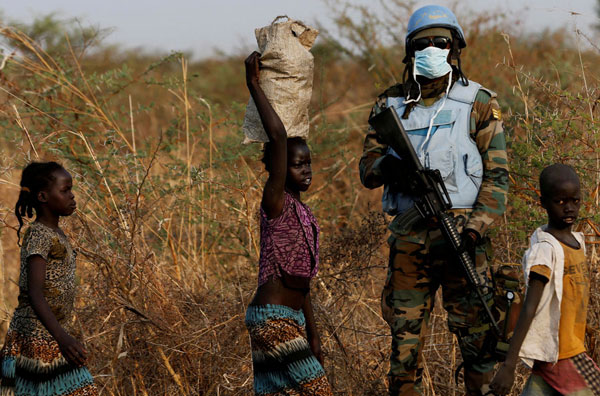
A United Nations Mission in South Sudan (UNMISS) peacekeeping soldier stands guard as children walk by during a patrol close to the town of Bentiu in Rubkona county, northern South Sudan, February 11, 2017. [Photo/Agencies] |
When I entered the United Nations Secretariat building for the first time as Secretary-General in January, my first act was to lay a wreath honoring more than 3,500 United Nations staff who died in the service of peace. Later that same week, two Blue Helmets were killed in the Central African Republic, where they were working to prevent violent confrontations between communities from descending into mass killings. United Nations peacekeepers place themselves in harm's way every day, between armed groups that are trying to kill each other or to harm civilians.
Countless lives have been saved and improved by UN peacekeeping over the past seventy years; countless families ravaged by war have been given a new start. Independent research has shown the worth of peacekeeping: it prevents the spread of violence; and it typically reduces the numbers of civilians killed by more than 90 percent, compared to before the deployment.
We also know peacekeeping is cost-effective. The UN peacekeeping budget is less than half of 1 percent of global military spending, and is shared between all 193 UN Member States. US studies show that UN peacekeeping missions are an estimated 8 times more cost-effective than when the US acts alone. That investment pays off many times over when we consider the economic growth and prosperity that follow from increased stability and security after successful peacekeeping missions.
In our interconnected world, the emergence of global terrorism means that instability anywhere is a threat everywhere. United Nations peacekeeping operations are on the frontlines of our efforts to prevent the emergence of lawless regions where insecurity, transnational crime and extremism can flourish. They are an investment in global peace, security and prosperity.
Our missions have contributed to a legacy of stability, development and economic growth from El Salvador to Namibia, and from Mozambique to Cambodia. Fifty-four operations have completed their mandates and closed; two more, in Liberia and Cote d'Ivoire, will do so in the months ahead.
While the United Nations is facing up to the challenges and shortcomings of our peacekeeping efforts, we should also recognize the successes of our mission for peace.
The Central African Republic was facing the threat of genocide when peacekeepers arrived two years ago. Today, the country has elected a new government in a peaceful and democratic process, and is struggling to move towards peace and stability, disarmament and the rule of law. Our mission, MINUSCA, is providing crucial support to reduce the threat posed by armed groups, but the situation remains challenging. It is frightening to imagine the tragic consequences if peacekeepers had not been there.
In South Sudan, UN peacekeepers are sheltering more than 200,000 civilians who fled when their homes were destroyed by the fighting. As famine stalks the country, UN peacekeepers are providing security for humanitarian agencies to deliver lifesaving aid.
Peace in our world may seem like an abstract concept. But peace on the ground depends on gruelingly hard work, every day, under difficult and dangerous conditions. The world relies on United Nations peacekeepers to go where others cannot and will not, despite the many obstacles they must confront.
Too often, United Nations peace operations face a gap between our goals and the means we have to achieve them. In many places, peacekeepers are deployed where warring parties show little commitment to peace. Our missions themselves are increasingly targeted by parties to conflict and violent extremists.
Dealing with this new reality requires a serious strategic reform on our part, based on an analysis of the mandates and capacities of our missions and our partnerships with governments and others. We must adapt peace operations to the dangerous and challenging environments they now face.
We have already made reforms that have reduced costs significantly and given us greater flexibility to deploy peacekeepers at short notice. But more remains to be done. I am determined to work with governments, regional organizations and other partners to make sure peacekeeping has the tools and rules it needs.
United Nations peacekeeping has been tarnished in recent years by appalling cases of sexual exploitation and abuse that are an outrageous violation of everything we value. Tackling this scourge is a priority for the whole United Nations system. I have presented a plan to all UN Member States that is aimed at ending impunity, and will create victims' rights advocates in our peacekeeping missions and at UN headquarters. I intend to mobilize world leaders around these critical steps.
When people around the world are asked about their priorities, from New York to New Delhi, from Cairo to Cape Town, they give the same response. They want safety and security, to raise their children in peace and give them education and opportunities to shape their future.
United Nations peacekeepers are one of the ways in which we deliver on that universal aspiration and make the world safer for everyone.
Mr. António Guterres is the Secretary-General of the United Nations.
- Peacekeepers 'need help' as dangers grow
- 140 Chinese peacekeepers return from UN mission in Liberia
- Chinese peacekeepers depart for South Sudan
- Three killed in car bomb attack on peacekeepers' Somali HQ
- UN peacekeepers start training course in Beijing
- Chinese peacekeepers set to join UN's fast-response team