India, Pakistan to gain from 'Shanghai Spirit'
 |
|
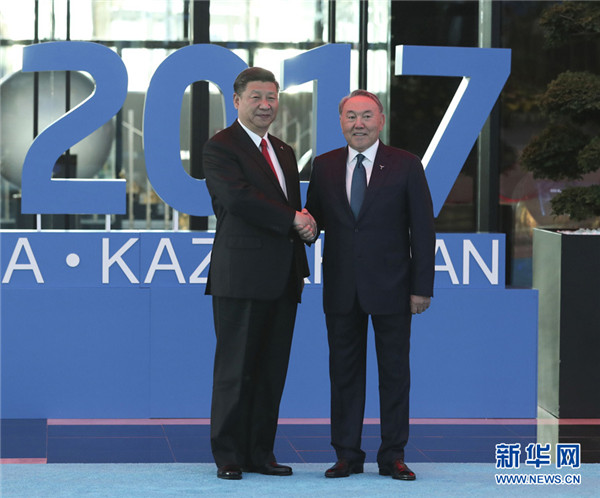
President Xi Jinping (L) is welcomed by his Kazakh counterpart Nursultan Nazarbayev when attending the opening ceremony of the Expo 2017 in Astana, Kazakhstan, June 9, 2017. [Photo/Xinhua] |
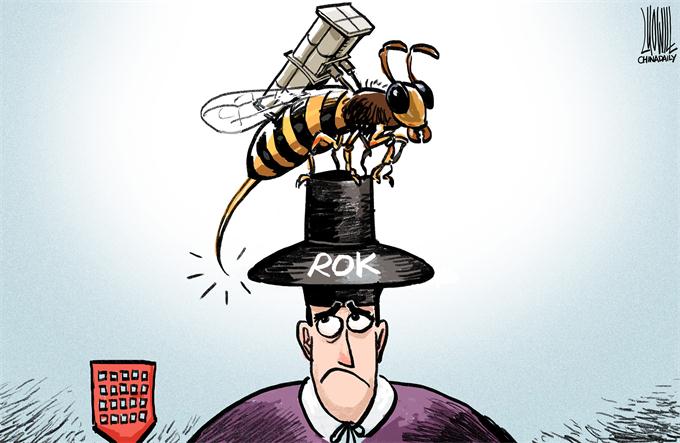
In the past 12 years, however, the roles of India and Pakistan as SCO observers convinced the bloc that the India-Pakistan rivalry would not have a negative impact on the SCO's stature and structures. Apparently, the two countries have embraced the Shanghai Spirit, and the six original SCO member states decided to induct them as full members of the bloc.
The first expansion of the SCO in 16 years was accompanied by the smooth proceedings of the 2017 summit, especially the successful adoption of the Astana Declaration and the Convention on Combating Terrorism, which show that doubts over India and Pakistan having a negative impact on the Shanghai Spirit could be misplaced.
The SCO has a reputation for being a robust bloc with detailed organizational structures and procedures that include exemplary structures like the regional anti-terrorist structure and collective security treaty organization that make it one of the world's most successful regional organizations. Besides, the SCO's two decades of regular interactions, starting from the Shanghai Five formed in 1996, have created a strong tradition of complementarity.
India and Pakistan, on the other hand, are widely expected to benefit from this "new space" to work together as partners. The memorandums of obligation, signed by the two countries to become full members, include provisions for joint military drills. Indian and Pakistani militaries have worked together in a few UN peacekeeping operations. Yet, thanks to the SCO, for the first time they will participate in regular joint military exercises in close formation. And for the first time their militaries will train together in countering terrorism, a menace for which they often blame each other. The two countries will also regularly share information and intelligence through the RATS, which could help them build mutual appreciation and understanding in the long run.
Besides, their SCO membership will greatly facilitate their connectivity with Central Asian states and other partners. The 1995 Quadrilateral Transit and Transport Agreement and the International North-South Corridor could now be revived with connections to South and West Asian countries. This could increase India's selective participation in various corridors and projects of the China-proposed Belt and Road Initiative.
For India, which is a large importer of fuels, the SCO membership will provide access to major gas and oil exploration sites in Central Asia, which could resuscitate India-Russia strategic partnership, as India explores new partnerships in the face of uncertain future of Indo-US relations.
The Astana summit shows the two countries are fast learning to set "bilateral" issues aside to focus on their multilateral priorities. The summit's opening ceremony also saw Indian Prime Minister Narendra Modi meeting his Pakistani counterpart Nawaz Sharif after 17 months.
Moreover, after India's abstention from the Belt and Road Forum for International Cooperation in Beijing last month, Chinese President Xi Jinping and Modi had a pleasant meeting. While Xi told Modi that he enjoyed watching the movie Dangal (a huge box office hit in China), Modi tweeted: "We spoke about India-China relations and how to further improve ties."
India didn't object to the Astana Declaration praising the Belt and Road Forum as it underscored respect for "equality and sovereignty of states" and reaffirmed its commitment that "there is no alternative to the political and diplomatic settlement of conflicts" which was welcomed by Indian interlocutors. So given the magnitude and magnetism of the SCO, its positive spirit is likely to have a stronger influence on India-Pakistan relations rather than the other way round.
The author is a professor at School of International Studies, Jawaharlal Nehru University, New Delhi.