China's sharing economy is now exporting innovations
 |
| Cai Meng/China Daily |
The intense competition in the bicycle-sharing business in China, which observers said would end up with a Didi-Uber merger as early as March, has now officially "gone global". Chinese bike-sharing startup Mobike is set to introduce 1,000 bikes to Manchester and Salford in the United Kingdom on June 29 in a bid to the European market.
Mobike made the decision just a week before an executive meeting of the State Council, China's Cabinet, on Wednesday approved a guideline on boosting China's sharing economy. Chairing the meeting, Premier Li Keqiang said that during his visits to several countries, leaders there welcomed Chinese bike-sharing companies to explore the local markets.
Capital has poured into China's bikes-sharing business over the past year. Thanks to its success in grabbing early market share, Mobike has acquired $600 million in its latest fundraising bid led by Chinese technology giant Tencent Holdings Ltd. In March, the Beijing-based company deployed 500 shared bikes in Singapore, where its chief rival Ofo, which has also conducted small trial runs in the UK, started operation months earlier.
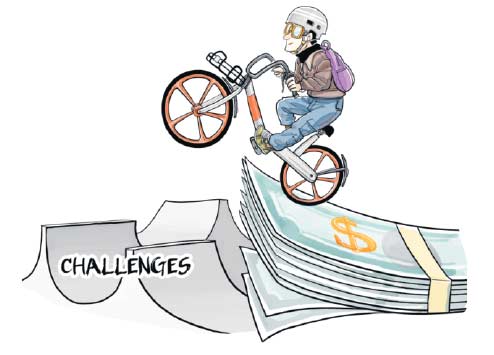
The two rivals' overseas trials have raised questions on how and why they are going global. Hailed as an innovative solution to the "last mile" dilemma facing urban commuters and a game-changer in China's effort to reduce overcapacity, the dock-less, often GPS-enabled bikes have also created chaotic parking and maintenance problems.
Besides, they may not enjoy the favorable policy support they get in China when they venture into overseas markets. In cities like New York and London, cyclists are required to wear helmets and other protection gear, while bike-sharing service providers need special authorization before their bikes can hit the streets. And those who own such gear are mostly enthusiastic cyclists and have their own bicycles.
Local competitors aside, Mobike and its rivals aspiring to go global may have to incur extra costs when it comes to bike production and mobile payment. Transporting bikes made in China to overseas markets means high shipping costs and tariffs, and outsourcing production to local manufacturers will not be cost-effective either. Third-party mobile payment platforms such as Alipay that many Chinese citizens take for granted and to which most bike-sharing apps are connected, face multiple restrictions in the West, where credit cards are still preferred.
But it would be unfair to call bike-sharing companies' attempts to go global a "folly", because even if they fail in their endeavor, they will leave behind valuable legacies for city planners. For instance, data sharing. Mobike had agreed to work with Manchester and Salford city councils and the Transport for Greater Manchester to share data of users' travel patterns for better urban planning. That could be a boon for both bike-sharing operators and local transport planners, and probably the only way for smart shared bikes to prove their worth.
Commuters' "insatiable" demand for shared bikes even when there are more than enough of them, may no longer be a problem once the service providers know the best timings and locations to dispatch their bikes. Data can also be used for credit scoring: failing to return a bike or use it properly means a decline in credit score.
Many failures of bike-sharing trials in European countries and the United States can be attributed to high charges. The affordable Mobike and Ofo services in China and elsewhere would not have been possible were it not for their deep-pocketed investors. They also teach a lesson: customers always vote with their feet and unreasonably high charges risk inviting the ire of financially weak individuals, who might either boycott the service or damage the bikes.
Chinese bike-sharing companies' attempts to enter the UK and Singapore markets are not just about offering shared bikes, but also about underscoring the significance of Internet Plus-based innovations, be they mobile payment systems or data-corralling chips equipped to the bikes. China is moving ahead in this field and ready to share its expertise. And hopefully, more smart bikes will ride into overseas markets, or at least offer some e-inspiration.
The author is a writer with China Daily. cuishoufeng@chinadaily.com.cn