Xi's diplomacy promotes inclusiveness
 |
|
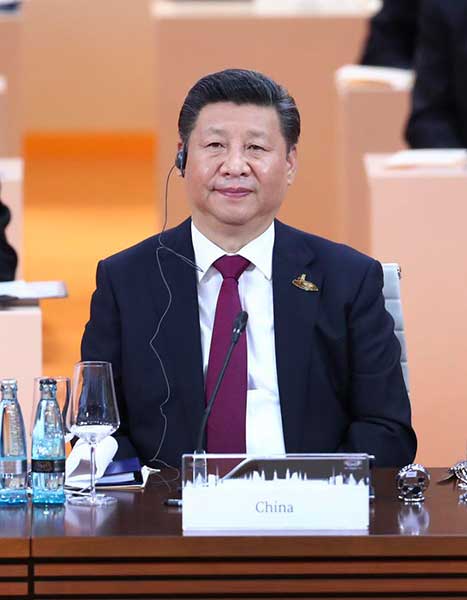
President Xi Jinping attends the 12th Summit of the Group of 20 (G20) major economies in Hamburg, Germany, July 7, 2017.[Photo/Xinhua] |
President Xi Jinping made some important remarks at the recent G20 summit in Hamburg, Germany, emphasizing the need to stay committed to building an open global economy, fostering new sources of growth for the world economy, and working together to promote inclusive and interconnected growth for shared prosperity and building a global community of shared destiny.
Such remarks constitute a part of Xi's diplomatic philosophy. Xi has used the Belt and Road Forum for International Cooperation in Beijing in May, and his visits to the United Nations regional headquarters in Geneva and the World Economic Forum in Davos in January to popularize China-advocated "Silk Road Spirit", which is characterized by "peace, cooperation, opening-up, inclusiveness, mutual learning, mutual benefit and win-win results". He has made a solemn commitment that China will shoulder its global responsibilities, and continuously integrate into the world economy and international community with an open mind to contribute more to the global economic recovery and development.
Xi's commitments not only demonstrate his broad diplomatic vision as the top leader of a large country, but also are a concise expression of China's consistent diplomatic values. His commitments also indicate that China has begun to make use of international forums and platforms to promote its diplomatic and other values while focusing on making the world a better place by narrating China's stories, offering Chinese proposals and contributing Chinese wisdom to build a more open and inclusive international community.
Diplomatic values, a reflection of a country's perception, judgment and approach in its dealings with other countries, are an integrated system of basic concepts and fundamental principles, based on which it can maintain national interests through diplomatic practices. They directly determine a sovereign country's basic perception of the world order and state-to-state relations, and dominate its diplomatic policies and their implementation.
A country's long-term foreign policy should be consistent with its interests and conform to its diplomatic values, and its concrete diplomatic policies and initiatives are in most cases a manifestation of its diplomatic values. That means diplomatic values directly decide what banner a country will carry, which path it will embark on, what ideologies it will advocate and what ideas it is opposed to. These values will also shape a country's diplomatic trait, guide its diplomatic practices and mold its diplomatic soul and propensity.
China's diplomatic values today are based on its diplomatic practices over more than six decades. With Marxist theory as its guiding light and based on its national conditions, China's diplomatic values have absorbed the quintessence of Chinese civilization, inherited its fine diplomatic tradition and are poised to serve socialism with Chinese characteristics. This is the fundamental reason why these values can maintain their advanced nature and vitality.
After decades of enrichment, China's diplomatic values have evolved into an organic combination of systematic diplomatic concepts and proposals. Sovereign equality is a prerequisite for these diplomatic values. And the essence of sovereign equality is: the sovereignty and dignity of all countries, big or small, strong or weak, rich or poor, should be respected, and their participation in the decision-making process of various international institutions on an equal footing constitutes an important driver of improved global governance, just as Xi has emphasized. They are based on the possession of an independent and self-decided power.
The core spirit of socialism with Chinese characteristics is the belief that Chinese people are the backbone of China's development path and the country's adherence to a development road that suits its national conditions. No country should regard its development road superior to that of other countries or impose its own development path upon others, as Xi has said.
As the largest developing country in the world, China has long viewed reform and development as its core national task and a core guideline for handling international relations. It fully understands and respects the urgent demand of the large number of developing countries to push forward economic and social development, firmly supports globalization and opposes protectionism, and advocates and promotes the Belt and Road Initiative to share its own development opportunities with other countries.
China advocates democratization of international relations, promotes the development of a new type of international relations with cooperation and win-win results as its core, and adheres to an approach that is fair and just. The concept of building a human community of shared destiny put forward by Xi thus reflects China's desire to pursue fairness and justice.
China pursues a defensive national defense policy, has implemented an overall national security policy, and strongly opposes the use of force or threat to resolve international disputes. It advocates the establishment of a common, comprehensive, cooperative and sustainable security outlook and strives to build a world of lasting peace and prosperity.
There are good reasons to believe that with China becoming an important player on the world stage, its leaders will promote such Chinese values with greater confidence and in a stronger voice.
The author is a research fellow at the National Academy of Development and Strategy, Renmin University of China.