 |
|
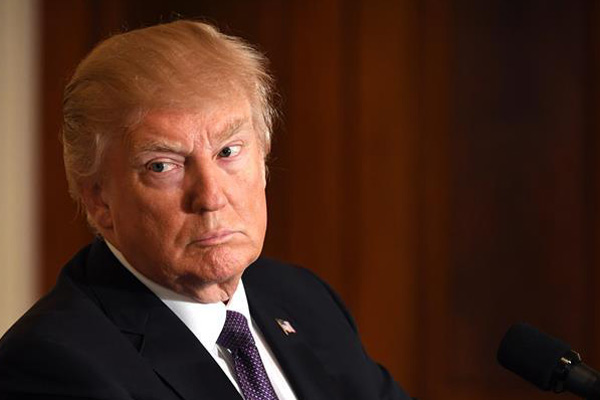
US President Donald Trump attends a press conference at the White House in Washington DC, on April 12, 2017. [Photo/Xinhua] |
As one among a series of measures taken by the Trump administration, the bill passed on July 14 contains provisions about "re-establishing" regular ports of call for the United States Navy at Kaohsiung or any other suitable port in Taiwan, and permitting the US Pacific Command to receive Taiwan vessels. It also gives the green light to more US "defense cooperation" with Taiwan and "normalizing" US weapons sales to the island.
For obvious reasons, China has strongly opposed the bill, seeing it as a serious interference in its internal affairs and a blatant violation of the one-China policy and the three joint communiqués that guide Sino-US relations.
Under the three joint communiqués, the US is obliged to abide by the one-China policy, recognize that Taiwan is part of China, and the government of the People's Republic of China is the sole legitimate government of China.
However, over the years the US has maintained unofficial contacts with the island and kept selling arms to it under the Taiwan Relations Act.
The latest US bill, if written into law, will set two troubling precedents for Washington's relations with Taiwan, and subsequently damage Sino-US relations. The port of call arrangement will, in effect, signal the beginning of direct military contacts between Washington and Taiwan and, along with the "normalizing" of US arms sales, amount to the US backpedaling on its official stance of phasing out arms sales to the island.
The US' national defense bill came into media spotlight one day after the Trump administration notified the US Congress of "seven proposed defense sales for Taiwan" worth $1.42 billion. Beijing has strongly criticized the Trump administration's first arms sales to the island, because it opposes any official or military exchange between Washington and Taiwan.
Considering that the Trump administration is still weighing the pros and cons of Sino-US ties, its intensified Taiwan-related moves show it is trying to play the Taiwan card, using it as leverage against Beijing to gain benefits in fields such as trade in return. That Trump, by nature, is a businessman and his credo is "America First" lend credence to this perception.
But the US should be warned that China brooks no interference in the Taiwan question, and any provocation over the issue will erode the mutual political trust between Washington and Beijing, even shake the foundation of Sino-US relations.
In the six months that Trump has been in the White House, China and the US have exchanged several high-level visits and held a series of talks.
The two countries reached important consensuses when President Xi Jinping and Trump met in Florida in April. They have implemented the 100-day economic plan, and decided to start a yearlong action plan for economic cooperation.
At the security level, the first China-US Diplomatic and Security Dialogue was held in Washington last month, which both sides said was constructive and fruitful. They have also made efforts to jointly address issues of common concern, including the denuclearization of the Korean Peninsula.
But the US arms sales to Taiwan risk compromising the consensuses reached between the two sides and undermine their mutual efforts to deepen cooperation on both bilateral and multilateral fronts.
Given that the US Senate needs to vote on the Taiwan-related bill before Trump signs it into law, US politicians need to thoroughly reflect upon the harmful effects of those controversial provisions and do not aggravate the situation. After all, it will take the efforts of both sides to build on the good momentum of bilateral relations and chart a brighter future for Sino-US ties.
The author is a senior writer with China Daily. wanghui@chinadaily.com.cn

Copyright 1995 - . All rights reserved. The content (including but not limited to text, photo, multimedia information, etc) published in this site belongs to China Daily Information Co (CDIC). Without written authorization from CDIC, such content shall not be republished or used in any form. Note: Browsers with 1024*768 or higher resolution are suggested for this site.
License for publishing multimedia online 0108263 Registration Number: 130349