 |
|
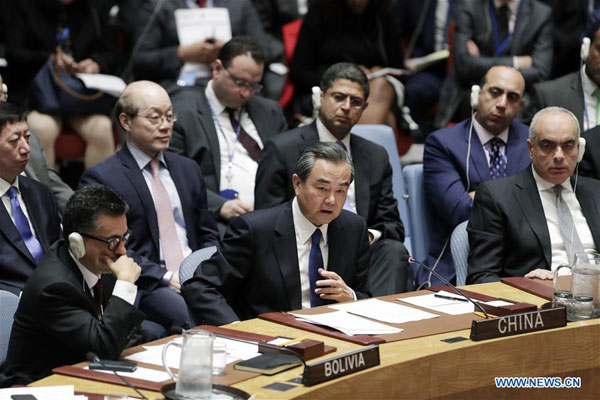
Chinese Foreign Minister Wang Yi (middle, front) speaks during a ministerial meeting of the UN Security Council on the nuclear issue of the Korean Peninsular, at the UN headquarters in New York April 28, 2017.[Photo/Xinhua] |
Susan Thornton, the acting US assistant secretary of state for East Asian and Pacific affairs, spoke in a Senate hearing on Tuesday about the need to increase the pressure on the Democratic People's Republic of Korea so it will give up its nuclear weapons program.
Besides calling for the UN member states to implement their commitments, she said the United States has urged all countries to suspend or downgrade diplomatic relations and cut trade ties with Pyongyang.
The strategy is all sticks, no carrots. There is no consideration that less pressure, rather than more pressure, might be a more viable way to achieve the peaceful denuclearization of the Korean Peninsula.
The US clearly believes that tightened sanctions will force the DPRK to change course. Yet tougher and tougher sanctions have failed to get the DPRK to halt its nuclear weapons program.
Senior US officials claim that the US wants to bring the DPRK to its senses, not its knees. Yet its strategy suggests that is not the case, and that it wants the DPRK to be on its knees.
US concerns that the DPRK could have a continental ballistic missile capable of hitting the US worsened this week after new assessment by the Pentagon Defense Intelligence Agency showed that the DPRK could have this capability as early as next year.
But the strategy Thornton laid out is deeply flawed because it shows the US is making no attempt to put itself in the DPRK's shoes. Thornton, for example, has not addressed any of DPRK's legitimate security concerns.
The US said it does not seek regime change, but it has threatened various military options. And the US' word does not inspire trust after it helped remove Libyan leader Muammar Gadhafi in 2011 after he gave up nuclear weapons and toppled Iraqi leader Saddam Hussein in 2003 under the pretext that he had weapons of mass destruction, which it knew did not exist.
Thornton also talked a lot about how China could use its unique leverage, noting that the US would not hesitate to punish Chinese individuals and entities violating the sanctions.
But in doing so, the US has again assumed the role of the world's policeman, something US President Donald Trump said he would reject during his presidential campaign.
Unilateral sanctions imposed by the US outside the UN framework undermine mutual trust and cooperation among nations. Yet the world's only superpower has found it an easy and appealing tool.
Contrary to the claims of its critics, China, which borders the DPRK, has a strong interest in denuclearization of the peninsula, as well as peace and prosperity in the region.
China has been working closely with the US on UN sanctions imposed against the DPRK. Yet the US has rejected China's proposal for "dual suspension"-the DPRK suspends its nuclear weapons program and the US and the Republic of Korea suspend their large-scale military drills-and resuming the Six-Party Talks and direct talks with the DPRK. The US still insists that the DPRK must first agree to talk about abandoning its nuclear weapons program before any talks can be held.
In Thornton's words, while the US continues to see a negotiated solution as the best way to resolving the problem, the conditions at present are not conducive to dialogue.
It is true that previous talks failed to achieve the goal of denuclearization due to missteps, probably more on the DPRK side than on the US side. But that should not be an excuse for shunning talks on such a critical issue.
What seems certain is that sanctions without talks will likely escalate tensions.
The author is deputy editor of China Daily USA.
chenweihua@chinadailyusa.com


Copyright 1995 - . All rights reserved. The content (including but not limited to text, photo, multimedia information, etc) published in this site belongs to China Daily Information Co (CDIC). Without written authorization from CDIC, such content shall not be republished or used in any form. Note: Browsers with 1024*768 or higher resolution are suggested for this site.
License for publishing multimedia online 0108263 Registration Number: 130349