Mitigating climate threat to China's food security
 |
| MA XUEJING/LI MIN/CHINA DAILY |
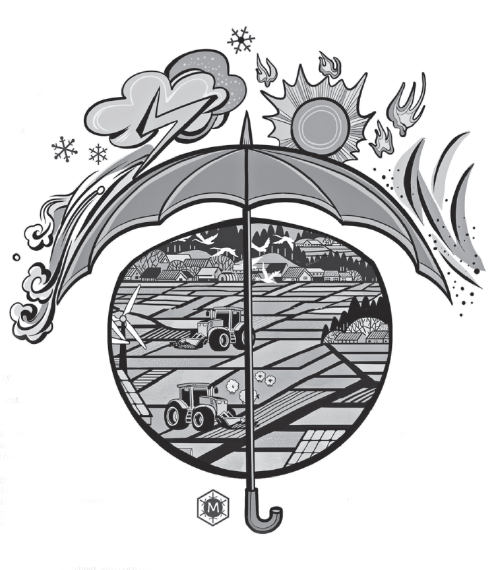
China is already experiencing the effects of climate change. According to the Third National Assessment Report on Climate Change, the average temperature of China's land area rose by 0.9 Celsius to 1.5 C from 1909 to 2011, which is higher than the global average. It is projected to rise another 1.3 C to 5 C by the end of this century.
Besides temperature rise, climate change has had other observable effects on China, such as rising sea levels, melting glaciers, changing precipitation patterns, more droughts and heat waves, and increasing risks of hurricanes. Climate change therefore has a significant effect on China's natural environment and economic growth.
Due to its complex climate conditions and fragile ecosystems, China is sensitive to climate change, with its agriculture being particularly vulnerable.
Although climate change will improve thermal conditions for agricultural production in some areas, the negative impacts are more pronounced. They include declining crop quality and yield, decreasing arable land quality, increasing price of water and fertilizers, aggravated crop pests and diseases, and more frequent and intense extreme climate events. It is widely believed the net effect of climate change on agriculture is negative.
Climate change therefore poses a huge challenge to the stability and sustainability of food production in China. Agriculture employs about 40 percent of China's population; it also produces 30 percent of rice, 17 percent of wheat, and 20 percent of corn in the world. The climatic shocks to agriculture will not only threaten the food security of the world's largest population, but also have a ripple effect on the global food market.
All these call for thorough assessment of the economic impacts of climate change on China's agriculture and a strategy to address the challenge.
The cost of climate change on China's agriculture has been assessed in a recent paper published in the Journal of Environmental Economics and Management by researchers from Hong Kong Polytechnic University, Duke Kunshan University and the Chinese Academy of Agricultural Sciences. The report's authors say climate change is likely to decrease the yields of rice, wheat and corn in China, and the authorities need to take urgent actions to deal with the challenge.
The impacts of climate change on the three staple crops are heterogeneous across Chinese regions. While climate change is harmful for rice production in southern China, it is beneficial in northern China. Additionally, the major rice-producing provinces, such as Hunan, Hubei, Jiangsu, and Jiangxi, will suffer significant losses.
For wheat, northeastern China could benefit from climate change. And while Central China, including several counties in Henan, Shandong and Hebei provinces, will suffer moderate losses, the impact of climate change on southern China will be severe.
When it comes to corn, all regions show the negative impacts of climate change, except for some counties in the Xinjiang Uygur autonomous region. In particular, the major corn-producing provinces, such as Jilin, Heilongjiang, Henan and Hebei, will be severely affected.
The impacts of climate change on rice, wheat, and corn productions are of great economic significance. And evidence suggests climate change can endanger China's food security. Domestic food production is likely to decline if advanced technology and improved farming methods cannot fill the supply gap caused by climate change. And if China has to rely, even if partly, on the world market for food security, it cannot achieve self-sufficiency in food production, which is a top priority for the Chinese government.
Given the impacts of climate change and potential risks, China needs to take immediate measures to deal with eventualities. Adaptation can help China mitigate the negative impacts of climate change and benefit from the positive impacts. According to the findings of a study, China's National Technology Needs Assessment for Climate Change Adaptation, funded by the World Bank, the priority adaptive measures include stress-tolerant varietal breeding, precision agricultural technology, and agricultural water-saving technology. By promoting these climate-friendly agricultural technologies, China can reduce the climate risks on food security.
The author is director of the environmental research center, Duke Kunshan University, Jiangsu province.
- Internet helps improve food security in Foshan
- Science collaboration to improve food security
- China needs a better system for food security
- Ministries discuss retirement age, food security
- To ensure its food security, govt has to support farmers to grow more
- What should be done to ensure food security?
- China needs a better system for food security