US must stop playing 'Taiwan card'
 |
|
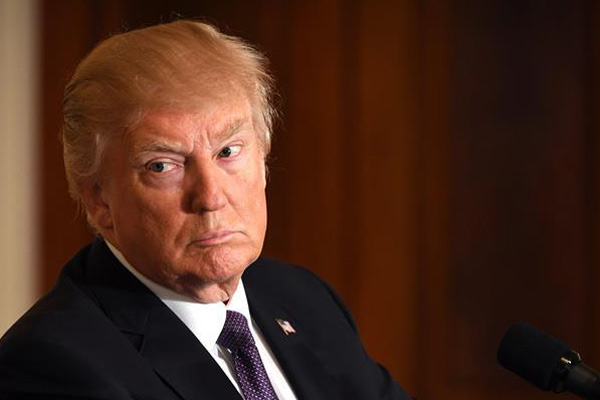
US President Donald Trump attends a press conference at the White House in Washington DC, on April 12, 2017. [Photo/Xinhua] |
The National Defense Authorization Act for Fiscal Year 2018, passed by the US House of Representatives on July 14, requires the secretary of defense to study the feasibility of "re-establishing" regular ports of call for the United States Navy at Kaohsiung or any other suitable port in Taiwan and "normalizing" the transfer of defense equipment and services to the island.
China has strongly opposed the move, because if the US Senate votes in favor of the bill and US President Donald Trump signs it into law, it will be a serious violation of the one-China policy and the Three Joint Communiqués that guide Sino-US relations.
During the talks for normalizing Sino-US diplomatic ties, former leader Deng Xiaoping made it absolutely clear that Washington has to sever "diplomatic" ties with Taiwan, withdraw US troops from Taiwan and annul the mutual defense treaty with Taiwan. Diplomatic ties were normalized on Jan 1, 1979, only after the Jimmy Carter administration agreed to fulfill the three conditions.
Beijing, on its part, agreed to Washington maintaining unofficial relations with Taiwan through commercial and cultural exchanges. All US administrations since have stuck to this policy. A strategic port-of-call arrangement, however, cannot be part of an unofficial relationship.
Some pro-Taiwan forces in the US are plotting to disrupt cross-Straits relations by supporting "pro-independence" forces on the island and creating obstacles for Taiwan's reunification with the mainland. At times, these pro-Taiwan forces have given calls to "disconnect Taiwan from US-PRC policy to the greatest extent possible", because they want "US-Taiwan" ties to have their own agenda.
The peaceful development and economic integration across the Straits rattled these forces. But after the Democratic Progressive Party won the Taiwan election last year, they seized the opportunity to "advise" the island authorities and act as a broker between Washington and Taipei.
Beijing has to take proper measures to foil their attempts.
The pro-Taiwan elements are concentrated in the US Congress. Conservative congressmen have sought the upgrading of US-Taiwan unofficial ties. For example, the House Foreign Affairs Committee proposed the "Taiwan Policy Act" of 2013, demanding comprehensive upgrading of relations with Taiwan in the political, economic and security fields. The so-called act was actually the Taiwan Security Enhancement Act of 1999 in disguise.
In December 2016, some congressmen again forced their ideas into the National Defense Authorization Act for Fiscal Year 2017, whose Section 1284 obligates the Pentagon to conduct an exchange program with Taiwan involving senior military officers and senior officials, and allowing generals or flag officers on active duty as well as Pentagon officials above the level of assistant defense secretary to visit the island.
On Dec 23 last year, US President Barack Obama signed the act into law. But since the law refers to Section 1284 as the "sense of Congress on military exchanges between the US and Taiwan", it has no binding force. Those US politicians still trying to use the "Taiwan card" should know they could end up hurting themselves.
And the US administration is capable of manipulating the legislation process both ways; it can influence critical members of Congress to delay or even stop the passage of a certain bill. In early 2000, for instance, the Bill Clinton administration worked on the Senate after the House of Representatives had approved the Taiwan Security Enhancement Act because it was strongly opposed to the bill. As a result, the Senate did not vote on the bill.
The one-China policy is the foundation of Sino-US relations. And the Taiwan question is at the core of all joint Sino-US communiqués and remains the most important and most sensitive issue in bilateral relations, as it concerns China's sovereignty and territorial integrity, and represents China's core interests.
China's position has always been clear and firm, with no room for hesitation or compromise. Economic and trade issues may be negotiable, but the one-China policy is not. The Trump administration should learn from the experiences of previous administrations and desist from using the "Taiwan card", so as to help Sino-US relations to progress steadily for the benefit of both sides.
The author is a researcher at the Chinese Academy of Social Sciences.
Courtesy: chinausfocus.com