Facts favor China in standoff
 |
|
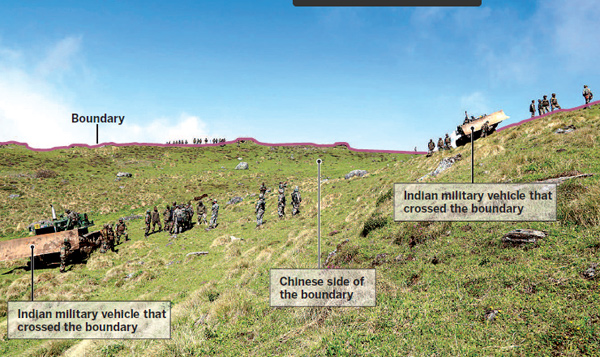
A Foreign Ministry photo released on Wednesday shows Indian troops encroaching on Chinese territory. Provided to China Daily |
Since the standoff began between China and India on a remote Himalayan plateau in mid-June, Foreign Ministry spokespersons have issued one strong statement after another, asking India to withdraw its troops from Donglang, and warning it against miscalculations and nurturing illusions. And Defense Ministry spokespersons have stressed the resolution of the People's Liberation Army to defend China's territory and called on India not to underestimate the country's determination to safeguard its sovereignty.
In the past, India and China have been able to manage their differences over their disputed borders that have arisen from time to time.
But the Chinese government's strong response suggests something is different this time.
First, the simple fact is that China and India have no border dispute in the Donglang area, because the boundary there has been delimited under the 1890 Convention Between Great Britain and China Relating to Sikkim and Tibet.
True, China and India share a long border across thousands of kilometers and most of it has not been officially demarcated. But the 220 km border between China and India in the Sikkim sector was settled way back in 1890, and successive Chinese and Indian governments have abided by it since then. But on June 18, the Indian troops crossed the established border and forcefully stopped their Chinese counterparts from building infrastructure on the Chinese side, which led to the current standoff.
India claims the standoff is at the "tri-junction" (meeting point of the borders of China, India and Bhutan), but the truth is that the site is at least 2 kilometers away from the tri-junction. China can only perceive the Indian intrusion as an attempt to expand the disputes into uncontested areas, which will make the border issue more difficult to resolve.
Second, India's claim of being under obligation to help Bhutan defend its territory has no legal basis, as Bhutan is not India's "treaty ally". Bhutan signed a Friendship Treaty with India in 1949, in which "Bhutan agrees to be guided by the advice of the Government of India in regard to its external relations". The treaty was revised in 2007, and now it states the two governments "shall cooperate closely with each other on issues relating to their national interests", and neither "shall allow the use of its territory for activities harmful to the national security and interest of the other".
Even though Bhutan has agreed to "cooperate", nothing in the treaty justifies India trespassing into Chinese territory.
Bhutan is a sovereign state, a friendly neighbor to both China and India. Of China's 14 land neighbors, Bhutan is the only one that has no diplomatic ties with China, and one of the two that have not settled their land borders with China (the other being India). Actually, Bhutan has made territorial claims that conflict with those of China. Both sides have held 24 rounds of talks since the 1980s and reached a common understanding on the basics of their borders.
But without India's endorsement, Bhutan cannot sign a border agreement with China. And without an India-endorsed border agreement, Bhutan cannot conclude negotiations to establish diplomatic relations with China.
As one of the founding members of the Non-Aligned Movement whose core principles include national independence, state sovereignty, and opposition to bloc politics, India knows full well that intervention in the name of a third party does not conform to its own foreign policy. India actually is harming Bhutan's national interests, and its "cooperation" with Bhutan is only for its national interests.
Third, Donglang has been under China's control and administration. PLA units conduct regular patrols in the area, and the local government has built roads and facilities to facilitate economic activities there to help improve the livelihoods of local residents.
Chinese herdsmen use the grasslands in Donglang to graze their cattle in the summer, as do Bhutanese herdsmen-but only with the endorsement of the Chinese local government and after paying the "grass tax". So China has every right to build roads, houses and other facilities in the area, because it is part of its territory.
The fact is that China and India have no disputes in the Sikkim section of their border, and hence India cannot justify its border transgression-either to defend its own territorial rights or to support a third party's territorial claim against China.
Contrary to what Indian External Affairs Minister Sushma Swaraj said in her speech in the Indian parliament on July 20-that China was "unilaterally" changing the status quo in Donglang-it is India that is trying to change the status quo, by creating a dispute where there is none, disregarding China's control over the area, trying to impede China-Bhutan border negotiations, and complicating the border issue with military buildup. It is the illegal intrusion of Indian troops into Chinese territory that is the most disruptive factor to the status quo.
The Donglang standoff is unprecedented. That is why the Chinese government has adopted a very strong stance and is seeking an unconditional withdrawal of Indian troops. There can be no room for negotiations before this wrong is righted. New Delhi should understand the severity of the situation and handle the sensitive issue more carefully and prudently.
Indian Prime Minister Narendra Modi once said that for four decades, not a single bullet has been fired across the India-China border. We all have to work harder to ensure the statement stands the test of time.
The author is a retired major general of the People's Liberation Army.
Courtesy: chinausfocus.com