Abe continues his struggle to tide over political crisis
 |
|
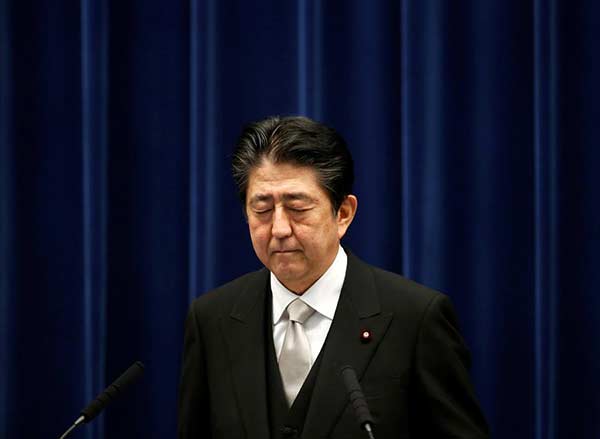
Japan's Prime Minister Shinzo Abe attends a news conference after reshuffling his cabinet, at his official residence in Tokyo, Japan, August 3, 2017. [Photo/Agencies] |
Japanese Prime Minister Shinzo Abe's approval rating slightly rebounded one day after he reshuffled his Cabinet on Thursday, the third reshuffle since he returned to power in 2012, according to local media polls. A survey conducted by Kyodo News Agency on Friday showed an increase of 8.6 points in the rating, compared with the previous poll. The 44.4 percent approval rating comes as a reprieve for the scandal-hit Abe administration.
The new Cabinet lineup, as that in previous reshuffles, is designed to help the incumbent administration to tide over a political crisis and shelve factional differences within the ruling Liberal Democratic Party. For Abe, it is all about distracting attention from the LDP's defeat by a novice rival in the Tokyo metropolitan election in July, as well as putting on a show of unity to win support in the race for LDP presidency next year.
Hit hard by allegations of favoritism to a friend in a business deal, Abe made the difficult decision of accepting the resignation of former defense minister Tomomi Inada a week before the reshuffle. One of his favorite political hardliners, Inada could not even complete one year in office following a series of gaffes and a cover-up, in which her ministry concealed records of the activities of Japanese troops on a United Nations peacekeeping mission in South Sudan.
The redistribution of power and reappointment of senior lawmakers, therefore, look more like an attempt by the Abe administration to escape from trouble. Some ministers are from Abe's first Cabinet in 2012, Finance Minister Taro Aso for example, and many are taking up their old posts, such as Defense Minister Itsunori Onodera. These arrangements reflect Abe's efforts to balance the interests of prospective candidates for the LDP presidency when his term ends next year.
It takes experience and excellent policymaking skills to lead Japan's ruling party, and not many contenders qualify for the job. Among the front-runners are former foreign minister Fumio Kishida, who now chairs the LDP's Policy Research Council, and party heavyweight Shigeru Ishiba, who lost to Abe by a narrow margin in the 2012 contest for LDP presidency. But neither is an Abe protégé.
Being popular among local LDP members, Ishiba seems set to make a comeback after being distanced for long by the party's central leadership. Appointing Kishida to a senior party post is a more likely choice for Abe to solicit support for re-election. But Kishida disagrees with Abe on the latter's proposal to amend Article 9 of Japan's pacifist Constitution, which states Japan should abandon wars, casting a shadow over the prime minister's political calculus.
It is evident that Abe has been struggling to press ahead with his political ambitions, particularly the so-called revamp of the education and defense sectors. He wants to instill in more Japanese people a stronger sense of "patriotism" and amend relevant laws to let Japan wage wars again.
The obvious controversies aside, Abe's waning public approval rating alone could call into question his right to continue as LDP president and Japan's prime minister. The reshuffle, however, may bring some desirable changes to Japanese politics and probably foreign policy. Known for criticizing even the ruling party, Taro Kono, the new foreign minister, can help alleviate diplomatic tensions with neighbors such as China.
The author is a researcher with the Institute of Japanese Studies at the Chinese Academy of Social Sciences.