Boycott of Chinese goods will hurt India
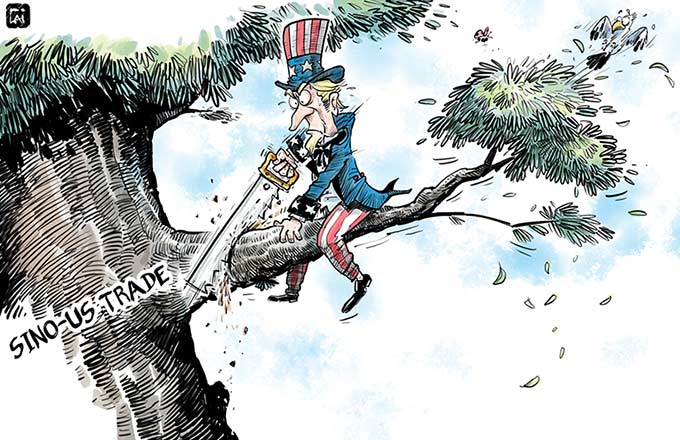
Amid the ongoing standoff between Indian and Chinese soldiers in the Donglang area of the Sikkim sector of the China-India border, several ultranationalist Indian politicians of the ruling Bharatiya Janata Party and some right-wing Hindu organizations are trying to incite Indian citizens to boycott Chinese goods. The call to boycott Chinese goods is a frog-in-the-well kind of perspective, which will not help India but could deter Chinese enterprises from investing in India and thus harm bilateral cooperation.
On Aug 7, the BJP's Karnataka provincial general secretary called upon people to boycott Chinese goods such as toys and consumer durables, saying the ruling party "will create awareness among the people about the problems caused by China at the border and the need to boycott Chinese goods". Two days earlier, yoga guru Baba Ramdev, who is more like a televangelist and heads a multibillion-dollar business empire, had urged Indians to boycott Chinese products, in order to stir up Hindu nationalism.
Over the past two years, various Indian right-wing organizations have called for a boycott of Chinese goods to "teach China a lesson" for creating trouble by preventing the UN Security Council from declaring Pakistan-based Jaish-e-Mohammad chief Masood Azhar a global terrorist and opposing India's membership of the Nuclear Suppliers Group.
The ultra-nationalist elements' call to boycott Chinese products is an infantile move, simply because Chinese goods have become part and parcel of everyday life in India. Still, if they insist on boycotting Chinese goods, they will cause much greater harm to the Indian economy.
Nationalism and trade are two different things. They must never be mixed together. China is the world's largest trading country, with its volume of exports reaching 13.84 trillion yuan ($2.07 trillion) last year, of which only about 2.5 percent was to India. This means a boycott of Chinese products would have little effect on China but a major impact on India, as 17 percent of India's total imports comes from China.
In the two years since President Xi Jinping's visit to India, Chinese investment in India has increased, with $2.3 billion invested in the first three months of this year, compared with only $1.35 billion between 2000 and 2016. Besides, Chinese enterprises are strong participants in the Indian government's "Made in India" campaign, with a total investment of $5 billion so far.
Despite the calls for a boycott, companies of all sizes across India still seek Chinese investment. And it is no exaggeration to say that Chinese products have entered almost every middle-class living room in India. A recent survey conducted by Hindustan Times, a leading English-language newspaper, showed 83 percent of the respondents preferred Chinese goods over Indian ones because "they are cheaper".
Each year during the festival season, which generally starts in October and includes Dussehra, Diwali, Christmas and New Year, Chinese products including decorative lights and lamps, gift items and firecrackers worth tens of millions of dollars are sold across India. So, by boycotting Chinese goods, Indian citizens will end up hurting Indian traders, who buy from China and sell in India. They will also reduce the government's tax revenue, for many of the traders are also big taxpayers.
Moreover, Chinese goods have helped to keep prices low in the Indian market, thereby helping poor and low-income families.
More important, the call to boycott Chinese goods is not a solution to the border standoff. Such "nationalistic" calls are devoid of any logic, and a violation of World Trade Organization rules. Right-wing Indian politicians should realize that bans and boycotts would mar overall bilateral relations. Besides, they would do good to remember that "consumer is king" at all times.
The author is secretary of New Horizon Radio Listeners' Club, West Bengal, India.