What China can teach US about clean air
 |
|
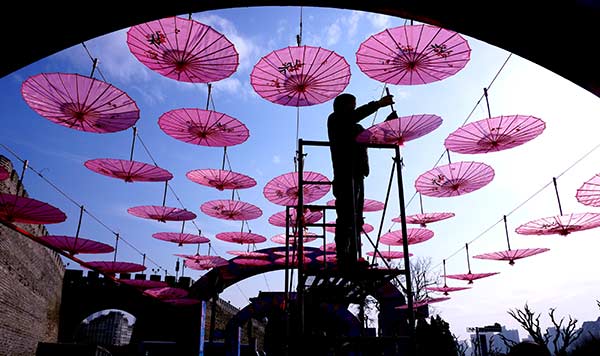
A worker hangs ornaments at the Ming Dynasty City Wall Ruins Park under a blue sky in Beijing in March, 2017. LIU PING/CHINA DAILY |
Every year, more than 4 million people around the world die prematurely from breathing dirty air. In China alone, the number of deaths attributable to air pollution exceeds 1 million a year. That figure may not come as a surprise, as we are routinely treated to images in the media of thick, sooty smog enveloping Beijing, Shanghai and other Chinese cities. But the United States' air kills, too-and it gets a lot less attention.
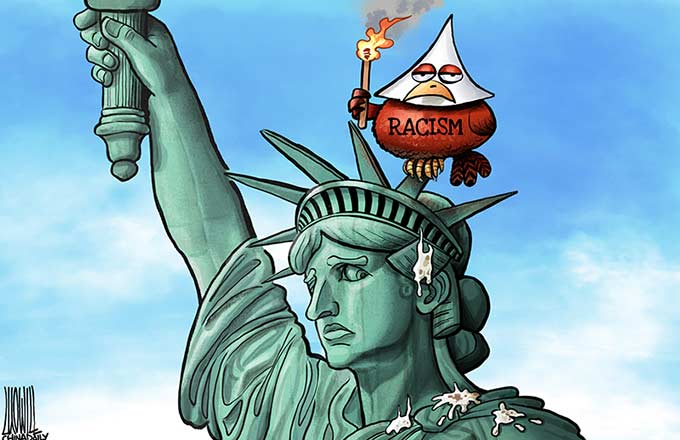
A 2013 Massachusetts Institute of Technology estimated that poor air quality accounts for 200,000 early deaths in the US each year, more than the number killed by car crashes and diabetes. Yet while China is aggressively tackling its air pollution problem, the US is rolling back air-quality protections in the name of economic growth-an ill-conceived strategy that will have a devastating impact on human health.
Research over the past 20 years has tied PM2.5(airborne particles with a diameter of less than 2.5 microns) to a range of adverse health outcomes, including asthma, acute bronchitis, lung cancer, heart attacks and cardio-respiratory diseases. We know, too, where most PM2.5 comes from: power plants, heavy industry and motor vehicles.
Knowing the killer pollutant and its sources, the US Environmental Protection Agency, under the 1990 Clean Air Act, issued new standards to reduce PM2.5 levels. The EPA estimates that between 1990 and 2015, the national concentration of particulate matter fell by 37 percent and that in 2010, some 160,000 premature deaths were averted as a result of the regulations. In short, despite a considerable number of deaths still linked to dirty air, the US had, until this year, been heading in the right direction.
Now, however, US President Donald Trump has promised to create "unbelievable prosperity" by discarding regulations intended to reduce toxic emissions from coal-fired power plants, lowering or eliminating fuel-efficiency standards for automobiles, and dismantling the EPA. He has also vowed to repeal limits on fracking, open up more public lands to coal mining, and expand oil and gas production in the Arctic and Atlantic oceans.
Let's assume, for a moment, that such measures would actually produce prosperity for the entire country, and not just for the fossil fuel industry. What price, as a country, is the US willing to pay? How many early deaths per year are too many?
There are alternatives that don't require a zero-sum tradeoff between economic growth and human health. And, ironically, one place to look for inspiration is China.
Holding up China as a model to emulate might seem absurd. After all, its PM2.5 levels are considerably higher than in the US, and consumption of fossil fuels, especially coal, is far greater. But Chinese policymakers are taking vigorous steps to reverse course, free the country from its dependence on fossil fuels and create a future-oriented economy powered by clean energy and green technology.
Today, China is the world's largest investor in renewable energy, with outlays in 2015 totaling $103 billion, more than double US spending of $44 billion. Of the planet's 8.1 million jobs in renewable energy, 3.5 million are in China, whereas fewer than 1 million are in the US. Convinced that clean energy is good for both the environment and the economy, China has committed $367 billion through 2020 to the development of renewable power sources-which is expected to generate 13 million jobs.
And to rein in pollutants from motor vehicles, the Chinese government has made adoption of electric vehicles a high priority, setting a target of 5 million on the country's roads by 2020. To promote sales, buyers are exempted from sales and excise taxes ($6,000-$10,000 per vehicle). And, anticipating the eventual replacement of conventional motor vehicles globally, the authorities are providing generous subsidies for domestic manufacturing.
In contrast, the Trump administration is trying to turn back the clock, by betting on the resuscitation of a dying-and deadly-fossil fuel industry. Describing a transition to electric vehicles as a job killer, Trump has advocated ending federal subsidies that encourage domestic development, manufacture, and purchase, such as the $7,500 federal tax credit for consumers.
China's dependence on fossil fuels has left it in a deep environmental hole, but its leaders are determined to climb out. The US, on the other hand, is literally digging its own grave. With as many as 200,000 Americans dying prematurely every year, economic hubris must not be allowed to trump the search for solutions-wherever they may be found.
The author is a professor of history at Smith College, Massachusetts. His latest book, Environmental Pollution in China: What Everyone Needs to Know, is forthcoming from Oxford University Press. Project Syndicate