 |
|
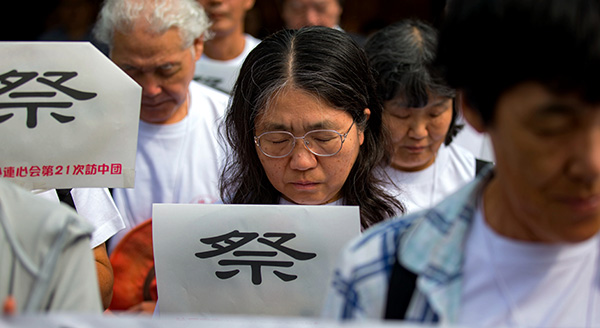
Members of a Japanese delegation mourn outside the Memorial Hall of the Victims in Nanjing Massacre by Japanese Invaders in Nanjing on Tuesday. YANG BO/CHINA NEWS SERVICE |
Summer is the time when Japan observes the anniversary of its sufferings during the last year of World War II and its surrender on Aug 15, 1945, which it describes as "the end of war".
The United States dropped an atomic bomb on Hiroshima on Aug 6, 1945, and a second on Nagasaki three days later. Before the Hiroshima and Nagasaki bombings, US B-29 Superfortresses had bombarded 64 Japanese cities, including Tokyo, Nagoya, Hamamatsu, Kawasaki and Sendai.
Passing through some of the bombarded areas, photographer John Swop, who on Aug 28, 1945, became one of the first Americans to set foot in postwar Japan, described them as "cities bombed into nothingness", "ghost cities", and "stinking ruins" peppered with "tin shanty shelters".
On Tuesday, the 72nd anniversary of Japan's surrender, the country's media outlets said the nation should pass down the memories of the horrors of war to future generations. Japanese people's sufferings in the aftermath of the Hiroshima and Nagasaki bombings should never be forgotten. But shouldn't Japan also acknowledge and atone for the atrocities the Japanese army committed on people in other countries?
In his book China's War With Japan 1937-1945: The Struggle For Survival, Rana Mitter, a professor of history at the Oxford University, says Japan has underlined its sad distinction as the only country to have been attacked with atomic weapons to make a case for itself as a "peace nation"-but often with little context or explanation given for the events that led to the dropping of the two atomic bombs.
On Sept 18, 1931, Japanese soldiers in Mukden (now Shenyang) blew up a railway line and sought to blame Chinese "bandits" for the attack, and used the incident as a pretext for invading and occupying Northeast China, and then invade the rest of the country.
On the evening of July 7, 1937, Japanese troops stationed around Lugouqiao, known as Marco Polo Bridge in West, claimed one of their men had gone missing and demanded entry to Wanping, a town 15 kilometers southwest of Beijing, to search for him. And all of a sudden, the Japanese soldiers started firing and launched a full-scale war against China.
Mitter says the deaths the war inflicted on China are still being counted-according to conservative estimates at least 14 million Chinese people were killed. The greater part of China's hard-won modernization was destroyed, including most of the railway network, highways and industrial plants set up in early 20th century-about 30 percent of the infrastructure in the rich Pearl River Delta region near Guangdong, 52 percent in Shanghai, and a staggering 80 percent in Nanjing, then capital of China. The narrative of the war is a story of a people in torment, from the Nanjing Massacre in 1937 in which the Japanese slaughtered more than 300,000 people and sacked the city to the blasting of dykes on the Yellow River in June 1938.
But while reminding people of the horrors of war, Japanese leaders didn't bother to say it was Japan that started the war to fulfill its expansionist designs. In fact, on Aug 13 when Japan's public broadcaster NHK aired a documentary on testimonies given by some medical workers in Unit 731 of the Imperial Japanese Army, which launched a project in Northeast China to develop biological weapons, many Japanese viewers felt uncomfortable, even angry, that the documentary was throwing mud on their country.
The Unit 731 soldiers captured local residents to conduct human experiments and dropped "plague bombs" on some Chinese cities as part of their "field tests".
On Tuesday, I saw a dozen or so Japanese dressed as Imperial Japanese Army soldiers outside Yasukuni Shrine in Tokyo. Ten days earlier, two Chinese tourists had been detained for giving Nazi salutes while posing for photos in front of the German parliament building in Berlin. The contrast in the attitudes of Japan and Germany to the past is self-evident.
The author is China Daily Tokyo bureau chief. caihong@chinadaily.com.cn

Copyright 1995 - . All rights reserved. The content (including but not limited to text, photo, multimedia information, etc) published in this site belongs to China Daily Information Co (CDIC). Without written authorization from CDIC, such content shall not be republished or used in any form. Note: Browsers with 1024*768 or higher resolution are suggested for this site.
License for publishing multimedia online 0108263 Registration Number: 130349