Africa seeks rivalry-free BRICS' support
 |
|
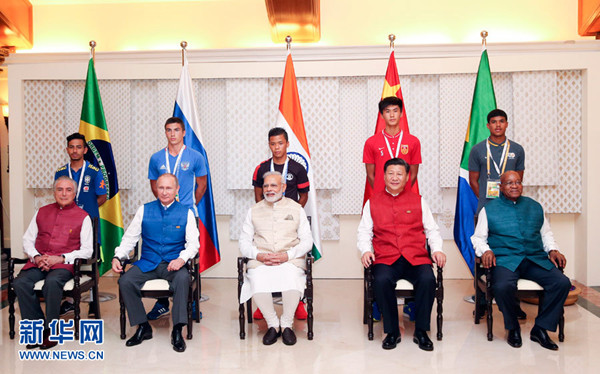
Leaders of BRICS countries pose for group photo with representatives from each country's youth national soccer team in Goa, India, October 15, 2016. [Photo/Xinhua] |
Although the theme of the 9th BRICS Summit is "A Stronger Partnership for a Brighter Future", there is likely to be some underlying tension among the five member states when they meet in Xiamen, East China's Fujian province, from Sept 3 to 5.
Eurasian rivalries such as border disputes are not new of course, but yet again they have shown that disagreements do not militate against cooperation. Furthermore, as emerging powers that wish to have a greater say in global affairs, and with potential leverage in conflict hot-spots such as the Korean Peninsula, the BRICS members should use the platform to propose a way forward to break the current spiral.
On the economic front China and India continue to be important engines of growth in the world economy, having benefited from an open trading system over the years. Undoubtedly the BRICS Summit will reflect unanimity in the members' commitment to an open global economic system, especially one where the industrialized world does not adopt more protectionist measures.
China, India, Brazil and Russia have ratified the World Trade Organization's trade facilitation agreement (with South Africa in the process of doing so). This is important because the "connectivity" promoted by the China-proposed Belt and Road Initiative is not only about building ports, roads and railways, but also about the soft institutional mechanisms that help trade around the world.
India has not joined the Belt and Road Initiative, announcing rather a new initiative with Japan called the "Asia-Africa Growth Corridor", which also seeks to improve connectivity between the two continents. The AAGC was in fact launched at the annual meeting of the African Development Bank in India 10 days after the Belt and Road Forum for International Cooperation held in Beijing on May 14-15. Like Moscow's Eurasian Economic Union, which Russian President Vladimir Putin agreed at the 2015 Ufa BRICS Summit would cooperate with the Belt and Road Initiative, the AAGC offers much opportunity for complementarity.
The fact that the three initiatives are led by BRICS members could help strengthen the practical links between the grouping and other countries-a form of "BRICS Plus". Yet that would require concerted efforts to bridge differences and remove mutual suspicions about geopolitical machinations.
South Africa was the first country in the BRICS to initiate an outreach to other countries when it chaired the summit in 2013. This has been followed by every single chair since then, and has facilitated engagement between BRICS and other developing economies.
However, it is not clear yet what the outreach has achieved in concrete terms. There are no "BRICS projects" per se with outreach countries, but BRICS has been a platform to discuss cooperation, whether bilateral or multilateral. Five years since the first such outreach, it is important to take stock of progress and how to best leverage the convening power of the BRICS in support of global development.
African states recognize the opportunities offered by the AAGC and arguably the Belt and Road Initiative for their development, although the latter still has to define what it may mean for the whole continent beyond Africa's eastern seaboard. While there is much that would still need to be fleshed out before the Belt and Road Initiative and the AAGC plans in Africa could be integrated into the African Union's Agenda 2063, Africans value their partnerships with both India and China and would seek to work on complementarities rather than rivalries. There are enough projects to go around.
Beyond these plans, though, what is crucial for Africa's development in an age of global uncertainty is that the world's great powers in the developing world play an active and constructive role in reducing conflict hot-spots, while managing their own regional rivalries.
The author is the chief executive of the South African Institute of International Affairs.