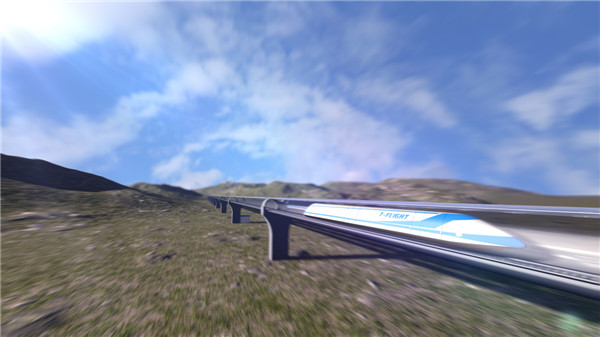
Imagine a train running at 4,000 km/h
 |
|
File photo / China Daily |
Technology faces major challenges
 |
|
Zhao Chunfa, a professor who specilizes in magnetic suspension trains at Southwest Jiaotong University |
However, currently we face some major challenges in that field. For example, hyperloop involves high-temperature superconductivity technology, for which we need materials of the tube to be superconductive to relatively "high" temperatures. But when a train would run at speeds of up to 1,000 km an hour, it will generate lots of heat and vibration in the vacuum tube. The question is: Will the materials remain superconductive to "super high temperatures" and violent vibration?
Besides, for a train to run at more than 1,000 km an hour, its rails have to be very, very smooth, in order to keep the train stable. A flaw of even 0.1 millimeter might cause the train to be unstable making passengers uncomfortable. Sometimes such a flaw could result in the train jumping the rails. And even the most advanced technology today cannot ensure our rails are smooth to that extent over thousands of kilometers.
Some might argue that the proposed hyperloop technology would allow the train to operate in vacuum tubes, but it would still be a mode of rail transport and has to meet the standards.
These are only two of the challenges that hyperloop faces. Others include safety concerns, difficulties in making thousands of kilometers-long vacuum tubes, and extremely high costs. This is not to say hyperloop as a technology is a failure ab initio, but it is necessary to conduct fundamental research first, so as to make it practicable.
Company confident about meeting goal
 |
|
Mao Kai, engineer in charge of the hyperloop program at CASIC |
Besides, CASIC is not the only organization engaged in hyperloop R&D. US-based companies HTT and Hyperloop One are also conducting such R&D, with the latter even using the term "hyperloop" in its name.
Compared with the two companies which aim to increase a train's speed to 1,000 km an hour, our goal is to raise it step by step to 4,000 km an hour. And we are confident of reaching that goal, because we are using electromagnetic force to propel hyperloop "vehicles" forward, while the other two companies plan to run hyperloop "vehicles" on wheels.
As for the major advanced technologies needed to develop hyperloop transportation, including ultrasonic technology, high-temperature superconductive magnetic suspension, as well as simulation and modeling technologies, we are now playing leading roles in all those fields. In other words, we have more mature technologies than our counterparts in other countries at our disposal and we are confident about succeeding in our R&D.