US using Section 301 probe as a weapon
 |
|
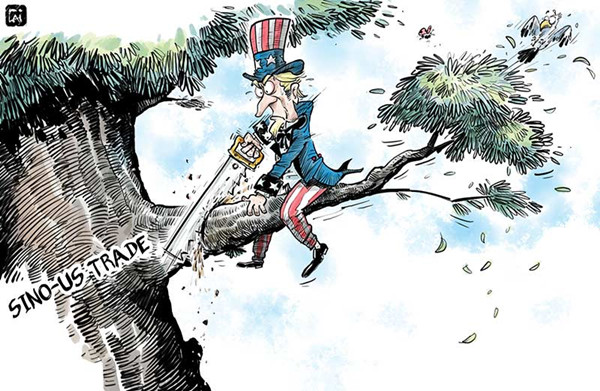
Sino-US trade / China Daily |
The probe into China's new energy industry in September 2010 was the last the US initiated under Section 301, which it eventually withdrew after the two sides resolved the issue through negotiations, according to which the Chinese enterprises involved made certain systemic adjustments.
Sino-US economic and trade relations have indeed been fluctuating after Trump became US president, but investigation under Section 301 is aimed at not only weakening China's position in certain fields but also compromising the multilateral nature of globalization.
If the US eventually imposes sanctions on China, it will set a dangerous precedent in Sino-US economic and bilateral trade ties.
Using Section 301 against its trade partners is an old Washington trick aimed at promoting US values through trade policies, which could have a severe impact on other economies. The US is known to use its market as a weapon to force its trade partners into accepting so-called international trade rules-which are actually made by Washington-in order to further the US' economic interests.
Section 301 smacks of unilateralism and aggressive parochialism; it is a concrete manifestation of how the US uses its domestic laws for political and economic gains. This suggests the US may be using Section 301 this time to increase its exports to China.
Unlike the earlier probes under Section 301, initiated by some US industrial associations, the latest Section 301 investigation against China has been launched by the US government. And since the Trump administration seems hellbent on playing the roles of judge, jury and executioner in the case, the use of Section 301 investigation in every way is arbitrary.
Thanks to its rapid economic development and corresponding growth in its national strength, China has taken giant strides in developing and protecting intellectual property, and made great achievements in building a strong intellectual property rights mechanism.
Since joining the World Trade Organization in 2001, China has implemented many laws and regulations to protect intellectual property rights as part of its commitments to the WTO. China has twice revised its Copyright Law and Patent Law, and one-third of the revision in the Patent Law is related to the WTO's Agreement on Trade-Related Aspects of Intellectual Property Rights, or TRIPS. China has also revised the Trademark Law twice and introduced more than 20 articles to meet the demands of TRIPS.
If, despite these important changes, Sino-US trade frictions snowball into a trade war, it will only expose the US' hypocrisy on the trade and economic fronts.
More importantly, by launching a Section 301 investigation now, the US is using trade protectionist measure to check China's economic and strategic rise, which it sees as a threat to its dominant position.
Since the delicate balance of power in global trade between China and the US over the past few years has been challenging Washington's dominant role, the Trump administration now wants to manipulate the global markets to continue making international trade rules and leading the world economy, and thus curb China's rapid rise on the trade front.
A full-blown trade war between China and the US still doesn't seem inevitable, but that shouldn't prevent Beijing from taking measures to cope with the US' trade protectionist weapon: Section 301.
The author is a researcher at the Chinese Academy of International Trade and Economic Cooperation.