Guizhou takes care of the alcohol problem
 |
|
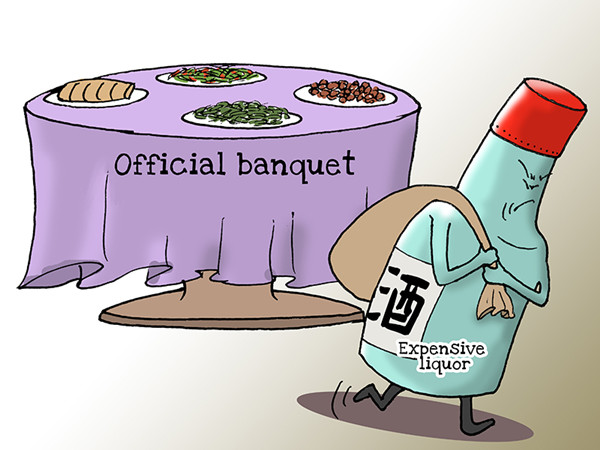
Alcohol ban [Zhao Tianqi / China Daily] |
The ban in Guizhou is remarkable because the province is home to the prestigious liquor brand Moutai and applies to all Party and government units that operate on taxpayers' money, including Party departments, various levels of governments, branches of the people's congress and people's political consultative conference, judicial departments, investigating and prosecuting wings, public institutions and State-owned enterprises.
Although the prohibition order says some foreign affairs and investment-promotion activities can be exceptions, prior permission has to be sought from government department heads before serving alcohol at such events and the discipline inspection commission at the same level has to be informed about the matter. It also has detailed rules on the categories, volumes and prices of the alcoholic drinks that can be served on such occasions.
It is almost predictable that alcohol will no longer flow at official business receptions in the province if the ban is strictly implemented. Statistics show the Chinese government's spending on receptions, cars and overseas business trips reached a record high in 2011. Although government spending on official receptions, foreign trips and cars has dropped markedly since 2012, the prohibition order in Guizhou is still remarkable.
Previously, governments at the provincial, city, county and township levels decided to what extent they would implement the central authorities' prohibition order. And because of the lack of direct, effective supervision by the central authorities, the ban on alcohol was not strictly enforced, as the central discipline watchdogs have occasionally disclosed the "black list" of the violators.
The Guizhou prohibition order reflects the further change in the mentality of provincial authorities as they have taken a stand in concurrence with the central authorities, making strict supervision clear to the lower-level authorities.
The other important aspect of the ban on alcohol at official receptions in Guizhou is that the provincial authorities have supplemented the central authorities policy, which has some loopholes that some grassroots officials often take advantage of to consume, for example, expensive liquor in mineral water bottles in canteens instead of fancy restaurants.
Guizhou's move redefines "official business activities", which includes almost all possible events which officials have occasion to attend during their career and senior officials use to consume as much "alcoholic drinks" as possible. Also, the Guizhou prohibition order makes it clear that senior officials will be held accountable for dereliction of duty if they do not discipline their subordinates who violate the rule, which is widely seen as one of the most potent clause that makes the ban order too powerful to ignore.
But Guizhou's ban on alcohol at official business gatherings still has room for improvement, for instance, it can include public supervision of officials' behavior at business receptions to ensure they think twice before consuming in alcohol.
Still, Guizhou has set an example for other provinces and regions to follow.
 |
|
The author is a writer with China Daily. liyang@chinadaily.com.cn |