THAAD detrimental to peace in region
 |
| China Daily |
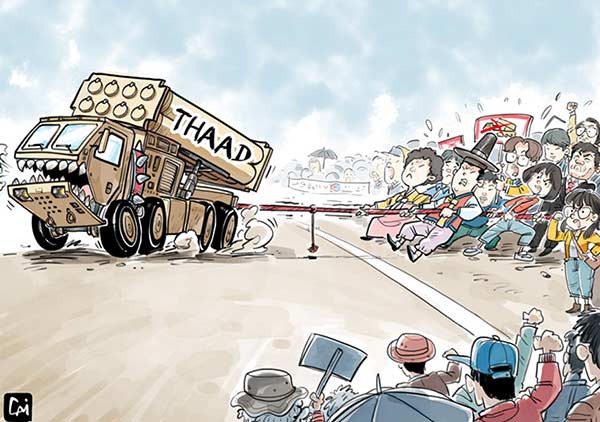
The Republic of Korea announced on Thursday that it had completed the installation of the remaining four launchers of the Terminal High Altitude Area Defense anti-missile system, and the battery will be operational as soon as the United States finishes its internal procedures. A THAAD unit comprises six truck-mounted launchers, 48 interceptors (eight each launcher), and AN/TPY-2 radar and other ancillary equipment.
The deployment of THAAD, to begin with, is contrary to ROK President Moon Jae-in's earlier statement that the antimissile system should not be deployed in a hurry. In fact, when US troops in the ROK started deploying THAAD on April 27, a couple of weeks before he took office, Moon "strongly objected" to the move.
Moon changed his decision mainly for two reasons: the Democratic People's Republic of Korea's sixth nuclear test on Sunday, which has made the ROK feel even more insecure; and the importance Moon attaches to Seoul's ties with Washington and the deployment of THAAD is a good way of expressing that.
On May 31, three weeks after he took office, Moon told visiting US senators that his administration won't change the decision to deploy THAAD. On July 29, one day after the DPRK tested a ballistic missile, he ordered the installation of the four remaining launchers. And after the DPRK conducted a nuclear test on Sunday, he accelerated the deployment of THAAD.
Seoul's security concern is understandable, but THAAD won't protect the ROK against intercontinental ballistic missiles and nuclear bombs. So, by hastening the deployment of THAAD, Moon is actually strengthening the US-ROK alliance.
Moon's other actions also bear this fact out. He paid a five-day visit to the US from June 28, becoming the first ROK president to do so in less than two months of being sworn in. Besides, the entrepreneurs accompanying him on the visit plan to invest $12.8 billion in the US states that voted for US President Donald Trump in last November's presidential election.
By deploying THAAD, Seoul is also trying to put pressure on Beijing to persuade Pyongyang to not create more trouble, because some politicians in the ROK have the wrong notion that China is partly responsible for the Korean Peninsula nuclear issue. In fact, to put more pressure on China to "rein in" the DPRK, some ROK politicians want Seoul to buy nuclear submarines from the US and allow it to deploy more strategic weapons in the ROK.
What they don't realize is that such tactics will only widen the distance between Beijing and Seoul, especially because the deployment of THAAD in the ROK poses a challenge to China's security and strategic interests, and might prompt the DPRK to continue, even expedite, its nuclear program. As a result, the situation not only on the Korean Peninsula but also in the whole of Northeast Asia will worsen.
True, Moon made efforts to improve relations with the DPRK after taking office, but Seoul-Pyongyang ties will not improve if THAAD continues to pose a threat to other countries and thus escalate tensions on the peninsula - and undermine Sino-US trust. In other words, by deploying THAAD, the ROK is also compromising its own interests.
When Moon served as the chief presidential secretary to former ROK president Roh Moo-hyun from 2007 to 2008, China and the ROK enjoyed very good relations and agreed on many aspects of the peninsula nuclear issue. That was a major reason why China had high expectations from Moon when he took office. Moon himself said he attaches great importance to the ROK's relations with China, but by accelerating the deployment of THAAD he has only hurt bilateral ties.
We hope Moon will make sincere efforts to improve bilateral ties and his administration will work with the Chinese government for the betterment of the people of the two countries.
The author is a researcher of Asia-Pacific studies at the Chinese Academy of Social Sciences.