Party's plans look to deal with changes
 |
|
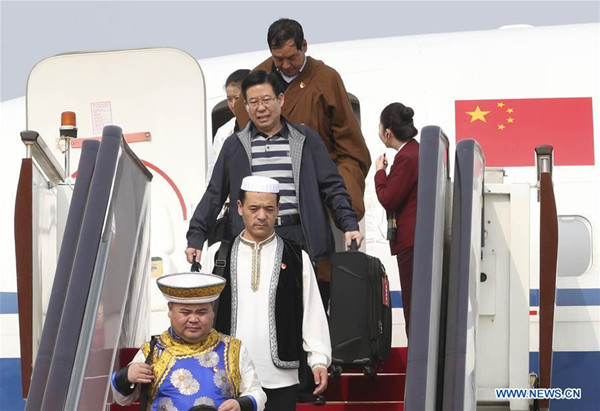
Delegates of Qinghai province to the 19th National Congress of the Communist Party of China arrive at the Capital International Airport in Beijing on Oct 15, 2017. [Photo/Xinhua] |
On Wednesday, the Communist Party of China will hold its 19th National Congress. Held every five years, the national Party congresses herald important changes for the country. The last congress saw two critical changes: Xi Jinping became top leader and the Chinese labor force began to decline. The former brought conspicuous improvements to the Party and captured the world's attention. The latter signaled an aging society, and that China's economic development had entered a new normal.
Traditional economics textbooks say that output is determined by two variables: capital and labor. The Chinese economic miracle over the past 39 years has combined heavy capital investment with a large population.
But investment has hit a ceiling, and China's labor force has declined. This shortfall in surplus labor is called the Lewis turning point, and China reached it in the last five years. In fact, in 2012 GDP growth dropped from the previous year's 9.5 percent to 7.7 percent. In subsequent years, GDP growth has declined to 6.7 percent. In 2030, a huge population decline is expected.
There is however a third variable that can be decisive to the rate of economic development-innovation. This variable can rewrite the economic textbook.
Innovation changes the game in three main ways. First, it reduces marginal costs to zero. For instance in an old post office, one Chinese character (equivalent to 2 bytes) used to be sent at a cost of 3 cents. Now, with online communication software like WeChat, 2 bytes or 2 kB or 2 GB, or even things a billion times bigger can be sent for free. Therefore, the marginal benefit becomes infinitely great.
Second, traditional economics teaches that natural resources are always limited. However, information is an unlimited resource that breaks this rule.
Third, innovation has created a shared economy that totally contradicts traditional economic concepts such as competition, trade, and private ownership.
Take symbols of the new economy such as big data, cloud computing, fintech firms, new energy cars, internet plus, and the countless innovative industries in China. These industries have been growing at an annual rate exceeding 20 percent, even in the new normal. By 2016, they already accounted for 31 percent of GDP, at 24.3 trillion yuan ($3.69 trillion). They are predicted to double in size and could account for more than half of China's GDP in five years' time.
At the last CPC National Congress, the objective of doubling China's GDP and per capita income over the following 10 years was set. With an average GDP growth rate of 7 percent over the next five years, this will be achieved just in time. But with an innovation boost, this can be achieved much earlier. We could call this the Chinese New Deal.
The new Chinese leadership is expected to outline a "New Deal" for the next five years and beyond during the 19th CPC National Congress. Its policies might include three shifts of emphasis: a shift from a focus on GDP to GNP, statistically giving more attention to China's international assets and yields; a shift from export-led growth to overseas investment, such as the Belt and Road Initiative, and a shift from heavy industries to innovative industries. After such structural readjustments, aging will no longer be a problem so long as the elderly remain healthy and productive, utilizing their mental faculties rather than their physical strength. Investment will break the ceiling to play in the global arena and innovation will give China's economy new ballast to reach new heights.
Nevertheless, one thing is still missing in the China model. Countries such as Israel and the United States still lead the world in technology and startups. Without policy support from the new leadership, the Chinese economic boat won't be able to move in the right direction. Luckily, China has the Party's leadership to guide it. This is China's unique strength. This could be called the fourth economic variable and completes the Chinese economic textbook.
The coming CPC National Congress will help China cope with these changes, be they natural or economic, social or political, domestic or international. The CPC will lay down a new deal to lead China's economy in this changing world.
The author is a senior fellow at the China Center for International Economic Exchanges and editor-in-chief of Globalization Journal.
Source: chinausfocus.com