Innovative leadership for new era in China
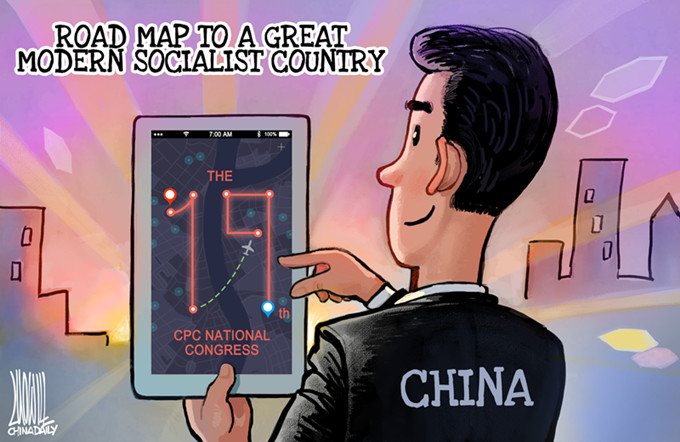
In his speech at the opening of the 19th National Congress of the Communist Party of China on Wednesday, General Secretary Xi Jinping set a new course for socialism with Chinese characteristics in a new era.
As head of the largest communist party in the world, Xi's challenge is to re-engineer the CPC to ensure it can effectively and innovatively deliver leadership. The question is how to take Marxism, a 19th-century economic theory that analyzed social relations during the industrial revolution, and make it relevant to China in the 21st century, when the nation leads the world in green finance, mobile phone banking, artificial intelligence research and robotics development.
Bridging those eras is a momentous undertaking. It is also generational. No wonder that Xi spoke for three and a half hours detailing the blueprint for transforming the CPC so that it can lead China into a high-tech and environmentally healthy future.
Economic distortions and imbalances topped Xi's list of concerns. He addressed these by calling for development of China's vast interior, so as to eliminate the last pockets of poverty and rebalance the economy. An entire program for reinvigorating the interior was at the core of his agenda, rehabilitating rural villages by creating new ecological cities that have the amenities, health, welfare and social services to draw migrants back to their hometowns for opportunities. As ambitious as it sounds, this is a necessary task to reduce social and income gaps, and even the economic playing field between the coastal and interior areas.
For the CPC, managing the expectations of China's growing middle-income group may prove as much of a challenge in the decades ahead as it was to raise so many people out from poverty in the preceding decades. Topping the concerns of China's middle-income group are the need for efficient transport, comprehensive healthcare, and lifestyles that have quality over simply quantity. In this respect Xi has called for quality growth, emphasizing that China's socialist market economy should be more than just high-speed growth in the new era.
A healthy environment matters for a higher quality of life. Creating an ecological civilization goes beyond calling for protection of the environment. It envisions environmental protection as the next driver for technology, innovation and a plethora of new industries for renewable energy grids, new energy transport and energy saving household appliances. Smart, green and sustainable are thus the standards that will need to be met in the new era. An ecological civilization goes beyond ecology. It includes urban ecology and preservation of heritage sites (many of which were bulldozed during the previous decades of development). Xi emphasized the importance of rejuvenating China's heritage as core to the Chinese Dream, to give generations ahead a sense of pride in their Chinese identity, the importance of which was underscored in an unqualified way in Xi's speech.
In many respects, this is also the first CPC congress that emphasized China's role in an integrated global context. Opening speeches at previous congresses had always focused on domestic issues, reform and opening-up, grappling with static State-owned enterprises, or how to maintain rapid growth. This time, Xi instead presented China as a global leader, sharing its own experiences in overcoming underdevelopment, re-balancing over-growth, correcting social imbalances and environmental damage by combining planning with the market.
From a political perspective, Xi noted how "a political system cannot be judged in abstraction without regard for its social and political context, its history and its cultural traditions". His words easily resonate with many countries in the developing world that face the challenge of external interference in their political systems from powers that fail to understand the social and historic complexities underlying their present conditions and development. By emphasizing the role of the Belt and Road Initiative in developing smart infrastructure to support bands of economic development, together with respect for sovereignty, he underscored the importance of addressing the sources of international risks, volatility, and violence.
In his speech, "innovate" topped the list of terms such as "unity", "solidarity", "vigilance" and "vitality" that were held up as necessary for CPC members to lead. And in a new era, it makes perfect sense that the ability to be innovative is the key requirement for the CPC.
Xi openly talked about past problems of corruption and abuse of power, saying, "We must have the determination to get rid of all outdated thinking and ideas and all institutional ailments, and to break through the blockades of vested interests." Thereby challenging conservative thinking and entrenched processes not consistent with the current new era we live in.
While Xi opened the 19th CPC National Congress by honoring the revolutionary leaders who founded the People's Republic of China in 1949, it is notable, therefore, that he ended his speech by acknowledging the importance of China's youth, and stated that, "a country will be full of hope and have a great tomorrow only when its younger generations have ideals, ability and strong sense of responsibility".
The author is a senior research fellow at Center for China and Globalization.