Stronger Sino-Russian ties help Eurasian integration
 |
|
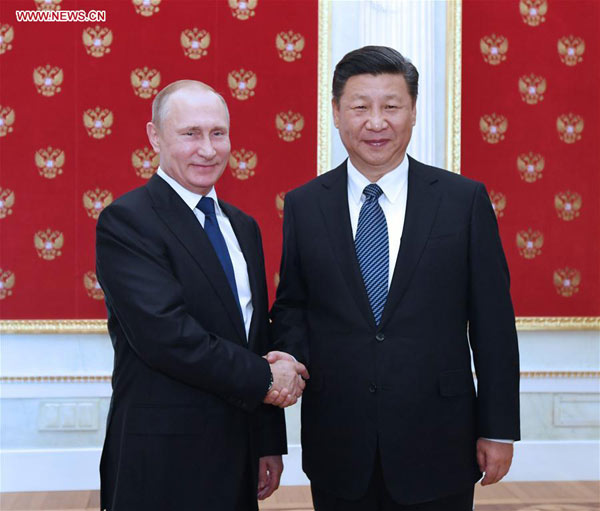
Chinese President Xi Jinping (R) meets with his Russian counterpart Vladimir Putin at the Kremlin in Moscow, capital of Russia, July 3, 2017. [Photo/Xinhua] |
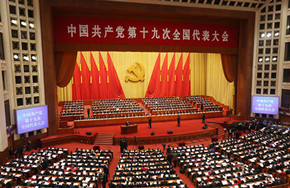
Russian President Vladimir Putin congratulated President Xi Jinping on his re-election as the general secretary of the Communist Party of China Central Committee and the success of the just-concluded 19th Party National Congress during a phone call on Thursday. He also hoped that Xi will lead the world's largest political party to achieve new goals.
Putin's congratulatory call came just five days before Russian Prime Minister Dmitry Medvedev pays a three-day visit to Beijing, during which he is expected to meet with President Xi Jinping. Medvedev will also hold a meeting with Premier Li Keqiang-the 22nd regular meeting between the Russian prime minister and Chinese premier.
Medvedev is among the first foreign leaders to visit China after the 19th Party Congress, which concluded on Oct 24. And his visit to China is evidence that Moscow holds its partnership with Beijing in high esteem.
The major-country diplomacy with Chinese characteristics, China's diplomatic approach that was part of Xi's report to the 19th Party Congress, is expected to upgrade the already close China-Russia relationship, as bilateral coordination deepens over major global and regional affairs. The China-Russia "comprehensive strategic partnership of coordination", which Beijing values highly, will see more regularized meetings between Russian and Chinese leaders and is expected to play a much bigger role in the global arena.
The past 20 years or so have been arguably the best period for China-Russia relations. After the end of the Cold War and the disintegration of the Soviet Union in the early 1990s, China and Russia managed to recalibrate their ties in just one decade by settling past disputes, regularizing leadership meetings and expanding cooperation channels.
The strengthening of China-Russia ties in the post-Cold War period means both countries are paying greater attention to each other's core interests and concerns, as well as their geopolitical strategic cooperation and economic exchanges, as part of their efforts to rise above the China-Soviet Union relationship, which was bogged down by Cold War mentality and geopolitical entanglements.
Sharing their respective pursuit of national rejuvenation and modernization, China and Russia now have more incentives to deepen their partnership and help optimize global governance, especially at a time when globalization is facing strong headwinds. The Beijing-proposed Belt and Road Initiative and the Moscow-led Eurasian Economic Union could well serve that end.
At the heart of the major-country diplomacy with Chinese characteristics is China playing a bigger, more constructive role in global governance. The Belt and Road Initiative, in essence, is designed to facilitate the modernization and connectivity of the Eurasian landmass, including Russia. The initiative's integration with the EEU, according to Russia's First Deputy Prime Minister Igor Shuvalov, might increase bilateral trade to $200 billion by 2020 while boosting high-tech, raw material, cultural and humanitarian exchanges.
In the light of China's major-country diplomacy, Beijing-Moscow ties will hinge on strategic cooperation and joint efforts to advance modernization, rather than on strategic partnership alone, instilling vital energy and momentum to the Eurasian integration process at a time when the United States has adopted an inward-looking policy.
The author is deputy dean of the School of International and Public Affairs, Jilin University.
- China-Russia relations draw closer through cultural promotion
- China will not change determination to deepen relations with Russia
- Russia's Putin hails 'open' CPC congress
- From Russia, with love
- China-Russia border port sees robust fruit and vegetable export growth
- Russia firm plans China cargo boost