False notion led to wrong impression about China
 |
|
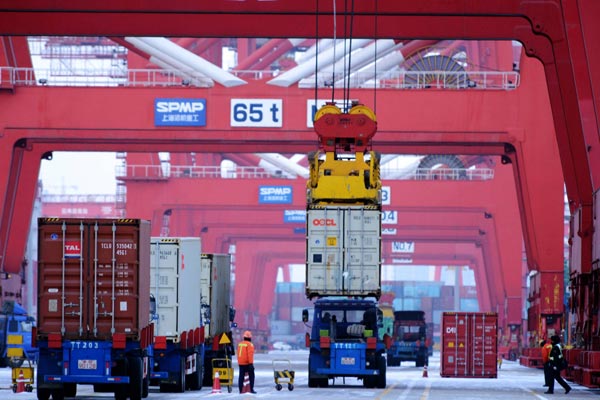
A ship loads containers at a terminal in Qingdao, Shandong province. [Photo/China Daily] |
It's a book that takes on conventional thinking-if not biases-held by many Americans about China, and very simply knocks it down. And it could come at no better time since US President Donald Trump will start his first state visit to China in a few days and misperceptions about China seem to be as rife in the White House as they are in average American households.
Former World Bank China director Yukon Huang talked about his latest book, Cracking the China Conundrum: Why Conventional Economic Wisdom Is Wrong, last week to an audience at World Bank headquarters in Washington.
Huang, a senior fellow at the Carnegie Endowment for International Peace, said at a book talk on Oct 27 that Trump and his advisers had said that too much of US foreign direct investment is going to China, resulting in job losses and declining competitiveness.
According to the White House, "we left jobs overseas, we left jobs to China; we need to bring them back here", but, in fact, only 1.5 percent of US foreign investment goes to China, Huang said, backing up his claim with a slew of diagrams.
"In my book, I explain this by the composition of trade and say if we get the diagnosis wrong, we get the policy recommendations wrong," he said. "It is about how to get more of America's foreign investment to China, rather than worrying that too much is going to China."
Speaking at a panel discussion on "China's 19th Party Congress Outcomes and Analysis" sponsored by the US-China Policy Foundation on Oct 26, Huang said that many average Americans share Trump's sentiment that China is responsible for the US trade deficits.
Those deficits were significant in the 1990s and had surged by 2006 and then they started to moderate. China's trade surpluses were essentially nonexistent until 2004 or 2005, then they started to get very big and then they came down, Huang said.
"America's trade balances and China's trade balances move totally in the wrong direction," he said.
In his book, Huang argued that trade balances are the result of multilateral rather than bilateral relationships.
"How could China be responsible for America's trade problems, when in fact, America's trade problems existed long before China even became an export power and their balances moved in opposite directions?" he writes in his book.
False perceptions about trade have created a wrong impression in the United States about who is the world's leading economic power, according to Huang.
A decade ago, annual surveys of Americans by Gallup and Pew about who is the world's leading economic power would generate a clear answer: America by far was the leading economic power; only 10 percent said it was China, Huang said at the discussion.
Today, the majority of Americans will say China is the world's leading economic power, while the vast majority of Chinese say America is, Huang said.
But the vast majority of China analysts argue that internal rebalancing is needed, and this view has featured prominently in China's policy discussions with the US.
For despite its impressive performance, China's growth process has been internally unbalanced, defined by its exceptionally low share of consumption to GDP and comparatively high share of investment to GDP.
Huang said cracking the conundrum of China is not whether one should be positive or negative about China's economy and its implications for the US, but instead about fitting China into a framework that leads to a better understanding of the reality.
The author is deputy editor-in-chief of China Daily USA.
huanxinzhao@chinadailyusa.com
- China-US relations are key to global, regional stability
- China, US communicating on deepening economic ties: spokesman
- First China-US investment database launched in New York
- Xi takes solid steps in China-US ties
- China, US work on clean energy cooperation at bilateral forum in Denver
- China, US hold first law enforcement and cybersecurity dialogue