China's vision for the future bright
 |
|
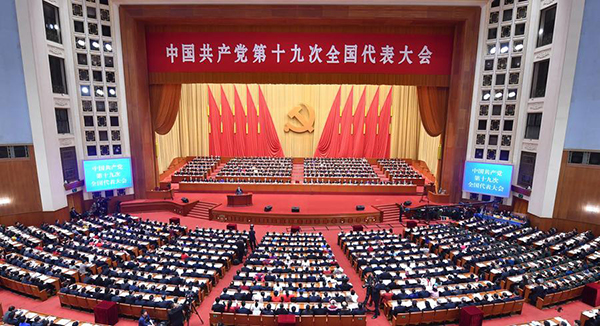
Xi Jinping delivers a report to the 19th CPC National Congress at the Great Hall of the People in Beijing, Oct 18, 2017. [Photo/Xinhua] |
The 19th National Congress of the Communist Party of China approved an amendment to the Party Constitution to enshrine "Xi Jinping Thought on Socialism with Chinese Characteristics in a New Era". The congress also produced a blueprint for China's development until 2050, one that reflects the changes that economic reform and opening-up have brought to the country.
With that in mind, the 19th Party Congress charted a new road map, based on the "two centennial goals" inherited from the 18th Party Congress-to build a "moderately prosperous society" (xiaokang) by 2021, and to transform China into a "fully developed and advanced nation" by 2049.
The 19th Party Congress went some way toward marking the path between these two goals, asserting that once the first centennial goal is realized, the next task will be to modernize Chinese society by 2035. Such a modern China would be a world leader in innovation, with a clean environment, a large middle-income group, and a much narrower gap between rural and urban growth, public services, and living standards.
Achieving these goals will require the Chinese leadership to understand where in the development process China is. It is promising therefore that the leadership acknowledged at the 19th Party Congress that China is and will remain in the primary phase of socialism. China must, therefore, sustain economic growth to solve the country's problems.
Given this, China's top leaders promised that they would continue implementing structural reforms and advancing economic liberalization. This builds on a resolution, adopted at the Third Plenum of the 18th CPC Central Committee in 2013, to give the market the "decisive role" in allocating resources.
As the 19th Party Congress acknowledged, honoring these commitments will require China to protect private property rights and entrepreneurship. The importance of this is highlighted by the fact that the private sector contributes more than 60 percent of China's GDP, 50 percent of its taxes, 70 percent of its technological and product innovations, and 80 percent of its jobs, despite accounting for less than 40 percent of the inputs.
As for liberalization, China is committed to implementing policies to open further its markets to trade and foreign investment, while protecting the legitimate rights and interests of foreign investors. As part of this effort, the government is authorizing further free-trade zones, and exploring the possibility of free-trade ports in selected locations.
China seems to be on track to achieve its goal of becoming a high-income economy by 2035. But it will have to sustain labor productivity growth of at least 5 percent annually for the next 15 to 20 years-an outcome that will depend on rising urbanization and deepening technological progress.
To achieve success, China has to effectively adapt to changing internal and external conditions and manage the risks that have accumulated in recent decades. For example, it must tackle growing income inequality, driven largely by the massive disparity between urban and rural incomes.
According to China Household Financial Survey data, China's Gini coefficient-the most common measure of inequality-climbed from 0.283 in 1983 to 0.474 in 2012. Though the Gini coefficient dropped to 0.465 by 2016, it still exceeded the 0.24-0.36 range for major developed economies.
If China fails to contain inequality, its long-term growth could suffer. But with a clear development blueprint and a powerful leader whose political clout all but guarantees continued reform, China might be in a strong position to address the challenges it faces and sustain its unprecedented economic success.
Yet even if China achieves its goals for 2050, the challenge will not be over, because it will then have to contend with an aging population. By 2050, 36.5 percent of China's population is expected to be above 60, according to the 2017 revision of the United Nations' World Population Prospects. The median age may be as high as 49.6, higher than in the Sweden, the United Kingdom, the European Union as a whole, and the United States. This makes it all the more crucial for China's leaders to make the right decisions and put the country on a stable footing by 2050.
The author is a professor of Economics and director of the China Center for Economic Studies at Fudan University.
Project Syndicate