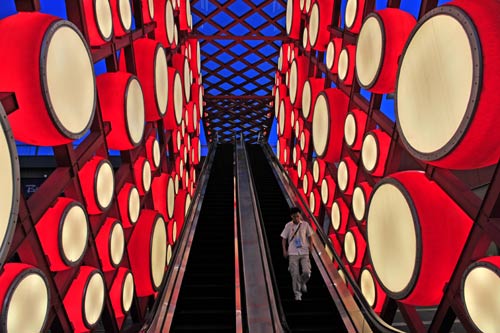
 Underground square in the Olympic Green(Xinhua)
For those who visited the Olympic Green in north Beijing during the Olympic and Paralympic Games, it was a journey not only of sports, but also the Chinese culture.
After watching Games competitions in the iconic Bird's Nest and Water Cube, the visitors could also read a "China Story" carefully prepared for them by the Games organizers.
It is staged in the north part of the Olympic Green Common Domain, where 30 tent-like houses attract an endless influx of people every day. Titled "China Story," the grand culture exhibition opened with the Olympic Games on August 8 and will last through the Paralympic Games' closing on September 17.
Most of China's provinces, municipalities and autonomous regions, as well as the two special administrative regions of Hong Kong and Macao, have come to the exhibition to display their unique intangible cultural heritages.
Though Wednesday was a working day, all the 30 "China Story" houses were full packed with visitors, with more people lining up at the gate and waiting for their turns to enter. The Sichuan House features the impact of the May 12 earthquake on the culture of Qiang ethnic group. Photos show watchtowers, or "Diaolou" built by the Qiang people, as well as their centuries-old marriage customs. The magnitude 8 earthquake in May damaged the Qiang ethnic culture seriously.
Two museums highlighting the culture of the Qiang people in Beichuan and Maoxian counties were leveled to the ground. Numerous residential houses, watchtowers and bridges in the Qiang community were destroyed, according to the exhibition in Sichuan House. Fortunately, the Chinese government has launched a special conservation program for the Qiang culture, including its unique language, buildings and customs.
"The exhibition of Sichuan House impressed me the most, as it showed the earthquake's devastating nature, as well as the government's emphasis on ethnic cultural preservation," said Dai Ping, 29, who works for a publishing house in Beijing.
Liu Cheng, a local private company owner, brought his three-year-old grandson to visit the "China Story" exhibition. In the Tianjin House, he explained to the boy what was a "New Year picture" and what was the "clay figurine." He also bought his grandson a set of "clay figurines" featuring Chinese boys in the rural areas celebrating the Spring Festival, or the lunar new year. "I want my grandson to learn and bear in mind the traditional Chinese culture as early as possible. I hope he will feel proud of the country's splendid culture when he grows up," he said.
The Guangdong House is distinctive for the "Lingnan culture" it puts on display. Many visitors took pictures in front of a Chaozhou woodcarving showing the pattern of the "Bird's Nest," while others listened attentively to House staff's introduction of the history of "Guangdong Lion Dance," or enjoyed the "Canton Embroidery" and "Dawu Clay Sculpture".
A middle-aged man surnamed Zong brought his wheelchair-bound wife to the Guangdong House. "The culture in Guangdong is very different from that of Beijing, so we are here to learn in details, " Zong said. Zong thought visiting the "China Story" exhibition is a very efficient cultural journey for his wife and himself, as they can learn about almost all well-known intangible cultural heritages in China in just a few hours.
"My wife seldom left home in the past, but over recent years, Beijing's barrier-free facilities have greatly improved, making it possible for us to be here," he added. In Jiangsu House, visitors marveled at this eastern coastal province's rich cultural heritage, such as Suzhou Embroidery, Nanjing Yun Brocade, Duihua Folk Art, Huishan Terra Doll, and Zisha Ceramics. But they paid more attraction to a man who was writing an ancient Chinese poem with a brush pen in his mouth.
His calligraphy was applauded by all, and he did not mind telling his story to others. A native of Jiangsu, his name is Shi Xiaohua. He lost both arms after touching a high-tension wire when he was six. Later on, he started to exercise Chinese calligraphy by mouth, for fun and also for finding back faith in life.
Currently working for the Beijing Disabled People Art Troupe, Shi was invited by the Jiangsu provincial cultural department to demonstrate his calligraphic skills at the Jiangsu House. It can highlight both the unyielding spirit of the disabled people and the traditional Chinese culture, department officials believed.
The Olympic Green now attracts more than 200,000 visitors a day, most of whom visit the "China Story" exhibition, according to sources with the Games' organizing committee. Lingering in various exhibition houses for hours, American visitor Brian Godzik looked intoxicated by the Chinese culture he had seen.
"The exhibition is beautiful and makes me understand the culture and people of different areas of China, and how those wonderful cultures come together to form China's marvelous culture," he said.