REGIONAL> Development

|
REGIONAL> Development
|
|
More firms restructure in Shanghai
By Zhou Yan (China Daily)
Updated: 2009-07-20 11:50
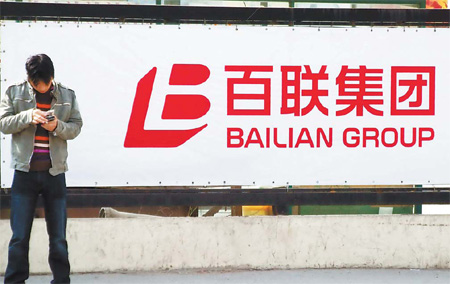
A man stands before a billboard of Bailian Group in Shanghai. Bailian Group, the country's largest retailer, recently submitted its restructuring plan to State-owned Assets Supervision and Administration Commission. Asianewsphoto SHANGHAI: The contraction in economic growth for Shanghai has accelerated the pace of restructuring among Shanghai State-owned enterprises. Trading was suspended early this month for eight of 72 companies listed on the Shanghai Stock Exchange to allow restructuring talks. The latest was financial services providers Aijian Corp. Prior to late last month, several publicly held or unlisted companies under the supervision of the State-owned Assets Supervision and Administration Commission (SASAC) had submitted restructuring plans. Among them is Bailian Group, the country's largest retailer and electronics giant SVA Group Co. The SASAC reported that 30 of 46 supervised companies submitted three-year restructuring and development plans between July and March 18. "Each group has already mapped out its core business and, guided by the asset regulator, nailed down corporate structures," Zhang Huiming, an economist at Fudan University, told China Business Weekly. "The next step is to present their restructuring targets," Zhang said. Zhang, who is actively involved in the local government's talks on state-owned assets' mergers and acquisition issues, said more restructuring plans are in the pipeline. But the benefits of restructuring depend on the "market environment" and the "management capabilities" of the companies, he added. By the end of 2008, the net assets owned by the local government-controlled companies reached 1.15 trillion yuan, accounting for one-tenth of state-owned assets nationwide. Shanghai has suffered from the global economic downturn, and Zhang said local asset regulators determined the timing was right to encourage restructuring to simultaneously prop up mainstay companies and spin off bad assets. Official figures showed the output of Shanghai-based industrial enterprises with more than 5 million in annual income totaled 188.9 billion yuan in 2009 - down 2.1 percent year-on-year. The national output, by comparison, was 8.9 percent. "The local economy's decline at levels sharper than the national average has become one of the major drivers for reform of State-owned assets," said Xu Wei, a strategic analyst at Guojin Securities. Last September, Shanghai's municipal government announced that the number of Shanghai-based, State-owned groups would be trimmed from 47 to between 30 and 35 within the next five years. The goals are to strengthen state-owned enterprises via restructuring, and attracting more involvement from foreign enterprises and area companies outside Shanghai, Yang Guoxiong, director of the local SASAC office, said at a recent news conference. The accumulated capital raised by the exchange's 72 listed firms with major shares controlled by the local government reached 41.7 billion yuan in the stock market last year. According to the local asset watchdog's deputy director, Liu Xie, the proportion of listed assets among the total state-owned assets will increase from 18 percent to 40 percent within the next three to five years. "The 40 percent target will be translated into over 250 billion yuan in assets injected into these publicly-held companies," Guojin's Xu said. Shanghai-based State-owned companies have to accelerate their restructuring efforts to overcome their currently poor financial performances to help Shanghai develop into an international financial center, said Mao Nan, a senior analyst with Orient Securities. Shanghai Airlines, for example, lost 1.25 billion yuan in 2008 with a liability ratio of more than 90 percent. The heavily debt-laden company has been listed "under special treatment" on Shanghai's stock exchange this year. The market is mature enough for State-owned companies to float shares, given the stable capital market, said Changjiang Securities' Zhang Fan. "Asset securitization is the major trend going forward," said Fudan's Zhang. |
主站蜘蛛池模板: 高碑店市| 吴川市| 长宁区| 杭州市| 会东县| 濉溪县| 花莲市| 尼玛县| 陇南市| 秦安县| 西峡县| 阜平县| 三明市| 阿克苏市| 巴塘县| 瓦房店市| 郸城县| 吴堡县| 福海县| 遂川县| 博白县| 黎平县| 曲靖市| 华池县| 垦利县| 绵竹市| 闽侯县| 津南区| 济源市| 彭阳县| 开封县| 化州市| 伊金霍洛旗| 波密县| 龙泉市| 长沙县| 垫江县| 安岳县| 堆龙德庆县| 丹巴县| 天全县| 湖口县| 布尔津县| 阳东县| 馆陶县| 玉山县| 嵩明县| 马鞍山市| 宁明县| 航空| 大埔县| 西贡区| 门源| 宜兰市| 永宁县| 布拖县| 吉隆县| 田东县| 桐庐县| 久治县| 青浦区| 宜良县| 澳门| 正宁县| 西吉县| 肥乡县| 青岛市| 宜宾县| 永兴县| 阿坝县| 会泽县| 大埔县| 五河县| 库车县| 浦城县| 镇原县| 浪卡子县| 隆尧县| 贵溪市| 灯塔市| 息烽县| 兴宁市|