Shandong
Superstitious Chinese flock to wed before 2010 Lunar New Year
Updated: 2009-11-26 11:47
Urged on by superstitious parents, flocks of Chinese young people are rushing to get married before February 14, the start of the 2010 Lunar New Year.
The Chinese lunar calendar divides a year into 24 periods (called "solar terms") that include a "Spring Commences" period, which the Chinese believe to be a time of Yang (masculine) energy.
But the 2010 lunar year starts after the "Spring Commences" period is over and ends before the next period begins in 2011, meaning 2010 doesn’t have that Yang energy.
To Chinese women, no Yang means no husband, which makes a woman a widow. This is why the 2010 lunar year is called a "widow year".
Tradition-minded Chinese parents also fear consequences including harm to husbands, disrupted marriages and unlucky children.
A man surnamed Luo from Weifang, Shandong province said that he and his fiancée had planned to get married next May, but his mother kept urging him to tie the knot within the 2009 Lunar Year. Several friends of his were also pushed by their families to advance the date before the next lunar year.
A woman surnamed Chang from Shenyang, capital city of north China’s Liaoning province, said "I just received a surprising call from my friend, announcing that she decided to get married at the end of this year. It really took me by surprise, since just days ago she told me the wedding was to be held next year.”
In Naning, capital city of Guangxi Zhuang autonomous region in south China, staff from the Wharton International Hotel and Mingyuan Xindu Hotel said they have seen a rise in bookings for wedding receptions. “The hotel’s wedding halls are fully booked for November and December,” one unnamed staff member said.
An unnamed wedding planner from the city’s Figaro Wedding Plaza said business thrives in November and December, “especially at weekends, when seven to eight couples get married in a single day”.
The Chinese calendar incorporates elements of the lunar calendar (also known as "agricultural calendar") with those of a solar calendar (or "common calendar”). Ancient Chinese only used the lunar calendar because China was fundamentally an agricultural country.
Yet in modern China, with increasing connections to the western world, the solar calendar is commonly used for day-to-day activities. The lunar calendar is used for marking traditional holidays, determining the 24 solar periods and choosing the most auspicious day for a wedding or the opening of a building.
The lunar year normally begins with "Spring Commences" and ends with "Severe Cold" (see figure below).
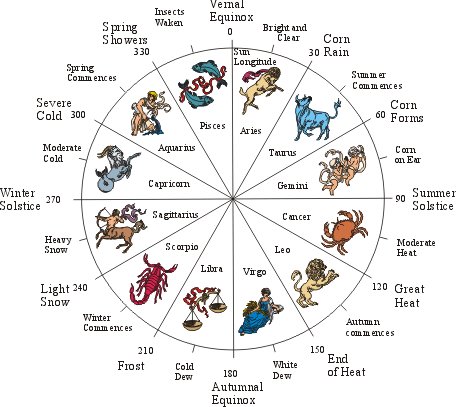 |
| The 24 solar terms and the 12 zodiac constellations |