Green Solutions Special
Carbon trading set to rewrite eco-rulebook
By Zhang Yu'an (China Daily)
Updated: 2009-12-07 07:52
 |
Large Medium Small |
|
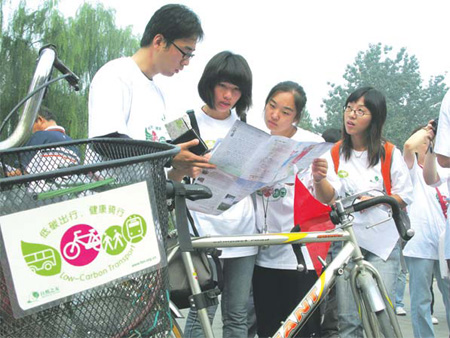
Environmentalists advocate low-carbon lifestyles and transportation throughout China. Deng Jia |
Market forces can play an important, if invisible, role in China's efforts to curb carbon emissions and the potential for carbon trading in the country is huge, according to the chairman of a new initiative aiming to introduce a little US-style environmental know-how across China.
Jeff Huang, assistant chairman of the Tianjin Climate Exchange (TCX) and vice-president-Asia of the Chicago Climate Exchange (CCX), said "Cap-and-trade schemes can prove themselves to be very cost-effective in this area."
The Chinese government has been active in regulating CO2 emissions and invests hugely in environmental protection projects aimed at pursuing sustainable economic growth.
Establishing a complete greenhouse gas cap-and-trade system nationwide will help boost its success in achieving its goals in this area. Such a system will enable companies to meet emission reduction targets at the lowest possible cost whilst, collectively, seeing cap emissions growth leveling off or actually reducing, depending on the rules of the cap-and-trade system.
Curbing carbon dioxide emissions through cap-and-trade scheme can reward companies who are able to achieve higher level of reductions than their target. They can then become vendors in the market and are free to sell their surplus to other companies who cannot meet their targets, for whatever reason.
Buyers in a well-designed cap-and-trade system can buy allowances ensuring that overall, emissions under the cap are being managed, Huang said. Overall, cap-and-trade is a system for building in economic incentives for clean energy use and emissions management, leading to their eventual reduction.
As China is one of the largest carbon dioxide emitters in the world, there is considerable potential for environmental and economic benefits through carbon trading
Attracted by the environmental and business potential, the CCX is working with the Tianjin municipal government and the China National Petroleum Corporation (CNPC) - the country's largest oil and gas producer - on the launch of the Tianjin Climate Exchange, of which the registered capital hit 100 million yuan.
Although cap-and-trade still requires industry-wide education and discussion, Huang is optimistic about the development of the TCX, based on the growth and market development history of the CCX and its affiliated exchanges worldwide.
Launched in 2003, the CCX now has over 400 members, including more than 100 industrial emitters, offset project providers and aggregators, as well as financial and trading firms. The emitting companies sign a voluntary, but legally binding, contract to reduce their baseline emissions each year. The current minimum reduction level is an entity-wide reduction of a minimum of 6 percent, below the average baseline level of the year 2000, by the end of 2010.
The current CCX total baseline is approximately 600 million metric tons, which is more than the capped emissions baseline of Germany under the European Union Emissions Trading Scheme.
This means that, through the CCX, the United States has more tons of absolute greenhouse gas emissions under a capped system than any other country. In 2008, CCX traded approximately 70 million metric tons of cash instruments on CCX itself, as well as an additional 40 million tons in CCX futures and options traded on the Chicago Climate Futures Exchange (CCFE), a wholly owned subsidiary of CCX.
During US President Obama's first state visit to China, the two countries signed a joint statement, agreeing that "the transition to a green and low-carbon economy is essential."
This is an encouraging sign and good news for carbon traders, said Huang. He also believes that the CCX can market its experience in environmental finance and cap-and-trade in China.
As a large potential carbon trading market, it is also essential for China to establish its own rules and framework that can be eventually linked to a global carbon trading market, Huang said.
The CCX, the Financial Research Academy of the People's Bank of China and CNPC have now committed to jointly establishing a low-carbon financial research center to develop financial tools for carbon trade.
(China Daily 12/05/2009 page6)