Culture Tourism
Kaifeng
(en.wikipedia.org)
Updated: 2010-06-01 16:55
 |
Large Medium Small |
Kaifeng is one of the Seven Ancient Capitals of China. Like Beijing, there are many reconstructions.
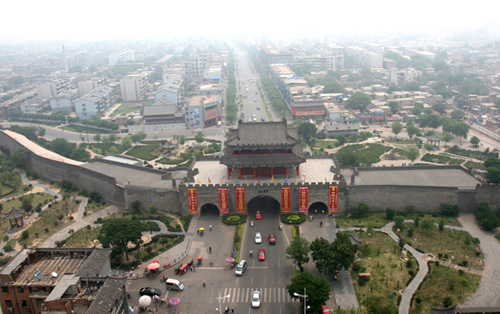 Kaifeng city |
In 364 BC, the state of Wei during the Warring States Period founded a city called Daliang as its capital in this area. During this period, the first of many canals in the area was constructed; it linked a local river to the Huang He. When the State of Wei was conquered by the Qin, Kaifeng was destroyed and abandoned except for a mid-sized market town, which remained in its place.
Early in the 7th century, Kaifeng was transformed into a major commercial hub when it was connected to the Grand Canal as well as a canal running to western Shandong Province.
In 781 (Tang Dynasty), a new city was reconstructed and named Bian. Bian was the capital of the Later Jin (936-946), Later Han (947-950), and Later Zhou (951-960) of the Five Dynasties Period. The Song Dynasty made Bian its capital when it overthrew the Later Zhou in 960, and shortly afterward, they further expanded the city.
During the Song Dynasty, called Dongjing or Bianjing then, Kaifeng was the capital with a population of over 400,000, living both inside and outside the city wall. Typhus was an acute problem of the city.
In 1049, Youguosi Pagoda, or Iron Pagoda as it is called today, was constructed, which measures 54.7 m in height. It has survived the destruction of wars and floodings and become the oldest landmark in this ancient city. Another Song Dynasty pagoda, Bo Ta, from 974, has been partially destroyed.
The famous painting Qingming Scroll is believed by some to portray daily life in Kaifeng. The painting, of which several versions are extant (the above is an 18th century remake), is attributed to the Song Dynasty (960-1279) artist Zhang Zeduan.
Games in the Jinming Pool, a late 11th or early 12th century painting depicting Kaifeng, by Zhang Zerui.
The Iron Pagoda of Kaifeng
Earth Market Street, Kaifeng, 1910. The synagogue of the Kaifeng Jews lay beyond the row of stores on the rightAnother well-known sight was the astronomical clock tower of the engineer, scientist, and statesman Su Song (1020-1101 AD). It was crowned with a rotating armillary sphere that was hydraulic-powered (i.e. by waterwheel and clepsydra clock), yet it incorporated an escapement mechanism two hundred years before they were found in clockworks of Europe, and featured the first known endless power-transmitting chain drive.
Kaifeng reached its peak of importance in the 11th century, when it was a commercial and industrial center at the intersection of four major canals. During this time, the city was surrounded by three rings of city walls and probably had a population of 600,000 to 700,000.
It is believed that Kaifeng was the largest city in the world from 1013 to 1127.
This period ended in 1127, when the city fell to Jurchen invaders (see Jingkang Incident) and came subsequently under the rule of the Jin Dynasty. While it remained an important administrative center, only the city area inside the inner city wall of the early Song Dynasty remained settled and the two outer rings were abandoned.
One major problem associated with Kaifeng as the Imperial capital of the Song Dynasty was its location. While it was conveniently situated along the Grand Canal for logistic supply, Kaifeng was militarily vulnerable due to its position on the flood plains of the Yellow River.
Kaifeng served as the Jurchen's "southern capital" from 1157 (other sources say 1161) and was reconstructed during this time.[2][3] But they kept their main capital further north, until 1214, when they were forced to move the imperial court southwards to Kaifeng in order to flee the Mongol onslaught. In 1234 they succumbed to combined Mongol and Song Dynasty forces. Mongols took control, and in 1279 they conquered all of China.
At the beginning of the Ming Dynasty in 1368, Kaifeng was made the capital of Henan Province.
In 1642, Kaifeng was flooded by the Ming army with water from Yellow River to prevent the peasant rebel Li Zicheng from taking over. After this disaster, the city was abandoned again.
Under the celebrated Qing emperor Kangxi (1662), Kaifeng was rebuilt. However, another flooding occurred in 1841, followed by another reconstruction in 1843, which produced the contemporary Kaifeng as we know it.
Kaifeng is also known for having the oldest extant Jewish community in China, the Kaifeng Jews.
It was here, too, that in 1969, the former Chairman of the People's Republic of China Liu Shaoqi, died in prison from medical neglect.
Culture
Kaifeng offers a wide range of food specialities such as steaming pie and Chinese dumplings. In the evening, Kaifeng's streets turn into restaurants while hundreds open their stands and begin selling their food in the famous night market. Often people from the nearby Zhengzhou come to Kaifeng to spend an evening with their family as the atmosphere is very appealing. Less adventurous Western tourists may prefer to eat inside the restaurants and just have their drinks outside because they might not want to try chicken feet, pork feet or bucks. Particularly famous is Kaifeng's five-spice bread (wǔxiāng shāobǐng), which, like pita, can be opened and filled.