yunnan 2011
Yunnan opens all its borders
By Li Yingqing, Guo Anfei and Liu Yujiao (China Daily)
Updated: 2011-06-01 08:27
 |
Large Medium Small |
|
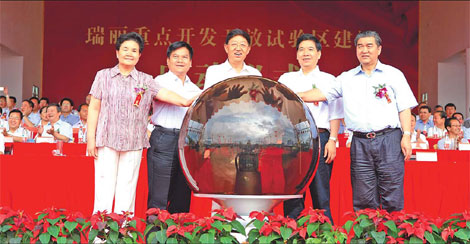
Government officials mark the launch of Ruili pilot area for the province's development and opening-up. Lei Tongsu / For China Daily |
Yunnan province has seen new opportunities for improving both its economy and its society now that a provincial project has become part of a national strategy.
Yunnan's Gateway Project was started in December 2009 as a direct response to remarks that President Hu Jintao made during a visit to Yunnan in July of that year.
Hu said that Yunnan should be a gateway for China to open up further to Southeast Asia.
This is also just a part of China's grander scheme to open not just to Southeast Asia, but to South Asia, West Asia and East Africa as well. This covers more than 50 countries and more than 2.8 billion people.
Qin Guangrong, Yunnan's governor, explained it in this way, "The Gateway Project will change Yunnan and other provinces from a peripheral border area to the front and give vitality to a new round of development for ethnic regions in the southwest."
Qin added that the gateway idea has five different forms - as a channel, window, platform, base, and barrier.
The channel, which is the key to the project, means building an international thoroughfare to Southeast and South Asia.
The window refers to making Yunnan a showcase of Chinese culture and friendship. The platform means that Yunnan should have an economic and trade cooperation role. The base refers to Yunnan as a manufacture and processing base, while the barrier refers to its role as an ecological barrier.
"We're going to build international highways, railways, water routes and oil and gas channels and make the city of Ruili a pilot in opening and exploring.
"It will accelerate economic cooperation as a cross-border economic zone, and take part in building trade and economic cooperation zones beyond the border," Qin went on to explain.
Even as these routes are being built, Yunnan already has three links to Southeast and South Asian countries.
One follows the Southern Silk Route and consists of the Kunming-Myanmar Road, China-India Road and Guangtong-Dali railway. It runs from Kunming, through Myanmar, to India and Bangladesh.
A second route consists of the Lancang-Mekong River, three highways that link Kunming and the port of Mohan port, and the Xishuangbanna airport. It reaches Laos, Myanmar, Thailand, Malaysia and Singapore.
The third, via the Kunming-Vietnam railway, Kunming-Hekou highway, and the Honghe River, runs to Hanoi, Haiphong, and other cities in Vietnam.
Qin said that transport is an important part of the Gateway Project. During the 12th Five-year Plan (2011-2015), the provincial government will rely on a national highway construction plan and improve links with inland cities, coastal cities, Southeast Asia and South Asia.
By 2020, the government is expected to complete work on superhighways in Yunnan; roads to cities, prefectures and tourism sites in Yunnan; improved roads to national ports; and superhighways to Sichuan and Guizhou provinces, and the Guangxi and Tibet regions.
Yunnan's transportation infrastructure has already improved relations with Southeast and South Asian nations, turning the border province into a major front and, according to Qin, "This has been an important provincial policy in recent years."
Yunnan has been following this policy for 10 years, going back to the beginning of China's West Development Program. The province has spent more than 250 billion yuan ($38.48 billion) on it.
It is believed that making Yunnan a gateway will increase economic and social growth in the Southwest. It will also connect China with developing markets in Southeast, South, and West Asia, as well as East Africa, while strengthening relations.
At the same time, it holds the key to Yunnan's social and economic development, especially in ethnic regions.
In 2010, Yunnan saw some progress in its foreign trade, with an annual increase of 69 percent, over 2009, which ranked second in China.
Trade with members of the Association of Southeast Asian Nations (ASEAN) amounted to 4.58 billion yuan, while imports from ASEAN members increased 59.3 percent. These show the possibilities for the Gateway Project.
According to Qin, ASEAN and South Asia mark the beginning of a new era for Yunnan. The province has been active in the ASEAN Free Trade Area (AFTA), Greater Mekong Sub-region cooperation (GMS), and in India, Burma and Bangladesh Regional Economic Cooperation.
In doing so it has increased China's connections with neighboring countries in the areas of electric power, commerce and customs activity.
Yunnan has played a major role in exploring the Mekong River Valley and in GMS economic cooperation. The Kunming-Bangkok International thoroughfare is already completed, shipping cooperation on the Lancang -Mekong River has helped the vegetables-for-oil, flowers-for-fruit, and other exchanges, and there has been progress in railway and energy cooperation.
And it does not end there. Qin told China Daily that, "This is a golden opportunity for Yunnan's tourism. Yunnan will take advantage of the Gateway Project to internationalize its tourism and build a first-class tourist province and popular tourist destination for Southeast Asia and the rest of the world.
"It will enrich tourism, by making use of airlines and tourist channels to neighboring countries, Southeast Asia, the Middle East, Europe and America."
In addition, "Yunnan's education has promising prospects with the Gateway Project," Qin said.
Yunnan can use its unique climate and ethnic diversity to provide a place where various cultures communicate and assimilate. The thing is, to gear education to international standards, and increase communications with ASEAN and South Asia colleges.
Over the next five years, the goal is to get 100,000 foreign students to come to Yunnan and to send Yunnan's young people to study abroad.
Thus, "going outside" is a major part of Yunnan's opening-up policy. Thanks to the reciprocal trade relations with Southeast and South Asia, many Yunnan enterprises will invest in those areas and get involved in projects there. Yunnan's foreign investment has it ranking higher than neighboring provinces.
|
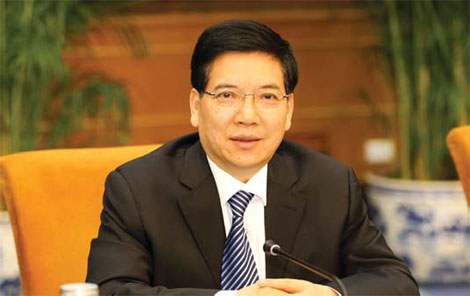
Qin Guangrong, governor of Yunnan province. Lei Tongsu / For China Daily |
(China Daily 06/01/2011 page28)
| 分享按鈕 |