An important way to pass on ethnic culture
Updated: 2011-09-10 08:09
By Qiu Bo (China Daily)
|
|||||||||||


|
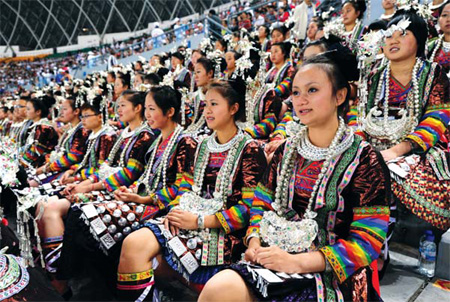
Spectators show up for event the dressed in their native costumes. Zhao Hui / for China Daily |
|
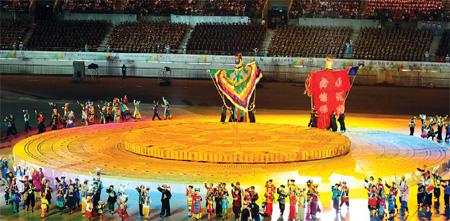
Final rehearsal on the eve of the opening ceremony. Zhao Hui / for China Daily |
Athletes and local officials in Guizhou have put a lot of time and sweat into these games, and expectations are running high
China's 9th National Ethnic Games will begin on Sept 10, in Guiyang, the capital of Guizhou province and the country's ethnic groups have a lot of hopes for the games.
The hosts of the event are the State Ethnic Affairs Commission and the General Administration of Sport, with backing from the central government's State Council. They are being organized by the provincial government.
Both the athletes and local officials have put a lot of time and sweat into the event, and people across the nation have been waiting expectantly to get a look at this once-every-four-years sporting event.
The games run for nine days with the opening ceremony being held Saturday evening. They have at least 16 types of events, as well as some non-competitive demonstrations and a special event for guests from various ethnic groups.
The officials are expecting more than 20,000 athletes, guests, and volunteer helpers, not to mention the, at least 1,000, reporters from across the country.
And, of course there is a mascot -the "Guizhou Dragon". The inspiration for this came from the dinosaurs that are believed to have roamed the area around Xingyi about 240 million years ago. And the mascot's green skin conveniently symbolizes the beauty of the environment of Guizhou.
And there is a logo for the games that can be read either as a "G" - that is, Guizhou - or the number "9", which is a homophone for the word "long" in Chinese, and, in this case, refers to the different ethnic groups working together for a long time.
Unity
Yang Jing, the organizing committee chairman, who is also head of the State Ethnic Affairs Commission, spoke to the media and said that these national ethnic group games are one important way for the various groups to pass on their history and culture.
"The games started in 1953, and have never stopped developing themselves. And they've made a great contribution to the uniting of all ethnic groups as one," Yang said.
Guizhou's governor, Zhao Kezhi, went further by saying, "It's an honor for Guizhou to be chosen to host the ethnic group games and it shows the charm of our land here."
Zhao explained that Guizhou's ethnic groups account for 36 percent of the population, and that ethnic autonomous areas account for more than half its land.
"But, when it comes to the people of Guizhou, whether they're from the province or somewhere else, whether they're Han or ethic groups, they have all contributed to its economic development," he added.
Chen Yiqin, head of the Party's publicity department in Guizhou, held a press conference last month, where she remarked that, "The media from China and overseas are welcome to come and see these traditional ethnic sports."
Measures
Over the nearly 60 years of their development, the games have become an influential nationwide event. After the second games, held in Inner Mongolia, they changed to a four-year cycle. This is Guizhou province's first crack at holding the games, so there is obviously a lot of excitement here.
The organizing committee has said that it has done everything possible to guarantee that the games go smoothly. Wang Fuyu, deputy Party chief of Guizhou, has said that more than 10,000 police will be on duty and, around 455 buses will be made available to shuttle spectators around.
The committee reported last week that at least 58 hotels in Guiyang are ready for the participants and visitors.
A reception team, staffed mostly by volunteers, has been set up with groups working round-the-clock to send people to the airport and railway station to receive delegations.
The last games were held in Guangdong province, in 2007, with some 8,000 athletes and officials taking part.
(China Daily 09/10/2011 page10)