Changyu: From pioneer to global winemaker
Updated: 2011-10-20 07:51
By Wang Qian and Zhao Ruixue (China Daily)
|
|||||||||||


|
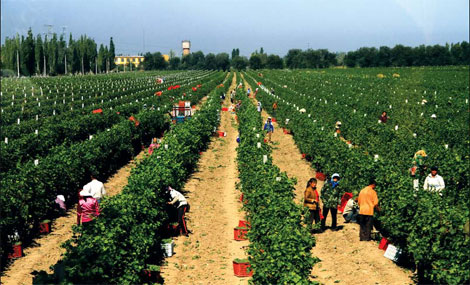
Grapes from Changyu's Xinjiang's vineyard have high sugar content as a result of ample sunshine and large day-night temperature differences. Ju Chuanjiang / China Daily |
Editor's note: The first to introduce European grapes and winemaking techniques in China when it was founded in Yantai, Shandong province in 1892, Changyu Pioneer Wine Co is one of nation's top producers on par with European winemakers.
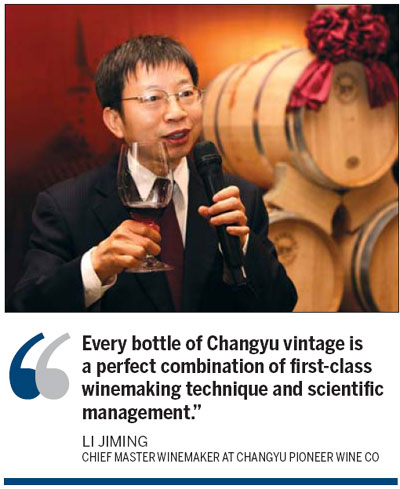
Li Jiming, chief master winemaker at Changyu, shares the secret of the company's success with China Daily:
Q: How do you view the role of a master winemaker - or enologist - at Changyu?
A: Enologists are the soul of a winery and cannot be replaced by even the most advanced equipment. Our company has a world-class team, including some from countries such as Canada, Australia and France. They are well experienced and work hard to ensure the best quality wine.
Every year Changyu sends its enologists to the world's leading wine companies and research institutions to learn the latest techniques and some globally renowned experts are invited to provide regular training.
Strict standards
Q: How does Changyu control the quality of its wines?
A: Changyu has strict management standards for both growing grapes and wine production.
Grapes are supplied from Changyu's own vineyards and contracted growers.
We have the same standard for both suppliers.
We provide contracted farmers with technical know-how and instructions. They also tend to sell us the best grapes because our prices are based on sugar content - prices for grapes that are rich in sugar are higher than the market stan dard.
At our own production sites, we use varied techniques for grapes from different areas.Every bottle of Changyu vintage is a perfect combination of first-class winemaking technique and scientific management.
The company has an infor mation track and quality control system for grape growing and wine production. Each bottle of high-end wine has an electronic tag so that customers can get more information on the wine - for example its production, storage and sales data.
Q: Changyu Jiebaina was rated as one of the world's top 30 wine brands at an international food and beverage show called Salon International de l'Alimentation (SIAL) in France in 2009. What led to this vintage receiving the award?
A: Changyu Jiebaina is a type of dry red wine created by our company in the 1930s. It is made of cabernet gernischt, a special type of grape particular to Yantai. Aging in barrels made from French oak for more than a year, it tastes soft with fragrances of black currant and oak.
Six growing centers
Q: Can you give us an overview of Changyu's grape-growing centers?
A: Changyu now has 16,666 hectares of vineyards in Xinjiang, Ningxia, Shaanxi, Liaoning, Yantai and Beijing. Grapes from our six sites each have different flavors, so they're used for different types of wines.
There are 6,000 hectares of vineyards in Yantai, a northern Shandong coastal city with similar natural conditions with the world's famed wine producing regions such as France's Bordeaux and Italy's Tuscany. The vineyards produce a variety of fine grapes, including cabernet gernischt, cabernet sauvignon, merlot and chardonnay.
The Shihezi area in Xinjiang has ample sunshine and huge day-night temperature differences, resulting in grapes with more sugar content. Grapes planted there include cabernet sauvignon, merlot, gamay, shiraz, pinot noir and saperavi, chardonnay, riesling and pinot blanc.
In Ningxia, which has strong sunshine, low rainfall, huge day-night temperature differences and clean air, we plant cabernet sauvignon, merlot, shiraz and pinot noir for making red wines and chardonnay, semillon blanc and longan for white wines.
In Jingyang, Shaanxi province, we grow chardonnay, longan, Italian riesling, ugni blanc and merlot.
In Liaoning's Huanren county, the coldest among the six sites, grapes are planted for making ice wine.
The vineyards in Miyun, Beijing mainly grow cabernet sauvignon, merlot and chardonnay.
Q: Cabernet sauvignon red and chardonnay white wines produced at Chateau Changyu AFIP Global in Beijing are frequently served at state banquets and summit meetings. How does Changyu ensure quality for such important consumers?
A: We have strict standards on growing grapes and making wines.
To ensure quality, every hectare of our vineyard at Chateau Changyu AFIP Global is only allowed to produce less than 4,500 kilograms of grapes.
Grapes are taken regularly to Changyu's test centers for checks to see if they are at best condition for harvest.
We also have strict grading procedures.
Then wine is carefully kept in barrels and bottles for a proper period after fermentation.
Chateau alliance
Q: Why has Changyu built a number of chateaus in China?
A: The wine produced at the chateaus is the main part of Changyu's high-end products.
Currently, we have Chateau Changyu-Castel in Yantai, Chateau Changyu AFIP Global in Beijing and an ice wine chateau in Liaoning.
Construction on another three chateaus - in Shaanxi, Xinjiang and Ningxia - will be completed by the end of this year.
We have also forged partnerships with four overseas chateaus.
(China Daily 10/20/2011 page15)