Developing a cultural province
Updated: 2011-11-18 07:39
By Feng Zhiwei and Wang Yanyun (China Daily)
|
|||||||||||


|
Zhou Qiang (center), Hunan's provincial Party secretary, showing his appreciation for the local culture industry. Photos provided to China Daily |

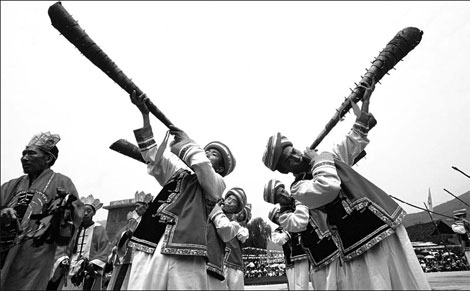
|
It's a splendid culture: members of the Tujia ethinc group in Hunan putting on an exuberant performance. Lu Ruisheng / For China Daily |
|
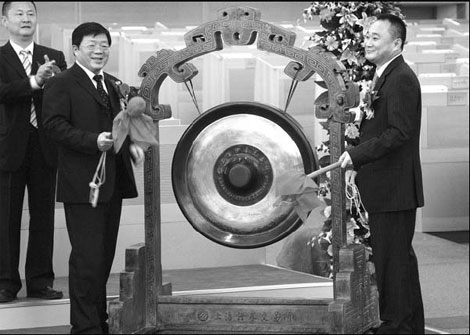
Lu Jianping (left), director of the Hunan Publicity Department, and Gong Shuguang, head of the Hunan Publication Group, sounding a gong to celebrate the group's going public. |
|
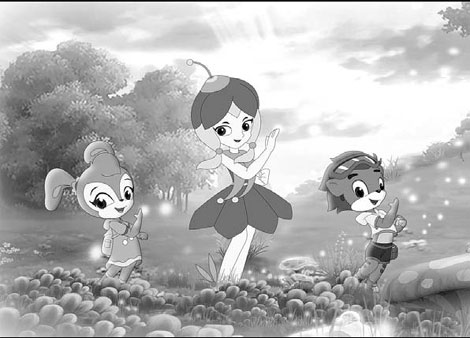
The latest work from Hunan's animation and comics industry - Rainbow Cat and Blue Rabbit's Adventures in Dreamland. |
The power of culture in China, as well as its influence, are stronger than ever, and no place is in a better position to demonstrate this than the province of Hunan, with its thousands of years of cultural history, according to Zhou Qiang, the provincial Party secretary of Hunan.
In fact, Hunan had already come up with the idea of developing into a "cultural province" as early as 2006. And, since then, it has come up with some original cultural phenomena on its own.
Some of its entertainment programs have become so popular that Hunan TV programs have young adults who are die-hard fans.
And, although its TV programs account for only a small part of the province's cultural output, there are signs its TV programs have even gained recognition outside Hunan.
|
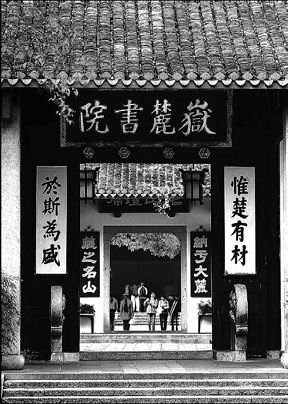
The Yuelu Academy, the nation's only Confucian academy to stay in continuous operation over the past thousand years. |
Moreover, the heads of some TV stations in more than a dozen countries came to Hunan on Oct 25 to get a look at the entire photographic production process handled by Hunan's TV Station, which is famous for its programs.
From 2006 to 2010, Hunan had 31 of the 222 cultural brands named in a Cultural Brands of China Report, or 14 percent. This year, it ranks first in the cultural brands of China list, with 25.
Because it is landlocked, Hunan has no special geographical advantage, or political, financial, or technological, for that matter. So, how could it be so energetic in its cultural development, even to the degree of being a model of other provinces?
Well, innovation, for one thing. It is an important factor in cultural development and Hunan has been brave enough to try to keep innovating. That may be the key to its success.
Some of the heads of TV stations in Hunan have been decisive in trying to improve their situation, and have taken new steps in advertising and in promoting their products.
But innovation alone cannot guarantee success in culture; capital is also needed and, in some ways, may even be more important.
Gong Shuguang, the head of the Hunan Publication Group, maintains that, "difficulty in raising fund can impede the development of the culture industry. It's not possible for a culture business to get bigger without the support of capital."
Obviously then, the development of that industry depends on the support of a well developed financial system, and Hunan officials have been quite clear about that. And, many companies in the business have been trying to go public to raise fund from the capital market.
To encourage the culture industry to connect up with capital, Zhou said, the government has tried to provide some opportunities, for example, by asking non-governmental organizations with capital to invest in culture industries. To support this move, it has come up with policies to further the cooperation.
Certainly, one thing that might help that capital-raising effort is the fact that the audience ratings of Hunan's TV programs have been in the No 1 slot, among all provincial TV programs across China, for consecutive eight years.
And, the Hunan Publication Group has been on the Top 500 list of Chinese companies for five years, and among the Top 50 cultural businesses, for four years.
From 2006 to 2010, the average annual growth of the province's culture industry was about 20 percent. By 2008, it had an income of more than 100 billion yuan ($15.8 billion), making its culture industry a pillar for the province.
In 2010, its income amounted to 186.8 billion yuan, an increase of 82.7 billion yuan over 2009.
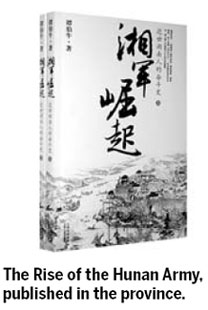
Meanwhile, local government officials have emphasized the construction of culture industry facilities to serve the public, with greater attention being given to non-profit cultural undertakings, for example, in education, entertainment, and books.
In 2010, several of its universities joined hands to combine education with non-profit businesses to make students more aware of the need for public service and to give them a sense of social responsibility.
This innovation has helped to improve the public service side of culture, and the government has tried to provide more for people in the countryside through its "TV and Radio Broadcasts in Every Household" and "Digital Films in the Village" projects.
In this way, people in the countryside can also immerse themselves in culture, which, in turn, promotes the overall development of Hunan.
Still, without a guiding strategy, Hunan's culture industry would not really have gotten so far, so fast.
The government first came up with a strategy - "How to Become a Province that is Characterized by Culture" - in 2006, and it has stuck to that program these past several years.
From 2010 on, it has set aside 100 million yuan annually for cultural undertakings, resulting in some vigorous development.
And, in the same way capital is a kind of impetus for cultural development, the same is true of talent. So, Hunan is paying more attention to talent searches and creation. Estimates put the number of people specializing in culture in Hunan, as of July 2011, at 1.15 million. These talented people are expected to be of great help in its overall cultural development.
This means that Hunan's prosperity is tied to cultural prosperity, so Hunan will continue with its cultural development effort.
By 2015, it expects the culture industry's income to reach 390 billion yuan, which would surely be great news for Hunan. It means that this pillar industry, with all its vigor, will be able to promote the development of other sectors in the province.
(China Daily 11/18/2011 page17)






Hot Topics
Libya conflict, Gaddafi, Oil spill, Palace Museum scandal, Inflation, Japan's new PM, Trapped miners, Mooncake tax, Weekly photos, Hurricane Irene
Editor's Picks
|

|

|

|

|

|