Comments()
  Print
Print  Mail
Mail  Large Medium Small
|
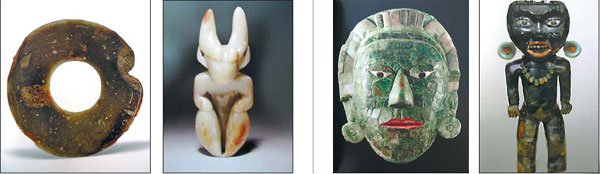
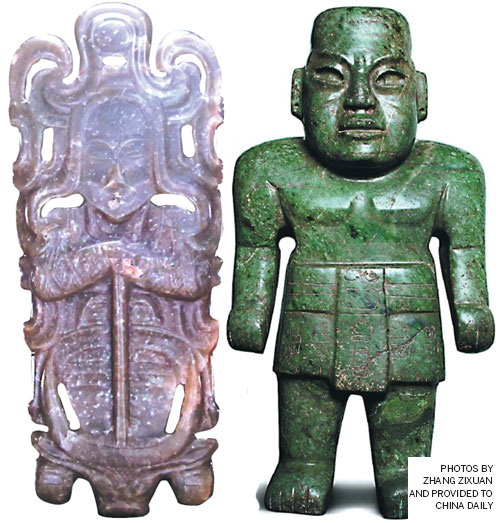
Six pieces of jade ware from Essence of Nature - Civilization of Ancient Jade in China and Mexico held in Beijing (Chinese works on the left, Mexican, right). |
A shared reverence for precious jade has started a dialogue between China and Mexico, and it's taking place at the Palace Museum in Beijing now. Zhang Zixuan discovers the essence of that meeting.
These are two of civilization's oldest cultures and they share a common appreciation of jade. Now, the most exquisite pieces from ancient China and Mexico are sharing display space at the ongoing exhibition Essence of Nature - Civilization of Ancient Jade in China and Mexico.
Jointly organized by the Palace Museum and Mexico's National Institute of Anthropology and History (INAH) and its National Council for Culture and the Arts, the exhibition was first hosted by the National Museum of Anthropology in Mexico from March to June. It is now ready to solicit admiration from Chinese audience at the Palace Museum.
The exhibition also commemorates the 40th anniversary of the establishment of diplomatic ties between China and Mexico.
"It is definitely a feast for the eyes looking at such an exhibition at both countries' biggest and best museums," says the Palace Museum's director Shan Jixiang.
China chose 100 pieces and groups of jade ware from its collection of more than 30,000 jade collections, spanning a historical period of 8,000 years.
"The Palace Museum is probably the only museum that owns a jade collection ranging from the Neolithic Age to the Qing Dynasty (1644-1911)," says Xu Lin, associate researcher of the Palace Museum's Ancient Ware Department, who is also curating this exhibition.
"Many people think the Palace Museum focuses mainly on Ming (1368-1644) and Qing cultural relics. That's not true. About 80 percent of the exhibits provided by the Palace Museum this time came from before the Ming Dynasty."
Xu also mentions quite a number of jade items on display to the public for the first time.
The Jade Human and Beast Statue made during the Hongshan Culture of more than 5,000 years ago, for example, features a human with a cloud-shaped crown, grasping a stick with both hands, and standing on top of a bear-like beast.
"The complexity of its composition is unprecedented, which means it should be the highest-level jade ware known from the Hongshan Culture," Xu says.
The Jade Wizard is also a representative piece of the Hongshan Culture. It features a seated wizard figure wearing an animal hat. No other such relic has been found, which makes this a unique discovery.
The 100 pieces of jade from Mexico were carefully selected from museums throughout the whole country, and are drawn from a 3,000-year jade culture of widely known Central American civilizations such as the Maya and Olmeca.
The most eye-catching is a mosaic statue found in the heart of the Pyramid of the Moon in Teotihuacan, Mexico. The nude, asexual figure inlaid with various colored stones is believed to be a captive sacrificed for the pyramid during the period of the Teotihuacan Culture (AD 100-650).
Unlike the diverse colors found in Chinese jade, the Mexican stone is mostly green.
"Green stone worship is the most significant characteristic in Mexican jade culture," INAH project manager Miguel Baez says. "To ancient Mexicans, the green stone was the most valuable object, more valuable than gold."
"The green stones in ancient Mexico are from varied sources, quite different from the types of Chinese jade," Xu explains, adding that this is the biggest difference between the two jade cultures.
But she notes that the Chinese also worshipped green stones before the Han Dynasty (206 BC-AD 220), after which their enthusiasm gradually shifted to white jade, pointing out a Chinese turquoise necklace exhibited as evidence.

Among the five display classifications - Ritual Jade, Burial Jade, Decorative Jade, Daily Jade, and Jade Material and Tool - Xu says that the advanced use of ritual jade and burial jade is the most significant similarity between the two countries.
Burial jade, like the greenstone masks commonly used in Olmeca Culture (1400-400 BC) in Mexico, had relatively similar functions with Chinese jade burial masks found since the Western Zhou Period (1046-771 BC).
"Archaeological evidence shows there may have been interaction between China and Mexico in ancient times. We hope this exhibition can contribute to cultural exchanges in a wider context," Xu concludes.
Contact the writer at zhangzixuan@chinadaily.com.cn.
(China Daily 08/24/2012 page18)

 Nanjing Massacre victims remembered in E China
 Isolated school makes do in hills of NW China
 NE China turns pretty in white
 Massacre victims remembered at Nanjing vigil
 Snow to hit Central, East China
 Baby red pandas survive in C China zoo
 Beijing covered in snow
 Supermarket of the future opens in E China
Copyright 1995 - 2010 . All rights reserved. The content (including but not limited to text, photo, multimedia information, etc) published in this site belongs to China Daily Information Co (CDIC). Without written authorization from CDIC, such content shall not be republished or used in any form. Note: Browsers with 1024*768 or higher resolution are suggested for this site.
License for publishing multimedia online 0108263 Registration Number: 20100000002731