Print
Print  Mail
Mail  Large Medium Small
分享按鈕
0
Large Medium Small
分享按鈕
0
|
Liu Xiaoqiang (left) and Wang Xiaojun get down to the "bear essentials" as they monitor pandas in the Wolong National Nature Reserve in Sichuan province last month. The trainers use disguise as they prepare pandas for life in the wild. Feng Yongbin / China Daily |
|
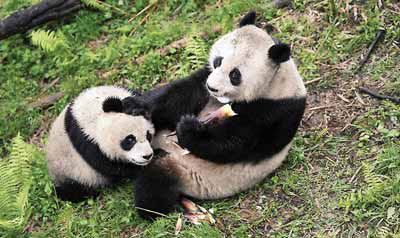
Tao Tao (left), tries to get close to his mother Cao Cao in their semi-wild environment. Provided to China Daily |
Bears to be released into natural habitat, Jiang Xueqing and Huang Zhiling report from Wolong and Dujiangyan, Sichuan province.
It took at least two hours for our all-terrain vehicle to bump along the rugged mountain road from Dujiangyan, a city near Chengdu in Sichuan province, to the Wolong National Nature Reserve. Devastated by the 2008 Wenchuan earthquake and subsequent mudslides, the dangerous state of the road means that very few tourists ever visit Wolong.
Tao Tao, a male panda cub aged almost 2 years, lives with his mother, Cao Cao in this isolated place that boasts scenery reminiscent of the elf kingdom in Lord of the Rings, and has seen few human visitors in the last four years.
Born in captivity on Aug 3, 2010, Tao Tao has been undergoing training in field survival techniques with the help of researchers from the China Conservation and Research Center for the Giant Panda almost since the day of his birth. The plan is to send him into the wilds of Ya'an, Sichuan province, by the end of October.
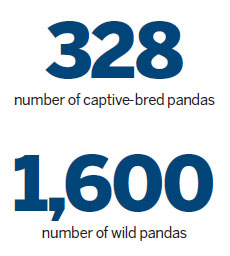
Pandas are an endangered species. According to Huang Yan, deputy chief engineer of the center, captive-bred pandas number just 328 and there are only around 1,600 in the wild. The wild pandas are scattered across the provinces of Sichuan, Gansu and Shaanxi. During the past 10 years, human activity, mainly in the form of roads and high-speed rail tracks, has cut into their habitat and divided the wild pandas into more than 30 small groups.
"We have no choice but to release captive-bred pandas into the wild to protect the natural environment," said Huang. "By providing wilderness-survival training for these animals, we hope to introduce them into a number of small groups, helping to increase the wild population and maintain their genetic diversity."
A short while after Tao Tao was born, the researchers placed the cub and his mother in a semi-wild area covering 2,400 sq m at a height of 1,820 meters above sea level. Unusually, Cao Cao was allowed full responsibility for the cub, a break from the usual practice employed at centers such as Bifengxia Panda Base in Ya'an, where keepers care for cubs and feed them formula milk.
During the training process, the mother plays the lead role in teaching the cub basic survival skills, such as how to find water and climb trees. The researchers play a secondary role by placing the pandas in an environment similar to their natural wooded habitat, providing the mother with food when bamboo is scarce, and monitoring their behavior and activities. In addition to Tao Tao, three other panda cubs are receiving the same kind of training from their own mother.
"We used to teach panda cubs based on our research and imagination. It took a lot of time and energy, but results were minimal," said Zhang Hemin, director of the center. "Now, we rely on panda mothers to do the training. They are much better teachers than humans, because they have an innate knowledge of what to do in the field."
Unlike some other nature reserves where the cubs develop close relationships with their keepers, in Wolong the researchers are kept virtually invisible to the cubs to minimize the impact of humans on them. The keepers and veterinarians even wear fluffy black-and-white costumes when the cubs are given a physical examination. As a result, Tao Tao has learned to be constantly vigilant and if he hears the sound of footsteps on bamboo leaves, he immediately hides by climbing the nearest tree.
On Feb 20 last year the researchers moved Tao Tao and his mother to a larger area, higher up the mountain. The area covers 40,000 sq m and is at an altitude of 2,000 to 2,100 meters above sea level. More than 10 wild pandas live on the outskirts of the training zone, which has plenty of umbrella bamboo, one of the most common varieties of the plant in Wolong. The environment is almost exactly the same as the pandas' natural habitat in the woods.
To prevent Tao Tao and Cao Cao from leaving the training area, they are enclosed by a 2.5-meter-tall fence. The scientists installed 55 cameras, both along the fence and inside the training area, to monitor the pandas. They also use binoculars to conduct long-range observation. Pandas are solitary and sedentary by nature and most of the time Tao Tao rests in the trees, only returning to his mother when he is hungry.

In China, most giant pandas live in the mountains of Qinling, Minshan, Qionglai, Daxiangling and Xiaoxiangling.

By the end of 2011, the number of wild giant pandas in the world was about 1,590.
Copyright 1995 - 2010 . All rights reserved. The content (including but not limited to text, photo, multimedia information, etc) published in this site belongs to China Daily Information Co (CDIC). Without written authorization from CDIC, such content shall not be republished or used in any form. Note: Browsers with 1024*768 or higher resolution are suggested for this site.
License for publishing multimedia online 0108263 Registration Number: 20100000002731