Peripheral vision
Updated: 2012-12-21 09:41
By Mu Qian(China Daily)
|
|||||||||||


 |
|
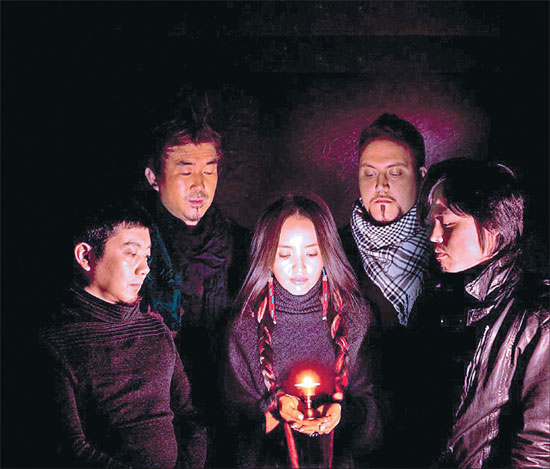
Haya Ensemble is a group devoted to making world music based on Mongolian traditions. Provided to China Daily |
The word haya in Haya Ensemble means 'the edge' in the Mongolian language, but the musicians tell Mu Qian they hope more people in the center will get to know them.
Zhang Quansheng says his Haya Ensemble concert on Saturday will be for the survivors. He is referring to Dec 21, 2012, the end-date of a 5,125-year-long cycle according to Mesoamerican eschatological beliefs. Haya's concert will take place the day after the supposed end of the world.
He is also talking about the theme of the concert. To be held at the Inter Gallery of the 798 Art District of Beijing together with the photography exhibition Paradise Lost, the Haya Ensemble will perform among sand dunes and beside dried up poplar trees brought in from Inner Mongolia.
"On the Mongolian Prairie, people used to live in harmony with the nature, but this has been compromised by the industrialization of the society," says Zhang, who plays the morinkhuur or horse-head fiddle) player of Haya, a band consi. All the musicians in the band are ethnic Mongolians.
"It is time for us to rethink our development and culture.
?In Mongolian language, haya means "the edge". It is a metaphor for the nomadic lifestyle that has become so edgy today.
Zhang believes that the truth is often found on the edge rather than in the center. For example, the nomads' respect for nature is something that urban people should learn.
In Delingha, Qinghai province, hometown of Haya Ensemble's singer Daiqing Tana, there is a place named Haya, which she is familiar with from childhood.
"The term 'Haya' brings back the feeling of living close to heaven and earth," she says. "It represents a kind of living that is being with nature."
Founded in 2006, Haya Ensemble will celebrate its sixth anniversary at Saturday's concert, and release a new DVD/CD set of its Migration concert on Dec 31, 2011 in Beijing.
The band has won the Golden Melody Awards of Taiwan twice, in 2009 with their first album Wolf Totem, and in 2012 with their CD Migration.
Another Haya album, Silent Sky, won the 10th Chinese Media Music Award in 2010.
Haya has also performed throughout the Chinese mainland, Macao and Taiwan, and abroad in Sweden and Germany.
"What we make is world music based on the Mongolian traditions," Zhang says.
"I hope our music will appeal to not just Mongolians, but also people of various ethnic groups."
Half of Haya's repertoire is adapted from traditional Mongolian folk songs, and the other half is original compositions. Almost all songs are sung in Mongolian.
They use Mongolian instruments such as the morinkhuur fiddle and tobshuur lute, as well as Western instruments like guitar and bass.
Zhang has spent a long time searching for his ideal musical language. He has performed with symphony orchestras, pop musicians, rock bands and jazz groups.
"I'm a Mongolian, and the Mongolian blood is always in my veins," he says. "But as someone who uses an Apple computer and drives a German car, I don't want to repeat traditional music, because I live in modern age."
After he founded Haya Ensemble, Zhang decided he wanted to make fusion music that combines Mongolian music with other elements.
"Mongolian people have created some of the most beautiful melodies in the world, but we don't have much in terms of rhythm," he says.
"If we put rhythms from, say, the Middle East, in our music, we create something new."
For Daiqing Tana, performing with Haya is a process for her to rediscover the most original state of singing.
After four years of vocal study at the Minzu University of China, she found that she could not adapt to the mode of China's mainstream vocal pedagogy.
She tries to give up the academic method of singing and goes back to the "edgy" state, where she feels comfortable to express herself in a simpler way.
"We are at the edge, but we hope more people from the center will get to know us," she says.
At the concert on Saturday, Haya will perform some of its most popular songs from the last six years. Apart from the show, the audience will also be able to enjoy an authentic Mongolian lamb meal.
Contact the writer at muqian@chinadaily.com.cn