
 Folklore
Yangliuqing woodblock prints introduction
New Year prints are closely associated with the traditional Chinese New Year. Chinese people usually celebrate the prior year's harvest during Spring Festival, which is usually filled with hope, joy and mystery. The New Year prints are hung as decoration and carry blessings for the coming year.
With a history of over 400 years, Tianjin Yangliuqing woodblock prints originated from the Ming Dynasty (1368-1644) and have developed into Tianjin's representative folk art genre.
Tianjin Yangliuqing woodblock prints combine woodblock printing and hand painting, techniques that date back to the Wanli period (1573-1620) of the Ming Dynasty. This technology endows Yangliuqing prints with live, festive and auspicious features and rich themes, making them unique among Chinese works of art. Hailed as "the leader of Chinese New Year pictures," Yangliuqing prints are a major part of woodblock painting art and play an extremely important role in the history of Chinese woodblock painting.
Tianjin Yangliuqing woodblock prints aren't just charming because of their bold woodcut style; they also feature aspects of traditional Chinese painting.
Yangliuqing prints mainly portray people's daily lives and record local customs. They are characterized by auspicious and festive content, plump and symmetrical composition, and bright and harmonious colors.
Their content pulls from a wide range of historical stories, myths and legends, literary allusions, opera characters, secular life, current events, anecdotes, scenic spots, flowers, birds, fish and insects. Thanks to their rich historical heritage, Yangliuqing prints are known as the "encyclopedia" of Chinese folk culture. They reflect ancient Chinese ideals and aesthetics. They were appreciated by ordinary people and spread traditional Chinese ideology and moral values.
When people paint, they usually sit on a stool or lean over a table. How are Yangliuqing prints different? The artists stand and paint on "door planks." The painting studio houses a line of planks that open and close. On the planks are papers that have been printed with picture outlines. Woodblock artists stand in front of the "door planks," scrutinizing their work while painting until they're satisfied.
Usually, a piece can take a long time, ranging from three days to half a month. People of Yangliuqing are attentive and strong-willed, not afraid of repeated scrutiny. They honor the art just as they honor gods , meticulously and ardently.

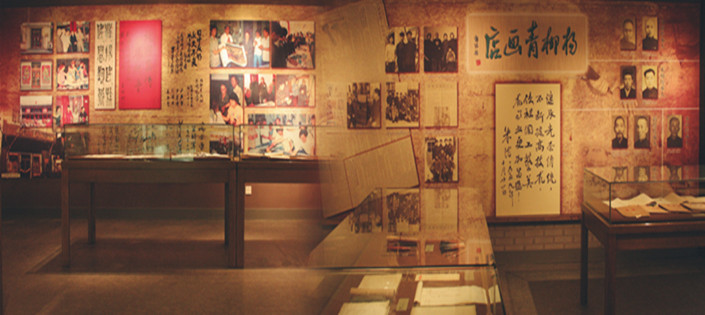
Tianjin Yangliuqing Woodblock Prints Museum
The Yangliuqing Woodblock Prints Museum is a non-profit pavilion for the collection, research and exhibition of Yangliuqing prints with strong local features. With an antique architectural style, the pavilion has a building area of 3,535 square meters and an exhibition area of 1,724 square meters. The museum boasts more than 600 pieces of Yangliuqing woodblock prints, over 10,000 New Year pictures collected since the Ming Dynasty (1368-1644), and more than 6,400 pieces of painting plates.
The museum leads all Chinese New Year picture museums in terms of its size, the number of exhibits and collection scale. The pavilion is divided into seven exhibition halls that display history, opera stories, painting plates, lady dolls, secular life, paintings on sustaining development from Dai Qi Painting Studio, and a collection of Chinese New Year pictures.
At the entrance of the museum stands two giant "door gods," 2.5 meters high and 1.2 meters wide. They were carved by three woodcut craftsmen led by Wang Wenda, an inheritor of the national intangible cultural heritage, and were collected by the museum. The classic masterpiece took a whole month to finish.
On the left side of the museum hall is a piece of a New Year picture with the inscription: "In the auspicious year to come, families are happy, healthy and safe." The painting is 8.5 meters in length and 2.4 meters in height, the largest New Year picture by far. It portrays a happy family gathering during the traditional Chinese Spring Festival.