City works on integration of its vast area
Updated: 2013-05-07 14:46
(China Daily)
|
|||||||||||



 |
|
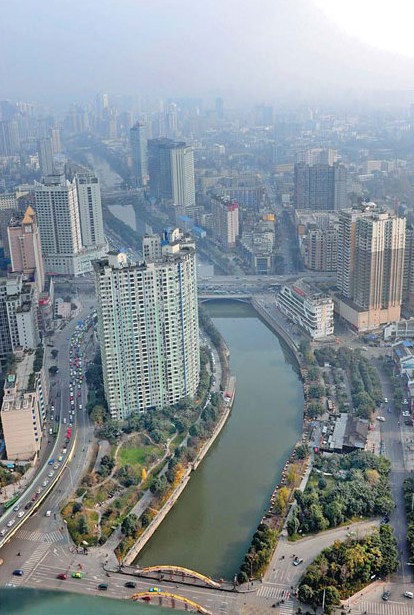
A bird's eye view of Chengdu's downtown area. The core urban area accounts for half of the city's economic size. Provided to China Daily |
Function divisions among counties, districts foster healthy competition
In October 2012, the Chengdu municipal government issued a comprehensive plan to better integrate the core urban area with its vast outer layer areas, a landmark step toward the city's full integration.
Unknown to most outsiders, the pan-Chengdu metropolis comprises more than 20 administrative units, and has an area of 12,400 square kilometers, equivalent to 10 New York Cities.
But the outer-layer areas are far more underdeveloped than the core urban area.
In 2011, the GDP of Jinniu district, the largest economy in the pan-Chengdu metropolis, was eight and a half times of that of the county with the smallest economic size. The core urban area, which accounts for only 4 percent of Chengdu's, accounts for half of the area's economic size. The counties within the third layer of the area account for 70 percent of the land but produce less than 17 percent of the GDP.
In Chengdu government's development outline, the swath of districts and counties within the pan-Chengdu area is compared to a flight of wild geese. Like geese, the six districts in the core urban area, like the head geese, should fly higher in the sky; the six districts or counties in the second layer of the area should compete with each other; and the eight cities and counties in the third layer should see leapfrogging development.
A major feature of the "full integration strategy" is that the Chengdu government clearly planned every economic function of the districts.
For example, western Chengdu is designed to develop high-tech and emerging industries, while the eastern section of Chengdu is designed to focus on high-end manufacturing such as the automobile industry.
The core urban area should gradually exit manufacturing and accelerate the growth of modern service industries. The second layer should strengthen its manufacturing and cultivate corresponding service industries. The third layer should develop its manufacturing and optimize its agriculture and tourism industries.
To avert vicious competition among districts, the Chengdu government stipulated that district that attract enterprises that are not in line with its function will be punished, while those that introduce enterprises they get to other, more suitable districts can enjoy a portion of the revenue the enterprises produce there.
A vivid example
Amid the roar of the machines, bags of wheat were processed into flour on the automatic production line. Outside the factory, three rails transported the goods to every corner of Sichuan province.
This is the production base of COFCO, China's largest State-owned oil, cereals and foodstuff trader and manufacturer, in Xinjin, a county in the third layer of the pan-Chengdu area.
In June 2012, the brand-new park was built in just 13 months. Given the sheer size of the park (1,253 mu, or 83.6 hectare), it was an incredible feat.
"The park comprises six major business units and 10 subprojects that can process wheat, rice, oil, feeds, starch sugar, and could be used as a warehousing center," said Yang Haitao, a manager of the COFCO Chengdu Industrial Park. "It is COFCO's first all-function production center in China."
Previous COFCO bases were all located in China's coastal areas, and each focuses on only one or two business.
Several factors have persuaded COFCO to spend 2.2 billion yuan ($354 million) to build the facility in Xinjin, a county 28 km from Chengdu's downtown, Yang said.
The huge market in Sichuan, and possibly the entire Southwest China region, is the largest attraction for COFCO. Though the majority of the raw material the base needs is imported far from other regions of China, the base allows COFCO to deliver its products quickly and cheaply to surrounding markets, which could offset the cost of raw-material logistics.
After finishing the second phase of the project, which Yang said could happen in June, more rail lines will connect the base to Sichuan's major railway network. The transportation will be much more convenient, and output will be doubled.
Xinjin's convenient transportation, as well as the favorable offers from the local government is another attraction.
The local government promised COFCO it would build the 3.5-km-long railway outside the park, and granted the park 133 hectares of land.
Now the base is the largest project in the Xinjin Industrial Park. Nearly 400 local jobs were generated, and 300 million yuan of tax is expected in 2013.
COFCO's base is one of the many projects that landed in Xinjin Industrial Park. By now, the park has attracted 10 Fortune 500 companies, nine Chinese State-owned enterprises, and eight of the largest Chinese companies, according to government statistics.
The 16-square-kilometer park has already formed an industrial agglomeration focused on new materials. In 2012, the park's industrial output hit 6.67 billion yuan, a 23.1 percent year-on-year growth.
Under Chengdu's full-integration strategy, the Xinjin government has partnered with Wuhou district, a district in Chengdu's core urban area. Wuhou district, the home of many large companies' headquarters, encouraged these companies to put their production facilities in Xinjin. Various other cooperation was also unfolded in education, healthcare and talent exchange.
A report by Chengdu's Municipal Commission of Economy and Information Technology said that the third layer area's advantage in cost, space, and environment capacity has emerged. The fully integrated pan-Chengdu area could serve as a growth pole for western China.
Contact the writers at zhengyangpeng@chinadaily.com.cn and liyu@chinadaily.com.cn







Hot Topics
CPC National Congress,Mo Yan, Bogu Kailai, Diaoyu Islands, iPhone, Yao Ming, Sun Yang, Li Na, Liu Xiang, shenzhou, taiwan, hiv, school bus, house, hk, rare earth, food safety
Editor's Picks

|

|

|

|

|

|