Comments
  Print
Print  Mail
Mail  Large Medium Small
 |
|
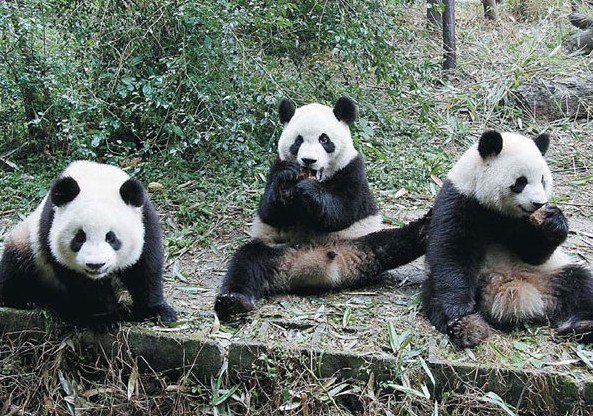
Chengdu Research Base of Giant Panda Breeding has more than 110 pandas under its care. Provided to China Daily |
Pandas to be sent back to the wild after being saved from extinction
Thomas Gou was in high spirits when talking about the Global Fortune Forum, which will be held in Chengdu, Sichuan province, in early June.
"Our hotel will be the main venue of the three-day conference in which representatives of Fortune 500 firms will participate," the middle-aged general manager of the Shangri-La Hotel Chengdu said.
Thirty years ago, Chengdu was best known for its delicious food, inaccessibility and rudimentary facilities. The most luxurious guesthouse in the city was Jinjiang.
After the central government launched the "go west" strategy in early 2000, Chengdu has witnessed unprecedented economic development.
In 2012, its GDP amounted to about $130 billion, ranking first in the central and western parts of China for six consecutive years.
With 238 of the Fortune Global 500 companies represented, Chengdu is the choicest investment destination in western China. Its actually utilized foreign capital in 2012 registered $8.59 billion, the highest among cities in western China.
Its Shuangliu International Airport is one of the best equipped in the country, with a passenger throughput of 31.5 million in 2012, fifth in China. Chengdu is the fourth-biggest air hub in the country, behind Beijing, Shanghai and Guangzhou.
But the city of more than 14 million people has never given up the conservation culture and has done its utmost to protect the giant panda.
In March 1987, it set up the Chengdu Research Base of Giant Panda Breeding with six sick and hungry pandas saved from the wild as the aftermath of widespread bamboo blossoming.
Base chief Zhang Zhihe said that thanks to the joint efforts of several generations of researchers, the 66-hectare base has solved the main difficulties with panda breeding, and it has 113 pandas under its care.
"It was difficult for pandas to be amorous, it was difficult for them to get pregnant, and it was difficult for the cubs to survive. These were the three difficulties in panda breeding," Zhang said.
There is also the risk of cross-infection of contagious diseases.
Pu Anning, director of the general office in the base, said: "If a panda catches flu, other pandas fall victim, too."
As an alternative, Chengdu decided to build the Panda Valley in Dujiangyan, a city under the administration of Chengdu, in 2006. In May 2010, the groundbreaking ceremony took place.
Covering nearly 134 hectares, the valley was designed to train pandas before sending them into the wild. With a total investment of $48 million, it can prepare 30 to 40 pandas for life in the wild.
In January 2012, the valley was formally opened to six pandas in Yutang town in Dujiangyan where the first wild panda was found after New China was founded in 1949.
Thirty to 40 pandas would follow the first six before the program is gradually extended to all the pandas in the Chengdu base, which plans to increase the number of pandas to 120 to 150 in about a decade, Zhang said.
The first six pandas were relocated from Zhang's base to the valley, about 50 km from Chengdu.
The two males and four females born between 2007 and 2009 have a strong ability to adapt to the new environment. The Chengdu base spent nearly a year choosing them from its 113 pandas based on their pedigree, health, genetic background and gender.
"They will spend increasingly less time with humans, including their breeders, before their release, and will feed on bamboo instead of dietary supplements.
"They will live in the valley where bamboo is distributed in different parts so that they must move around to look for food," said Huang Xiangming, head of the animal management department at the base.
Added Zhang: "We have spent five decades saving pandas from extinction and have lived with them peacefully. We will spend another five decades or more sending them to the wild."
To tell the world about the plight of pandas and promote the conservation culture, Chengdu government organized experts from Zhang's base and journalists for a month-long tour in 2006 of cities that housed or once housed pandas.
The panda delegation visited the United States, France, Germany, Austria, Thailand and Japan, said Tan Hongming, deputy chief of the base, who was a member of the delegation.
In China, only about 1,600 pandas are living in the wild.
 |
|
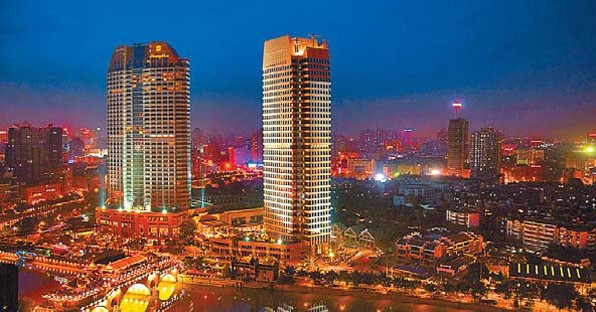
Shangri-La Hotel Chengdu will be the main venue of the Global Fortune Forum to be held in early June |
 China shows of its beauty in spring
 Beijing starts landmark medical reform
 Cherry blossoms turn Tongji University must-see site
 How Chinese companies are contributing to US society
 Fantastic 'tree paintings' seen in Anhui province
 Tracing nationwide Tomb-sweeping Day travel rush
 Ex-inmate runs free school for poor children
 Shanghai's iconic Grand World reopens on 100th anniversary
 Over 1,500 teachers, students perform bamboo dance in Hainan
 Panda cubs move to Dutch palace
 Queen Elizabeth II plays with her namesake baby elephant
 Hot spots to see flowers flourish in spring
 Pregame blasts rock German soccer team bus, player injured
 Dybala nets 2 as Juve beats Barcelona 3-0 in Champs League


Copyright 1995 - . All rights reserved. The content (including but not limited to text, photo, multimedia information, etc) published in this site belongs to China Daily Information Co (CDIC). Without written authorization from CDIC, such content shall not be republished or used in any form. Note: Browsers with 1024*768 or higher resolution are suggested for this site.
License for publishing multimedia online 0108263 Registration Number: 20100000002731