Introduction to Japan
Updated: 2013-07-10 16:10
|
|||||||||||


Japan is an island nation in East Asia. Located in the Pacific Ocean, it lies to the east of the Sea of Japan, China, North Korea, South Korea and Russia, stretching from the Sea of Okhotsk in the north to the East China Sea and Taiwan in the south. Japan is an archipelago of 6,852 islands, known as the “Thousand Island Country”. The four largest islands are Honshu, Hokkaido, Kyushu and Shikoku. The land area of Japan is about 377,800 square kilometers. The prefectures of Japan are the country's 47 first-order subnational jurisdictions on a state or provincial level: one "metropolis", Tokyo; one "circuit", Hokkaido; two urban prefectures, Osaka and Kyoto; and 43 other prefectures, namely, Aichi, Akita, Aomori, Chiba, Ehime, Fukui, Fukuoka, Fukushima, Gifu, Gunma, Hiroshima, Hyōgo, Ibaraki, Ishikawa, Iwate, Kagawa, Kagoshima, Kanagawa, Kōchi, Kumamoto, Mie, Miyagi, Miyazaki, Nagano, Nagasaki, Nara, Niigata, ōita, Okayama, Okinawa, Saga, Saitama, Shiga, Shimane, Shizuoka, Tochigi, Tokushima, Tottori, Toyama, Wakayama, Yamagata and Yamaguchi Yamanashi. Each prefecture is further divided into cities, towns and villages. The chief executive of each prefecture is a directly elected governor.
Capital
Tokyo, the capital of Japan, is a modern metropolis with a population of 12.76 million—one-tenth of Japan’s population. It experiences a one-month seasonal lag, with the warmest month being August, which averages 25 C (77 F), and the coolest month being January, averaging 3.0 C (37.4 F).
National Flag
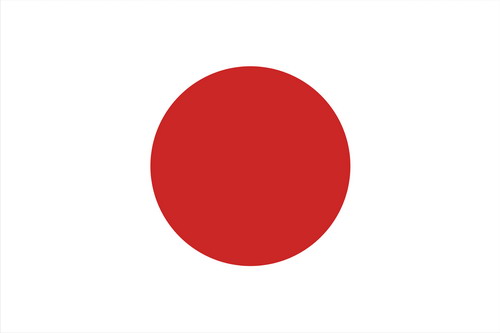
Japan's flag is a rectangle with a ratio of 3:2. It is white in color with a deep red disc in the center. The color white represents integrity and purity while red represents sincerity and passion. Japan's location to the east of Asia, from the direction the sun rises, helped Japan earn the nickname, "Land of the Rising Sun". It is said that Japan is the birthplace of the sun goddess Amaterasu, from which Japan's imperial family is said to have descended.
Demographics
Japan's population is estimated at 127.05 million. The most dominant native ethnic group is the Yamato people. The primary minority group—the indigenous Ainu—live in Hokkaido. More than 99 percent of the population speaks Japanese as their first language. The Ainu language is only used by a few elderly native speakers remaining in Hokkaido. The main religions in Japan are Buddhism and Shinto, accounting for 49.6 percent and 44.8 percent of the total religious population, respectively.
National Symbol
Akihito, born on December 23, 1933, has been the emperor of Japan since 1989. He graduated from Gakushuin University in 1956. In November 1952, Akihito was invested as heir to the Japanese throne. Akihito became the 125th emperor of his line according to Japan's traditional order of succession on January 7, 1989. His reign was designated Heisei, or “Achieving Peace”. According to Japan's constitution, he is "the symbol of the state and of the unity of the people."
Geography
Japan lies in a temperature zone with mild climate and distinct seasons. The sakura is Japan’s national flower. About 70 percent of Japan is mountainous, with a mountain range running through each of the main islands. Mt Fuji is Japan's highest mountain as well as an active volcano, with an elevation of 3,776 meters. As Japan is situated in a volcanic zone along the Pacific deeps, frequent low-intensity earth tremors and occasional volcanic activity are felt throughout the islands.
Economy
Japan is narrow in land area and poor in natural resources. As postwar Japan focused on economic development in the 1960s, Japan became the second largest national economy in the world, after the United States.
Japan largely depends on imports for mineral resources. Resource import dependencies are as follows: coal 95.2 percent, petroleum 99.7 percent, natural gas 96.4 percent, iron ore 100 percent, copper -99.8 percent, bauxite 100 percent, lead ore 94.9 percent, nickel ore 100 percent, rock phosphate100 percent and zinc ore stone 85.2 percent.
The forest covered area of Japan covers 66.6 percent of its total area, 25.26 million hectares. However, 55.1 percent of timber is imported, making Japan the largest timber importing country in the world.
Japan is rich in water resources and fish. Its hydropower generation accounts for 12 percent of Japan’s electricity production.
Japan is a leading nation in industry. The nation's industrial activities contribute to 40 percent of Japan’s GDP. Industry is concentrated in several regions, in the following order of importance: the Kantō region surrounding Tokyo, the Tōkai region, Kinki, the southwestern part of Honshū and northern Shikoku around the Seto Inland Sea, and the northern part of Kyūshū. In addition, a long narrow belt of industrial centers is found between Tokyo and Fukuoka.
Based on its “trade nation” strategy and the GATT most-favored-nation treatment, Japan practices free trade with most parts of the world. Japan’s foreign trade has increased rapidly and its main export markets include the United States, Asia and the European Union. Japan’s fiscal year runs from April 1 to March 31.