They have always been small, close-knit family businesses. And for decades, they were the backbone of the Shantou manufacturing industry.
But now these clusters of companies in the eastern coastal city of Guangdong province are feeling the pinch. As exports stall, times are hard as they struggle to match cheaper rivals in Southeast and South Asia.
In their heyday back in the 1990s, Shantou's small factories churned out cheap clothing and toys at breakneck speed. While the work was labor-intensive, the rewards were as big as the foreign orders that poured in.
At one point, family-owned businesses accounted for more than 70 percent of Shantou's economy. In 2012, the industry was worth about 100 billion yuan ($16.13 billion), according to local government data.
But now the golden days are just a distant memory. Part of the reason is their business model, which is from a different era and as old fashioned as flared jeans.
Locals call it drinking kungfucha. Literally translated, it means "making tea with effort" - a lifestyle that originated in Guangdong and neighboring Fujian province.
The factories were small and packed with workers. The owners lived on the premises, usually on the floor below the clattering sewing machines. Technology was a word rarely used and the pace at times was leisurely.
How times have changed. As China embarks on a new era of technology and innovation in the manufacturing sector, these small businesses look like relics from the past. Of course, the clothing and toy sectors are still important industries, but they are facing massive challenges.
According to the Shantou government website, the city's foreign trade edged up by only 0.5 percent to $1.4 billion in March from a year earlier. Export orders were down 14.6 percent year-on-year.
Cai Yinggen, 34, owns a factory in Shantou that makes sweaters, and paints a bleak economic picture. Revenue, he said, at his family-owned company, fell sharply in the past four months.
"Exports have only grown slowly in recent years due to lower overseas demand," said Cai. "Many small businesses are finding it hard to make money."
The reasons behind Shantou's gradual decline are simple.
Family-owned businesses are being squeezed out by cheaper competitors in Vietnam, Cambodia and Bangladesh, where wages are rock bottom.
The global economic climate is still difficult with major markets in Europe just recovering from sluggish growth.
Finally, the strength of the yuan has made Shantou products more expensive to export, especially without the advantage of advanced technologies.
But bringing these factories up-to-date will not be cheap. Only large injections of investment will do the trick. Naturally, some will survive but many will disappear and become a legacy of China's early boom years.
"It is difficult for us to upgrade our businesses like so many companies in the Pearl River Delta region have done because we don't have original brands and technology," Cai said.
Other cities in the region are also catching up. Neighboring Jieyang saw its economy grow by 6.5 percent to 37.4 billion yuan in the first quarter compared to the same period last year.
Shantou's economy increased by 7.5 percent year-on-year to 35.5 billion yuan, according to sources from the local government. But that increase was mainly fueled by investment from State-owned companies into the industrial and cultural development zone.
So what is the answer? One way to check the downward spiral in exports would be to move into more innovative and information-based industries. But this will not be easy. "The city has developed an industrial chain for toys and clothes," Cai said. "Starting other businesses would be difficult."
Another possible solution is to overhaul Shantou's small businesses with the help of local government support.
"Innovation and building brands should play a key role, "said Lin Jiang, a professor with the Sun Yat-sen University in Guangzhou, the capital of Guangdong. "Factories should also expand domestically through e-commerce."
Sound advice, but will it bring back the glory days to Shantou?
Contact the writer at qiuquanlin@chinadaily.com.cn
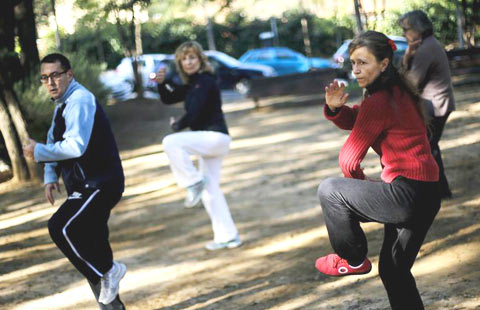
Guadalupe, a 55-year-old lady living in Spain, has been practicing tai chi for almost 20 years. She believes tai chi is not only a kind of martial art but a complete system of fusing traditional Chinese culture.
One of the potentially most traumatic things a girl has to go through is finding a new hairdresser.
Copyright 1995 - . All rights reserved. The content (including but not limited to text, photo, multimedia information, etc) published in this site belongs to China Daily Information Co (CDIC). Without written authorization from CDIC, such content shall not be republished or used in any form. Note: Browsers with 1024*768 or higher resolution are suggested for this site.
License for publishing multimedia online 0108263 Registration Number: 130349