China playing central role in free trade
By Zhang Lin (China Daily Europe)
2015-07-10
Beijing is pursuing a multilevel strategy using FTAs to help set new rules for the evolving global economy
China is a latecomer in terms of reaching free trade agreements with other economies. But it has sped up in recent years with the signing of a few landmark FTAs with countries and regions including Switzerland, South Korea and Australia.
On the multilateral front, China is also participating in negotiations for the Regional Comprehensive Economic Partnership and the Free Trade Area of the Asia-Pacific, which have become important for Asia-Pacific regional integration.
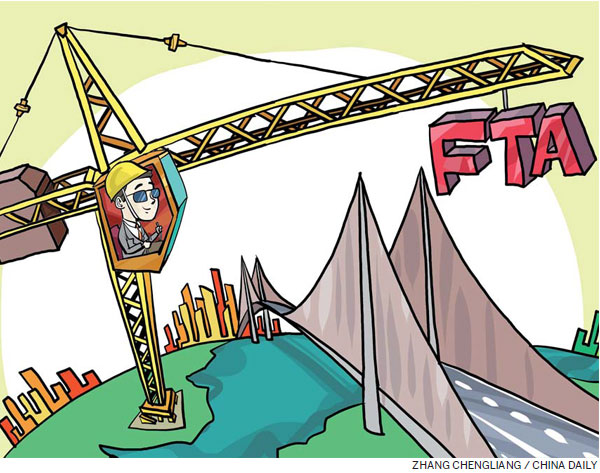
Through these efforts, China clearly shows the acceleration of the implementation of its free trade area strategy, which indicates China's confidence and determination to continue to open up wider to the outside world and to actively participate in economic globalization and regional integration.
Indeed, China's FTA strategy has entered a new phase. Its understanding and expectations of FTAs have changed with its increased participation in the global economy. To understand this change, a brief look back at how China developed FTAs might be helpful.
China has experienced three stages in its formulation of FTAs. The first was from 2001 to 2005, when China was testing the waters. One of the major developments during the period was that China and the Association of Southeast Asian Nations reached a consensus on building an FTA in 2001. They signed a package framework agreement on establishing a free trade area in November 2002, marking China's first step on the FTA cooperation framework.
The second stage, from 2005 to 2010, witnessed rapid development in the signing of FTAs. One important milestone during the period was that top policymakers started to view FTAs as a major component of China's opening-up strategy. It was in 2007 that the top leadership in China put forward the idea of implementing the strategy of FTAs and "strengthening bilateral and multilateral economic and trade cooperation". Hence, FTAs became the basis to further promote that goal. But it is noteworthy that the FTAs China signed during the first two periods were mostly with small, developing economies.
Things started to change in 2010, when China's FTA practice entered the third stage. At this stage, "comprehensiveness, high quality and balance of interests" became goals for China's FTA strategy. To achieve these goals, China set higher FTA standards, aiming to integrate itself with international investment practice and rules, expand the scope and depth of FTAs, participate in forming of FTA platforms in East Asia and Southeast Asia, and seek to reach bilateral investment treaties with the United States and the European Union.
Externally, there are a few positive factors for China in advancing its FTA strategy.
First, the Doha round of World Trade Organization negotiations have stagnated on trade liberalization when there was failure to reach a consensus. Thus, many countries are more dependent on trade promoted by the development of regional integration and investment liberalization. It stimulates the construction and development of regional integration and free trade areas. Regional trade increases significantly and signs of trade development show a regionalization trend.
Second, developed economies led by the US are formulating new global investment rules and promoting the standards of FTAs by advancing free trade deals such as the Trans-Pacific Partnership agreement and Transatlantic Trade and Investment Partnership agreement. The evolution of new rules requires China to accelerate FTA cooperation and practice with foreign countries to catch up with global trends.
Internally, China also feels the strong need to expand and update its FTA efforts. In the past, China focused on trade and market diversification when it signed FTAs with other economies. But recently, it has seen new driving forces to promote its FTA efforts.
First, it is the inevitable requirement for deepening and tightening the global value chain. The global value chain of production and trade model promotes regional economic and trade exchanges, and strengthens the degree of geopolitical relationships. The new international division of labor depends on highly efficient production and rationalization of market layout. China's recent FTAs with South Korea and Australia are a result of the formation of the intra Asia-Pacific regional value chain and the pattern of a deepening division of production. Economic and trade relations are increasingly close. This interwoven and interdependent situation is the result of the expansion of trade and investment among regional countries. It is also an important foundation of Asia-Pacific regional economic growth.
Second, an accelerated FTA effort can help promote all-around economic reforms within China. After three decades of reform and opening-up and 10 years of being a member of the World Trade Organization, China has accomplished great achievements, but its reforms have entered a difficult period. From the point of the domestic environment, an increase in wages has led to a surge in export costs, squeezing profit margins. Enterprises are under heavy pressure to survive. Export products are at a relatively low added value in the low end of the division of the industrial chain.
These problems are striking. China's traditional foreign trade development pattern, relying on energy resources and labor, must be changed. China will need to speed up integration with new global trade and investment rules, improve internationalization levels, promote foreign cooperation, and boost domestic reform by opening up. To achieve these goals, China needs to use FTAs to push domestic reforms.





China-ASEAN Expo Secretariat
Hotline: +86-771-12343
Address: No. 98 Zhuxi Avenue, Nanning, Guangxi, P.R. China
For more information, please click the official website: http://eng.caexpo.org/


