Financing for development in Asia and the Pacific
By Shamshad Akhtar (chinadaily.com.cn)
2015-07-16
 |
|
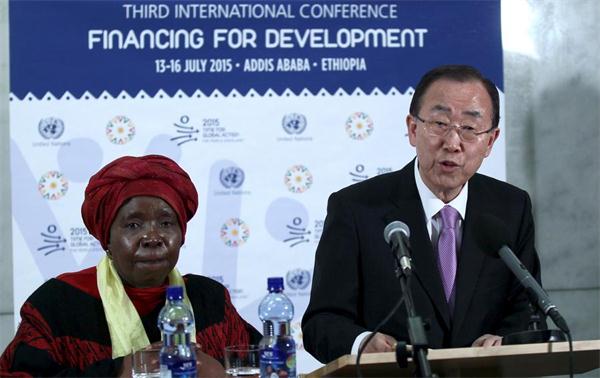
U.N. Secretary-General Ban Ki-moon (R), next to African Union Commission Chairperson Nkosazana Dlamini-Zuma, addresses a news conference during the Third International Conference on Financing for Development in Ethiopia's capital Addis Ababa, July 13, 2015. [Photo/Agencies] |
The world eagerly awaits the outcome of the 3rd International Conference on Financing for Development this month which will be a real test of the international community’s commitment to sustainable development. In this context, it is worth underscoring that the Asia-Pacific region – a dynamic and vibrant market - has already been at the forefront of deliberations on financing for development and has endorsed initiatives that will unleash its resource potential. With substantial scope for tapping domestic resource mobilization and infrastructure financing, the region will build on the development achievements secured in past years which have simultaneously driven global growth. Our region has made impressive gains in reducing the incidence of extreme poverty from a staggering 53 percent in 1990 to 12 percent today, illustrating its resilience to the 2008 financial crisis given that most countries strengthened their financial systems regulatory frameworks in the aftermath of Asian financial crisis in 1997-1998. Trade growth has remained steady, with the level of intra-regional trade second only to that of the European Union.
The key to financial stability and people’s well-being will be their improved access to financing for development, which involves broadening coverage of financing to all segments of society, including the unbanked and sustainable businesses. Given the growing demands to implement the ambitious and wide-ranging sustainable development agenda in the period after 2015, financing systems will need to be harnessed further to channel the right financing mix and blend. Home to 60 percent of the world’s population, ESCAP estimates that the financing requirements of the region, which are growing faster than advanced economies, could be anywhere between $2.1 trillion and $2.5 trillion per year to fund a comprehensive sustainable development agenda which includes ending poverty, improving access to basic services, the provision of social protection, infrastructure development and addressing both climate mitigation and adaptation. Asia Pacific, which accounts for almost 57 per cent of global trade finance transactions, needs to launch initiatives to meet the region’s trade finance requirements which currently account for more than half of the global trade finance gap, estimated at nearly $2 trillion.
Inadequate levels of finance can hurt firms’ productive and export capacities and limit their participation to only low value-added stages of production.
While the amount of money involved may seem daunting, the region is nonetheless known for its high saving rates, build-up of reserves and ability to attract large capital flows and remittances. Moreover, in 2013, the region’s fiscal revenue was estimated to be $4 trillion, and private sector savings were estimated to amount to another $6 trillion. In the same year the stock of financial assets of the region’s most wealthy individuals amounted to $35 trillion.
If financial resources are, in principle, more than sufficient to fund the required investments in sustainable development, why then, are they not being applied more effectively? The first reason is that investments in sustainable development, such as social protection or climate change mitigation and adaptation, have high social returns but are perceived to have low or zero private returns in the traditional sense. A second reason is the skewed distribution of financial needs and resources with a few countries having a repository of large surplus of funds, while the majority have needs exceeding their own financial resources. Lack of long term and risk capital is a serious obstacle to the implementation of key infrastructure projects - including cross-border infrastructure - which has the potential for high payoffs for the region’s competitiveness and prosperity.
Recognizing these challenges, Asia and the Pacific, with ESCAP’s support, has engaged in two high-level consultation processes in last twelve months. Conversations between regional political leaders, financing experts, the business community and civil society have led to a consensus on a tangible and actionable agenda for dealing with these financing shortfalls. Among others, proposals have been tabled on:
Establishing an Asia Pacific Forum to raise tax-to-GDP ratios by broadening tax bases, removing exemptions and loopholes, and improving administrative efficiency and collection. These should be implemented.
Better and efficient deployment of public expenditures to reduce wasteful and unproductive expenditures.
Implementing BEPS (base erosion and profit shifting) by promoting regional cooperation among national tax authorities with the aim of reducing revenue losses due to tax evasion by multinational corporations and to illicit financial flows.
Ensuring that countries deliver on official development assistance and directing it where it is most needed and leveraging more financing.
The region will further benefit from a range of diversified approaches and mechanisms of South-South and triangular cooperation. On one hand, this involves the concrete actions taken by China, Russia and India to operationalize new development banks, establish the Asian Infrastructure Investment Bank (AIIB), and the Silk Road Fund. On the other hand, there has been welcome capital enhancement of the Asian Development Bank. Close cooperation between these new and existing multilateral development banks will play a critical role in financing sustainable and resilient infrastructure in the region, including supporting better transboundary connectivity.
There is further scope for developing regional financial markets by adopting modern, harmonized financial regulations and institutions which would facilitate mutual recognition arrangements - where two or more States agree to recognize the adequacy of each other’s regulation. This can facilitate the trading of securities across countries and can lay the groundwork for developing a regional capital market at a later stage. The ASEAN Capital Market Forum –consisting of capital market regulators of the 10 ASEAN members - is the first move in the region to develop mutual recognition in primary offerings, financial intermediaries, market professionals, collective investment schemes, and securities exchanges.
The good news is that the Asia-Pacific region is not waiting but has already moved towards providing the necessary means to implement these sustainable development goals. Although the region has taken a leading role in these first important steps, it is vital that this momentum be maintained, that the consensus developed be maintained and implemented, so that Asia and the Pacific can continue to lead on inclusive and sustainable development.
The author is an Under-Secretary-General of the United Nations and Executive Secretary of the Economic and Social Commission for Asia and the Pacific (ESCAP). She is also the UN’s Sherpa for the G20 and previously served as Governor of the Central Bank of Pakistan and Vice President of the MENA Region of the World Bank.





China-ASEAN Expo Secretariat
Hotline: +86-771-12343
Address: No. 98 Zhuxi Avenue, Nanning, Guangxi, P.R. China
For more information, please click the official website: http://eng.caexpo.org/


