Iron Man suit in movie may look cooler than real-life version
In the US movie Iron Man, businessman Tony Stark developed a robotic suit that gave him inexhaustible power to fight the bad guys.
The reality of the suit, however, was that it was so heavy and unwieldy that even actor Don Cheadle in Iron Man 3 complained that it was "not really cool at all" to play a superhero in the suit.
Now Chinese scientists are developing a flexible and controllable exoskeleton that moves as nimbly as a mind controls its limbs.
Scientists from the Institute of Advanced Manufacturing Technology in Changzhou, Jiangsu province, recently completed an exoskeleton that can help people climb mountains with 30 kilograms of gear or punch through a wall without breaking a sweat.
The exoskeleton, which has neither the bright red color nor the cool appearance of the Iron Man suit, looks more like an iron skeleton with a bevy of sensors and electric wires. When worn, its sensors catch every move's neuromuscular signals and respond with the right action.
"The potential application of the exoskeleton is wide," said Wang Yucheng, an assistant researcher at the Institute of Advanced Manufacturing Technology. The institute, a unit of the Hefei Institutes of Physical Science at the Chinese Academy of Sciences, focuses on robotics and intelligent manufacturing.
At a Brain-Inspired Intelligence Forum in June, Tan Tieniu, deputy secretary-general of the Chinese Academy of Sciences, said, "Artificial intelligence will bring us into the second machine age - an age featuring exponential growth, digitization and combined innovation."
One of the uses of such an exoskeleton is to increase the fighting capacity of an individual soldier. For example, the Robotics & Human Engineering Laboratory at the University of California, Berkeley, in the United States has been researching exoskeletons since early 2000, and has developed a range of products for military use. The Human Universal Load Carrier can carry up to 200 pounds while the wearer feels no load, for example, and the ExoHiker can enable the wearer to carry a 150 pound load and walk for 21 hours.
Besides military uses, superman abilities also are desired in emergency situations such as fire fighting and earthquake rescues. "For example, if a firefighter runs into a burning building with an exoskeleton, he or she can carry out two or more people who passed out due to the smoke, instead of carrying out one and heading into the danger again," Wang said.
Exoskeletons also can help some disabled people walk or make movements, such as kicking a ball. At the opening ceremony of the 2014 FIFA World Cup in Brazil, 29-year-old paraplegic Juliano Pinto kicked a soccer ball to start the games with the help of a mind-controlled exoskeleton.
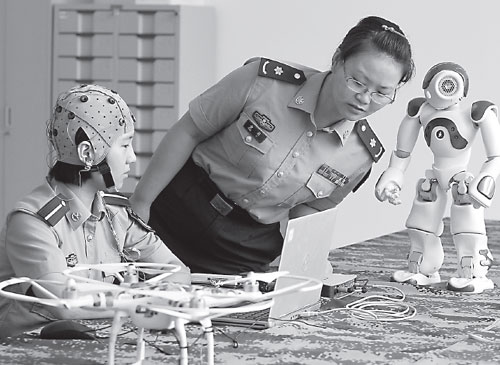
"The mind-controlled exoskeleton, with an electrode cap like that used on the World Cup opening ceremony, reacts faster than the neuromuscular-sensation exoskeletons like ours," Wang said.
When a person wants to make a certain movement, the electrode cap reads the change of his or her brain wave and makes the movement almost simultaneously. The neuromuscular sensors, on the other hand, can only feel the body's movement when the action starts, so they react slower.
Scientists at the Chinese Academy of Sciences are cooperating with experts from the National University of Defense Technology to develop mind-control exoskeletons. The technology has been tried on intelligent cars that can start, stop, make turns and drive at 5 to 10 km/h under mind control.
Mind-controlled machines are nothing new in the neuroscience field. Research on brain-computer interfaces began at the University of California, Los Angeles, in the 1970s. In 1998, researchers at Emory University in Atlanta implanted a device on a patient with locked-in syndrome - a condition in which only the eyes can move - that helped him move a computer cursor.
More recently, researchers from Brown University and the University of Pittsburgh Medical Center succeeded in enabling brain-controlled robotic prosthetic limbs on paralyzed patients in 2012.
As successes mount, governments are pouring more money into the technology.
In April 2013, US President Barack Obama announced the BRAIN Initiative, or Brain Research through Advancing Innovative Neurotechnologies, with $100 million budget to map the human brain. The European Union's Horizon 2020, the biggest EU research and innovation program, also targets brain research.
China included the brain and cognitive science as one of the eight research fields in the national long-term science and technology development plan through 2020. And experts had disclosed earlier this year that the Chinese government would publish the country's brain project shortly.
"Research into brain-inspired intelligence has been included in the development strategies of major developed countries. China should boost the development of AI to seize the commanding heights of the new round of technological revolution," Tan said.
While people can use their minds to control some external devices, machines do not yet understand human thoughts, said Yang Zhi, a researcher on cognitive neuroscience at the Institute of Psychology, Chinese Academy of Science.
"Some of the mind-control technologies are actually using the reactions of people's brain activity - such as neuromuscular signals and movement of eyeballs - to control the external devices, while we still understand little about what kind of thoughts people may hold in their mind when they have a certain kind of brain activity and the corresponded reactions," Yang said.
Yang and his team have been studying that relation by analyzing a database that contains more than 5,000 brain magnetic resonance imaging scans relevant to people's emotions and thoughts.
Recently the team found that activities of certain brain regions are related to people's answers to yes-or-no questions.
"For example, if I ask you if one minute equals 100 seconds - apparently the answer is no - a certain region in your brain will be active, so that I will learn what your real idea is, no matter what you say to me," Yang said.
The technology has been used to test the brain activity of patients in a vegetative state to detect their responses to questions like: Can you feel the pain?
Connecting thought to corresponding brain activity is key to expanding the application of mind control, Yang said.
chengyingqi@chinadaily.com.cn
|
Two researchers at the PLA Information Engineering University test how to control robots with the "mind". Shen Xiang / for China Daily |
(China Daily 08/24/2015 page5)
For a scholar focusing on Australia's public diplomacy, working as a recreational manager in China may never be part of his career path. But Bradley McConachie does have lots to say now about his special experience at a resort in the picturesque tropical coastal city of Sanya in South China's Hainan province.


One of the potentially most traumatic things a girl has to go through is finding a new hairdresser.
Copyright 1995 - . All rights reserved. The content (including but not limited to text, photo, multimedia information, etc) published in this site belongs to China Daily Information Co (CDIC). Without written authorization from CDIC, such content shall not be republished or used in any form. Note: Browsers with 1024*768 or higher resolution are suggested for this site.
License for publishing multimedia online 0108263 Registration Number: 130349