 |
|
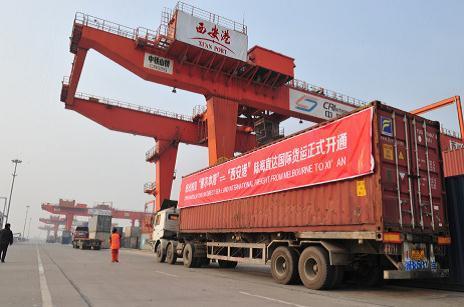
Xi’an’s International Trade and Logistics Park has sought to develop itself into a major trade and transportation hub by integrating land, air and sea networks. [Photo provided to China Daily] |
The yellow earth was once seen as a symbol. Back in the 1980s, when many Chinese were still not confident about the nation’s economic rise, it was seen to represent isolation from the rest of the world and slow change. The bright development was blue, near the ocean and the coastal cities built on foreign investment and exports.
But critics asked if such a divide was necessary. Must yellow earth and blue ocean be symbols of two totally different economies and living conditions?
Don’t forget, they argued, that the city of Xi’an was not only the center of some of the powerful ancient empires in world history, but also the key eastern destination and supply hub for the Silk Road, the once-flourishing international trade route across the Eurasian continent.
From the first century BC to the 800s, before the world knew such seaports as Rotterdam, New York, Hong Kong or Shanghai, Xi’an — called Chang’an back then — was one of the largest commercial ports in the world.
Merchants speaking various languages gathered in its inns, trading gems from Afghanistan, glassware from Europe, fruit and spices from Persia, in returned the acquired local products, most famously silk and chinaware.
One difference from the modern times was that the shipments that Xi’an sent away were carried on the camel back, instead by ships.
As a natural linkage between the eastern and western parts of China, and between China and its western neighbors, indeed, why can’t Xi’an regain its past commercial glory along with China’s rise in economic prowess, in the age of globalization?
It can. With all modernized land and air transportation conveniences, it can help China better serve its partners in Central Asia and develop alternative modes of trade with entire Europe.
Thus a daring, although not entirely unfamiliar, concept was proposed by the local economists: Xi’an should build itself into a port-on-land.
It should be like the Shanghai port, to become a modernized hub for China’s west-bound trade by land transportation? It should, once again, be a host of merchants from “ten thousand countries”, as it was described poetically in ancient times, although they don’t have to come to city leading their caravans.
An inland port? English teachers from local universities scratched their head, as Han Song, deputy mayor of Xi’an recalled, when they were asked by the municipal government to translate the name of the concept.
“In the end, we decided to give it a straightforward English name, just to call it Xi’an International Trade & Logistics Park.”
In ITLP’s early days, Han said, skepticism abounded as a city like Xi’an, which is some 1,300 kilometers away from Shanghai, 1,200 kilometers from Qingdao (a northern China port city) and 1,100 kilometers away from Beijing and Tianjin, can play such a key role in the country’s foreign trade and logistics service industry.
As it turns out, however, Xi’an has been fortune despite, or precisely thanks to, its distance from the country’s eastern shore.
The city is well-positioned on not only many key transportation lines connecting China’s sea ports with its heartland, but also a few important national economic development programs, most importantly the central government’s strategic attempt to lead China’s economic reform and opening up from its industrialized coastal cities in its more densely-populated eastern regions to the country’s vast western regions that lag still behind.
Beijing’s another strategic ambition, namely to let more people move into the cities, and arrange for them off-farm jobs, may allow Xi’an, as one of the three existing large cities in West China (the other two being Chongqing and Chengdu), to become a main stage for various business breakthroughs and innovations.
In physical infrastructure, Xi’an is the hub connected with railways to Beijing, eastern port cities like Shanghai, Tianjin, Qingdao and Lianyungang, the southwestern city of Chengdu, and westward, through Xinjiang Uygur autonomous region, to access to Kazakhstan and Russia’s Far East rail system.
Xi’an and Beijing is already connected by high speed passenger train service, the fastest of which takes only about four and half hours for a one-way trip.
For air transportation, Xi’an has an airport that ranks among the top 10 in China. Overseas, it is connected with major many East Asian destinations by direct flights.
In June, it just opened a direct flight to and from Helsinki, its first in Europe. In 2012, it handled 23 million passengers, more than double from 2008, along with 170,000 metric tons of cargo.
The ITLP is designed to sit close to Xi’an’s all major transport facilities.
Part of it is the Xi’an Railway Container Center Station, one of China’s 18 rail container hubs designated by the national railway authorities. With some 600 million yuan in investment, the rail container center station started building in September 2008, and is already in full operation from July 2010.
Adjacent to the rail container center station is a bonded zone, an area under the direction supervision of the customs, where companies benefit from tax breaks and tax rebates.
The international freight train Chang’an makes its maiden run to central Asia in November 2013.
Last year, it run to Europe for 100 times. This year, the train adds two round trips per week, and by the end of 2016, it will run to Europe for 150 times.


Copyright 1995 - . All rights reserved. The content (including but not limited to text, photo, multimedia information, etc) published in this site belongs to China Daily Information Co (CDIC). Without written authorization from CDIC, such content shall not be republished or used in any form. Note: Browsers with 1024*768 or higher resolution are suggested for this site.
License for publishing multimedia online 0108263 Registration Number: 130349