Huizhou's roots in trade still echo today


Over a millennium, the merchants of Anhui province, collectively known as the Huishang, became legendary for their hard work, enterprising spirit, honesty and their unique contribution to China's development.
They began as vendors of small articles in the countryside and cities of this ancient land, dominated by self-reliant agriculture, in China's east.
Gradually, they turned to bigger businesses with a sales network that covered the entire country. Their success was unparalleled, except by the merchants of Shanxi, also famous for their business acumen.
The name Huishang was first used during the Jin Dynasty (265-420) and, throughout the following centuries, Anhui's merchants flourished with a long period of prosperity during the Ming (1368-1644) and Qing (1644-1911) dynasties.
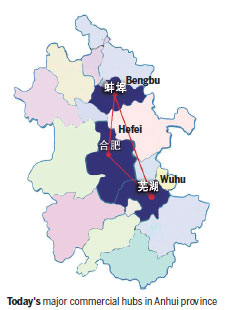
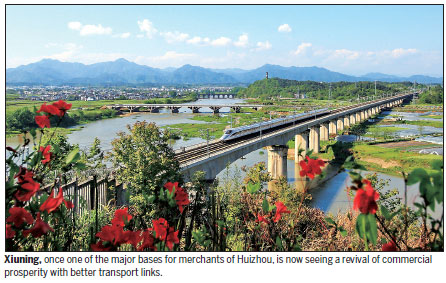
The Huishang merchants were mostly from Huizhou, today's Huangshan city in southern Anhui, with many coming from Shexian, Xiuning, Qimen, Yixian, Jixi and Wuyuan counties.
According to records, the number of traders accounted for about 70 percent of the male population in Huizhou during the middle Ming Dynasty. They mostly sold locally produced tea, ink, paper and other items to the rest of the country.
According to the Ming Dynasty Anhui Chronicle, "Many people in Huizhou - a mountainous region with limited farmland - chose to engage in trading business because they had no other options to make a living".
Huizhou people were not born merchants - their success was the result of various social factors and their painstaking efforts.
Huishang merchants maintained good relations with the government to ensure their businesses' success. For more than 1,000 years, Chinese officials were selected according to academic ability. As such, the merchants built many schools in their hometowns and provided funds for students to train there, hoping to groom beneficial friendship in the future.
The merchants also emphasized connections with their home communities. When they returned home with success and glory, they built mansions, ancestral temples, guild halls, roads and bridges to extend the influence of their clans.
However, the sun began to set on the Huishang lifestyle during the late Qing Dynasty due to intense competition from businesspeople in China and abroad who were more skilled in modern commerce. Nonetheless, the unique culture that grew from the Anhui merchants - teamwork, moral integrity, honesty, sympathy for the poor, and loyalty to the country - is still remembered by the province's people and is even recognized in the rest of the country.
Huishang conference
Now, Anhui's leaders are looking to create some new legends by reviving those ancient traditions, once again for greater economic growth.
One way to do this is through the International Huishang Conference, held annually in Hefei, Anhui's capital.
This year's expo is to be held in May in Hefei. It will be the 13th session of the event.
Its official name is the China Anhui Investment and Trade Expo and it has become the province's most important trade and investment fair. The event is a prime platform for Anhui to promote key investment projects and build connections between foreign and domestic businesses, with activities such as investment promotions, trade talks, exhibitions, forums and conferences.
The event is also used to describe the province's history and promote its tourist attractions, economic growth and business opportunities.
Huizhou-style buildings
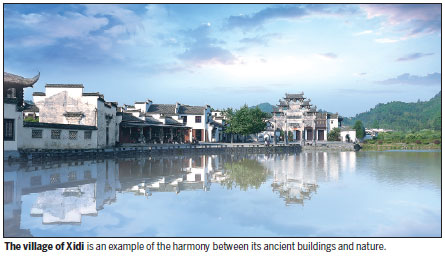
Huizhou-style buildings, associated with local merchants, can be found in the southern Anhui region of Huizhou - what is known as today's Huangshan city - and the neighboring areas, and are some of the most distinguished examples of ancient Chinese architecture, with striking features in the delicately crafted eaves and decorative ceilings.
Huizhou-style buildings, influenced by the city's unique geographic location and folk culture, are nothing like anything else in China.
Such an ancient house in Huizhou is usually divided into two parts that are in perfectly symmetric. The indoor garden called the tianjing - which literally means "skylight yard" - is located in the center of the house, with bedrooms on each side, and a living room in front.
People from Huizhou have focused on the aesthetic side of the houses in addition to their practical use for a long time.
The cornices of the houses are shaped something like a mustache, curling up at the edges. But the most distinguished features are the intricate carvings, including windowpanes carved from stone and carved wooden pillars.
While the Huizhou-style buildings are famous for their complicated and delicate carvings, the color tones outside remain simple and clean, with only black roof tiles and white walls, resembling a typical Chinese painting.
Xidi and Hongcun in Yixian county are among the renowned ancient towns with many well-preserved Huizhou-style buildings. These embody both ancient and modern Chinese culture, reflected in the contrasting styles of architecture.
Even in the modern age, Xidi and Hongcun have preserved what the towns were like hundreds of years ago, featuring Huizhou-style architecture like carved stone bridges and traditional houses around every corner. The cultural legacies have made the two towns and their neighboring areas popular tourist destinations in Anhui, receiving millions of visits each year.
(China Daily 04/11/2017 page25)