The benefits of the race to be "China's own SpaceX" go beyond the stars
( China Plus )
Note: The following is an edited translation of a commentary from the Chinese-language "Commentaries on International Affairs."
 |
|
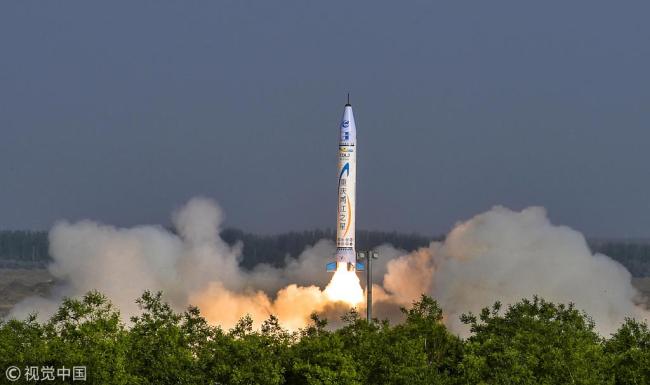
OneSpace becomes the first private company in China to launch a commercial rocket on May 17th, 2018. [File photo: VCG] |
The private Beijing-based aerospace company Space Honor Technology (also known as iSpace) successfully launched its Hyperbola-1Z rocket from the Jiuquan Satellite Launch Center in China on Wednesday. The launch vehicle delivered three private satellites into sub-orbital space, and the company also conducted some of their own scientific experiments. It was followed by a sub-orbital launch early on Friday morning by OneSpace, another China-based spaceflight company, of their Chongqing Liangjiang Star rocket from the same launch center.
For more than a year, news about China's private aerospace technology companies has been gradually emerging. Compared with OneSpace, which in May took the honor of being the first private company in China to launch a commercial rocket, Space Honor has kept a relatively low profile. But they are becoming a strong competitor in China’s commercial space industry, as this weeks’ launch was not a test, but a commercial launch with paying customers.
So far, the launches by OneSpace and Space Honor have not been space flights in the true sense, as they have not reached orbital space. A sub-orbital space launch has a trajectory similar to that of a cannonball fired far into the sky: it doesn’t have the velocity to escape Earth’s gravity and remain in orbit. The next major milestone for the companies will be an orbital launch. OneSpace already completed testing of the second and third stages of its OS-M orbital launch vehicle, which is expected to be ready later this year.
Until recently, governments led the development of space rockets. The inordinate amount of money and vast amount of resources that it required could only be drawn from the accumulated wealth of one of the world’s most advanced nations. And it took an immense political will to dedicate the nation’s resources towards such an ambitious goal. This is why, when United States President John F. Kennedy announced in 1962 that the Americans would land a man on the moon, he said "I believe we possess all the resources and talents necessary. But the facts of the matter are that we have never made the national decisions or marshaled the national resources required for such leadership. We have never specified long-range goals on an urgent time schedule, or managed our resources and our time so as to insure their fulfillment."
The development of America’s space industry spurred developments in a range of high tech fields, including advanced materials science, microelectronics, chemicals, metallurgy. This had positive flow on effects for the country’s manufacturing sector and benefited American consumers, as some of the new technologies needed for the space program gradually moved into the consumer market.
Now the United States has become the birthplace of the private aerospace industry. SpaceX's Dragon capsule has repeatedly docked with the International Space Station, and its liquid-fueled reusable rockets have incentivized Boeing and Lockheed Martin to enter into a partnership so they can compete. These achievements have been possible because America’s industrial development has reached a sufficiently advanced stage that private companies like SpaceX and Blue Origin can compete in the open market for the talent and high-grade precision products they need to build their own launchers.
By contrast, private aerospace companies in China are still launching sub-orbital flight using simple solid fuel rockets, because of the technical limitations of the domestic market in which they are operating. This is why the gap between the capabilities of the private commercial aerospace companies in the United States and China at a deeper level reflects the gap between the overall scientific and technological development of China and the United States.
That said, the players in China’s private space launch market have set themselves big goals. For example, Space Honor is planning to develop a liquid-fueled reusable rocket similar in principle to the SpaceX Falcon 9 rocket. And both Space Honor and Blue Arrow, another domestic player, are undertaking research on a methane-fueled engine. This is a new type of engine technology currently being tackled by many countries including the United States. It will be better suited for use in a reusable rocket, and has strategic significance for the launch of interplanetary voyages.
Manufacturing the components of a methane burning engine poses a whole new set of technical challenges that need to be overcome. The development of this technology by companies such as Blue Arrow and Space Honor stands to benefit China’s manufacturing industry more broadly, just as the Apollo moon missions benefited America’s technological development. These benefits are of far greater historical significance for China's private aerospace industry than who gets crowned “China's own SpaceX".
 The Area with Six Parks
 Global Top 500