..
Showtime for modern Chongqing
Updated: 2014-01-07
China Daily


China's economic focus is shifting from east to west, Wang Hao, Tan Yingzi and Wei Tian report from Chongqing.
On a map, the narrow Yuzhong Peninsula, bounded by the Jialing River to the north and the Yangtze River to the south, resembles a smaller version of Manhattan Island in New York.
A glance out the window when flying over Yuzhong, the central business district of Chongqing, simply reinforces that impression: Skyscrapers and bridges suggest no less prosperity than in the Big Apple.
 |
|
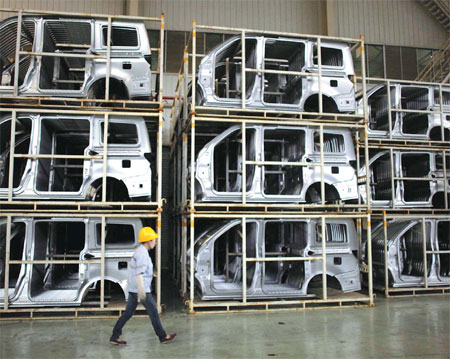
Vehicle shells in storage at the workshop of Changan Automobile Company in Liangjiang New Area in Chongqing. Photos by Wang Jing / China Daily |
The city shows its other side when night falls. The sounds of laughter that echo from packed eateries with neon signs and cheering crowds on pleasure boats remind one of the city's nickname, "The Miniature Hong Kong".
The image Chongqing displays is the message the city wants to deliver to the world - that it can become one of the growth engines of the globe's second-largest economy during the next few decades.
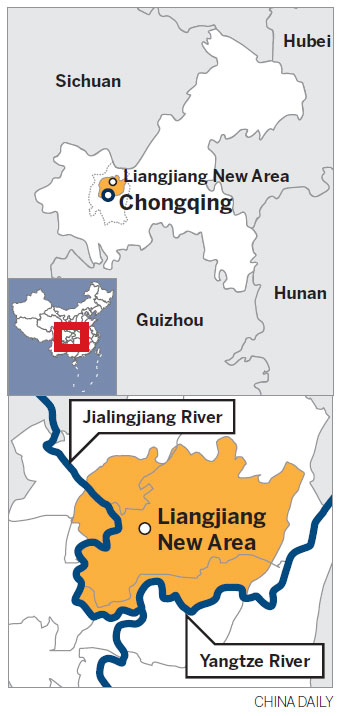
That ambition was put into practice in 2010, when a 1,200-square-kilometer area across from the north bank of the Yuzhong peninsula was pinpointed as the "New Area", a pilot zone to test new policies, introduce foreign investment and drive future growth.
The district, known as Liangjiang New Area, was the third national development area approved directly by the State Council after Shanghai's Pudong New Area and the Binhai New Area in Tianjin. So far, it's the only one of its kind situated in an inland province.
According to the State Council's approval document for the establishment of the new area, Liangjiang, which means "two rivers" in Chinese, has been designated for development into a base for advanced manufacturing and modern services, a regional financial and innovation center, and an important door for opening-up inland China.
There's almost a sense of dj vu, given the similarities with Pudong 20 years ago, albeit 2,000 km away on the upper reaches of the Yangtze. But how easy will it be to reproduce the Pudong miracle?
Challenges
"The timing for us is not as good as Pudong's when it was developed during the 1990s," said Tang Zongwei, deputy director of the Liangjiang administrative committee.
"At that time, although Pudong was short of capital and technology, China's vast potential market and low costs were so attractive that it attracted investors from around the world.
"But now, the country faces the problems of industrial overcapacity and excessive liquidity and the challenge for us is how to identify the new market," said Tang.
Despite his concerns, data show Liangjiang has done a good job in the years since it was founded.
According to the 2012 development report, Liangjiang achieved annual GDP growth of 20.4 percent, outpacing the 20.1 percent recorded in Binhai, and Pudong's 10.4 percent and far outstripping the national average of 7.8 percent.
However, that growth was mainly the result of surging fixed-asset investment, which has risen by 30.3 percent annually, and booming foreign trade, which has rocketed 200 percent year-on-year.
Liangjiang is aiming to maintain annual GDP growth of 20 percent during the next eight years to drive development of China's vast, underdeveloped western region, said Tang in an earlier interview in March.
"The first three years have been easy and smooth because we received a great deal of support from the central government, but now we must shift from developing the fundamentals to developing the functions," he said.
Tang expressed concern that the goal will be hard to achieve if growth in the western region simply replicates the experiences of the eastern areas. "Now everybody else is already in position, it will not be an easy task for us to gain a foothold in the market, no matter how much we invest," he said.
To find a niche market, Liangjiang must have high-tech products, Tang said, adding that to do so the area must find ways of attracting more foreign investors over the next few years, but the quality of investment will be given a much higher priority than the quantity.
According to the New Area's blueprint, electronic information, automobiles, high-end manufacturing, aviation, and biomedicines have been identified as the region's five pillar industries.
The region needs to attract around 100,000 highly skilled workers to sustain its development. Some 400,000 jobs will be on offer by 2015, according to Tang.
"Overall, we are dealing with more challenges than opportunities here," he added.
Related reading:
Villagers become city slickers

Video

UK trade commissioner for China praised Chongqing as a burgeoning center in intelligent manufacturing.