..
Liangjiang New Area at core of China’s growth
Updated: 2015-08-11
By ZHUANG TI, China Daily


|
 |
|
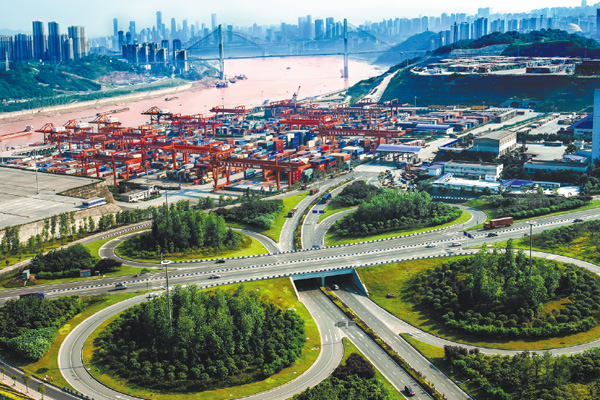
A bird's-eye view of a bonded port at Liangjiang New Area. PING AN / FOR CHINA DAILY |
Hefty returns have driven foreign investors to pour more into the area during the past five years. Among them, automaker Ford continued its expansion in the area, and investments in fixed assets by AT&S, a leading European printed circuit board manufacturer, surpassed 171 million euros ($189 million) by the end of 2014.
In June, Kawasaki Heavy Industries from Japan set up its branch in Liangjiang. Asea Brown Boveri is also seeking to move into the new area.
The world’s largest glass substrate production company, Corning Inc., is working to sign an investment contract with the Liangjiang New Area to construct an industrial cluster, according to the committee.
Liangjiang has also attracted a number of enterprises in cloud computing, core technologies and big data.
Tencent, one of China’ s largest Internet service companies, has invested 3 billion yuan in the first cloud computing data center in western China. This project began operations on June 10.
Behind the investment boom is the trend that global industries are moving to the west of China, especially with the rising costs in labor in the coastal region.
Among the areas with the highest investment return ratios, Liangjiang has embraced nearly 20 percent growth in its economy over the past five years, due to its friendly investment environment and advantageous location.
The Liangjiang area has become an international logistics center since the Chongqing-Xinjiang-Europe International Railway made its debut in January 2011. The 4,200-mile link transported 5.4 billion metric tons of cargo worth $6.8 billion by the end of last year.
The railway begins in Chongqing, crosses the border into Kazakhstan at Alashankou, the Xinjiang Uygur autonomous region, and passes through Russia, Belarus and Poland before reaching its terminus in Duisburg, Germany.
It cuts what was a five-week shipping time to only about two weeks, and costs 80 percent less than air freight.
Jiangbei International Airport has 22 international passenger routes and 18 international cargo routes.
With an annual throughput of 25.3 million passengers and a capacity to move 300,000 metric tons of cargo, the airport ranks 63rd among airports in the world. An ongoing expansion project will increase its annual throughput of passengers to 45 million.
Guoyuan Port, which is linked with the Chongqing-Xinjiang-Europe International Railway, began operations in December 2013.
With investment of 10 billion yuan, the port has 16 berths and can handle 6 million metric tons of bulk cargo annually. Coal and iron ore from the Xinjiang Uygur autonomous region and Gansu province are transferred at the port.
Clearance at 12 customs offices along the Yangtze River economic belt, including Shanghai, Nanjing, Hangzhou, Ningbo and Chongqing, has been integrated since December.
South Korea is also looking to create a greater presence in the zone after the nation signed a free trade deal with China on June 1.
About three weeks later, Hyundai Motor started construction on a new facility at the China-South Korea Industrial Park in Liangjiang New Area. It will be the South Korean company’s fifth factory on the Chinese mainland.
With a total investment of 7.75 billion yuan, the factory is expected to produce 300,000 vehicles every year.
Liangjiang’s surrounding environment is another attractive feature. The area has 22 mountainous parks, 58 waterfront parks and 23 specialized parks, said Hao Ming, deputy director of the Liangjiang administrative committee.
Liangjiang has rejected more than 200 enterprises that have applied to establish a branch in the new area over concerns about the companies’ pollution records, Hao said.
“We should stick to the strictest standards of environmental protection as Liangjiang is located on the upstream of the Yangtze River,” Hao said. “We should never pollute the environment before taking remedial measures.”
The area’s success has contributed to the rapid economic growth of Chongqing. In the first quarter, Chongqing’s GDP growth stood at 10.7 percent, top among all provincial regions in the country.

Video
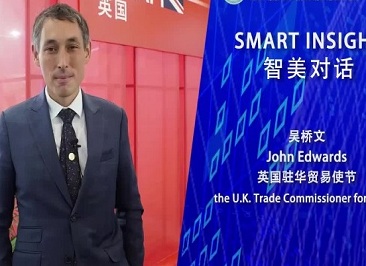
UK trade commissioner for China praised Chongqing as a burgeoning center in intelligent manufacturing.