..
Hotpot Hot Spot
Updated: 2017-08-08
By Xing Yi, China Daily


Though the best place in the country to savor the speciality is Chongqing in Southwest China, there is no shortage of places in Beijing where you can experience the real thing. Xing Yi reports.
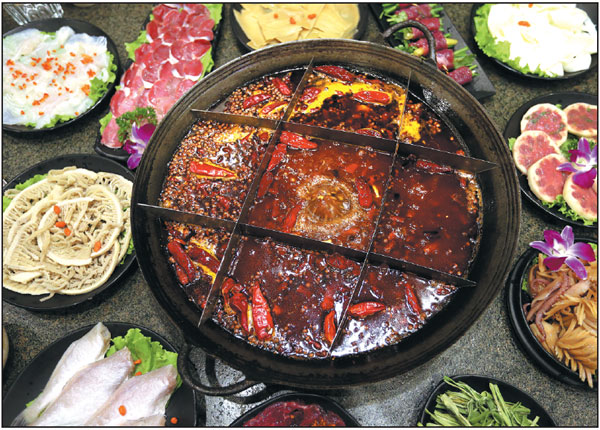
Hotpot is one of China's favorite dishes. A pot is filled with boiling chili broth, plates are full of raw ingredients chopped into slices, and diners putting whatever they want into the pot.
But eating a hotpot on a hot summer day? Some might call that crazy, but not in Chongqing.
"Hotpot and ice beer, that's my favorite when the temperature hits 40 C," my cousin Zhao Shishi, a Chongqing local, says.
"Eating hotpot is not about the temperature, but the mood."

Hotpot is not a one-person meal. And the atmosphere in hotpot restaurants is lively and boisterous.
People chat while putting meat or vegetables into the pot and waiting for it to boil.
Though the origin of hotpot is hard to determine, the current "hotpot capital" is Chongqing in Southwest China.
The title was bestowed on the municipality in June by the China Hotel Association. Eating hotpot is part of the city's culture, and there is even a comedy film, Chongqing Hotpot, which was released last year.
The city has more than 20,000 hotpot restaurants which own 50,000 franchises around the country, according to the Chongqing Hotpot Association. So it is not hard to find a Chongqing-style hotpot restaurant in Beijing.
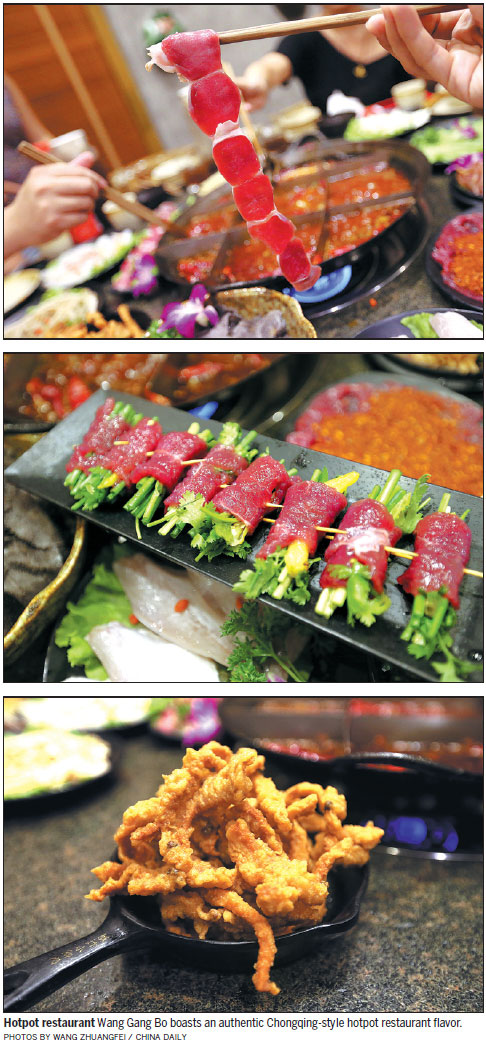
But if you want to try an authentic one, Wang Gang Bo is a good place to start.
"The restaurant's name gangbo comes from the Chongqing dialect which means to chat," says Feng Li, the co-founder of the restaurant.
"We hope our guests enjoy chatting with friends while they eat hotpot."
The restaurant is located to the north of the Liangmaqiao embassy area.
For a meal for five to six people, the average cost per person is around 120 yuan ($18).
"We don't adjust our flavor to cater to local diners, if we did, we would lose our uniqueness," says Chen Jun, the main chef at the restaurant.
Chen has been working in hotpot restaurants for nearly 15 years, and he came to Wang Gang Bo's Beijing branch when it opened last year.
He says that there is a health consideration for eating hotpot in the summer from the perspective of traditional Chinese medicine.
"Chongqing is very humid which increases the dampness in the body, so eating hotpot can burn off the excessive moisture," says Chen.
Unlike Beijing-style hotpot broth which is largely flavorless, the Chongqing-style broth is heavily flavored.
The broth served at Wang Gang Bo has seven ingredients including chili pepper, Sichuan pepper and old ginger giving it a red color and a spicy taste.
For those who cannot eat spicy food, there are mushroom or pork broths.
The joy of eating hotpot comes from its do-it-yourself character.
The simmering pot is used to cook meat, seafood and vegetables. Lotus root is among the restaurant's current favorites.
There are also many ways to make the dipping sauces. "In the Chongqing-style recipe you mix sesame oil and mashed garlic, while the Beijing-style sauce uses salty sesame paste, fermented bean curd and leek flowers."
It is said that Chongqing hotpot was invented in the ports along the river by sailors and porters who sought a simple and cheap way to cook. This may explain why the typical raw ingredients to cook Chongqing hotpot are animal organs such as duck intestines, beef tripe and pork arteries - as they were leftovers from the markets near the ports.
For first-timers, the ingredients may be a bit difficult to stomach. But there is no shortage of choices - lamb, beef, seafood, potato, bamboo shoots, lettuce - for today's diners.
Contact the writer at xingyi@chinadaily.com.cn
(China Daily 08/08/2017 page19)

Video

UK trade commissioner for China praised Chongqing as a burgeoning center in intelligent manufacturing.